
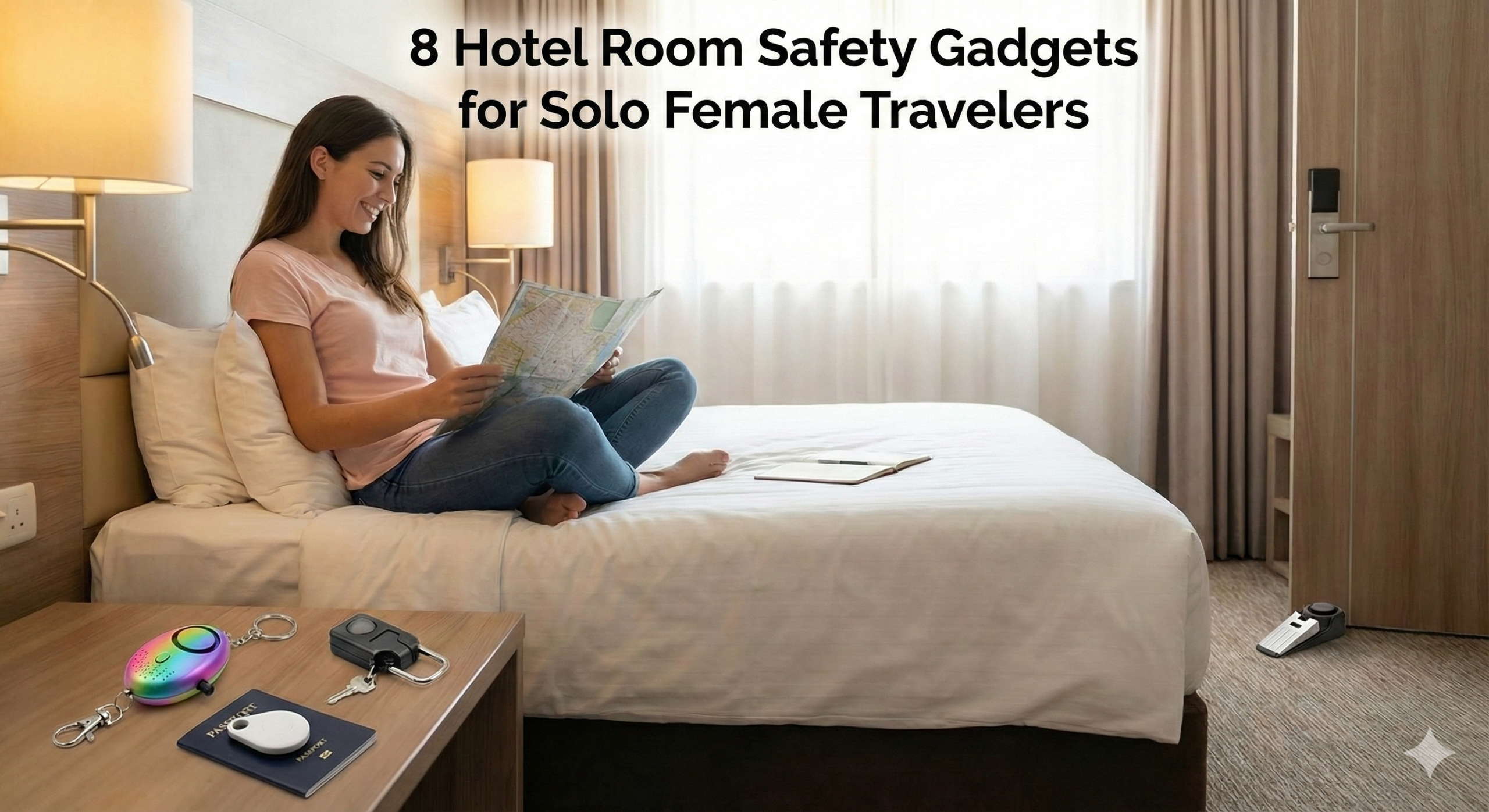
Traveling solo as a woman is one of the most liberating, empowering experiences in the world. It’s a chance to connect with new cultures on your own terms, build profound self-confidence, and create memories that are uniquely yours. In 2026, more women than ever are packing their bags and heading out alone.
However, the reality of the world means safety is a valid concern. When you check into a hotel room, that space should be your sanctuary—a place to completely relax and recharge. Unfortunately, anxieties about faulty locks, unwanted entries, hidden cameras, or theft can keep you awake at night, dampening the joy of your trip.
The good news is that technology has caught up with our needs. You don’t need to be paranoid; you just need to be prepared. A few small, lightweight, and affordable gadgets can add significant layers of security to your temporary home.
This guide is not meant to scare you. It is meant to empower you. We have rounded up 8 essential hotel room safety gadgets designed specifically for the solo female traveler. These tools are easy to pack, simple to use, and provide that extra peace of mind so you can sleep soundly and wake up ready for adventure.
Also Read:- The Only 3 Cables You Need to Pack for International Travel
1. The Portable Door Lock (Addalock style)
This is perhaps the most essential item on this list and the first thing many experienced solo travelers pack. A portable door lock is a mechanical device that adds a second lock to your door from the inside.
Even if someone has a key card—like hotel staff, maintenance, or a previous guest who kept a copy—they cannot open the door if this lock is engaged. It works on most standard hotel doors that open inwards. It uses the existing strike plate on the door frame to create a barrier that is incredibly strong.
Why do you need this if the door has a deadbolt? Hotel deadbolts can sometimes be disengaged by master keys in emergencies. Furthermore, older hotels may have weak locks. A portable door lock is a physical barrier that you control completely. It takes seconds to install without any tools, and it gives you the confidence that once you are in for the night, no one else is getting in.
| Feature | Details |
| Primary Function | Prevents forced entry, even with a key. |
| Installation Time | Under 30 seconds (no tools required). |
| Compatibility | Works on most inward-opening doors. |
| Material | Heavy-duty steel and sturdy plastic. |
| Weight | Very light (usually under 5 oz). |
Pros and Cons
- Pros:
- Provides a physical barrier stopping master keys.
- Extremely lightweight and portable.
- Inexpensive and durable; no batteries needed.
- Cons:
- Only works on doors that open inwards.
- Won’t work if the gap between the door and frame is extremely tight.
Expert Review: The Solo Safety Specialist
“In 2026, electronic hotel locks are sophisticated, but mechanical failure or human error (like staff entering the wrong room) still happens. The portable door lock is my non-negotiable. It’s low-tech, high-impact security. It doesn’t rely on apps or batteries; it just uses physics to keep the door shut. It’s the best $15 insurance policy you’ll ever buy for your peace of mind.”
Buy on Amazon: Addalock Portable Door Lock
2. The Door Stop Alarm
While a portable door lock physically stops the door from opening, a door stop alarm acts as an early warning system. It looks like a standard rubber door wedge you might use to hold a door open at home, but it has a pressure-sensitive plate on top.
You wedge this under the door from the inside before going to sleep. If someone tries to push the door open, the bottom of the door hits the metal plate. This triggers an incredibly loud (usually 120 decibels or more) siren.
This serves two vital purposes. First, the screeching alarm will almost certainly wake you up instantly, giving you time to react. Second, the sudden, piercing noise is usually enough to terrify an intruder into fleeing immediately. They are looking for an easy, quiet entry, not a noisy confrontation. Many models also have adjustable sensitivity levels to prevent false alarms due to strong drafts.
| Feature | Details |
| Primary Function | Emits a loud siren if the door is opened inward. |
| Loudness | Typically 120dB – 130dB (extremely loud). |
| Power Source | Usually a 9V battery or AA batteries. |
| Dual Use | Can act as a regular door stop when turned off. |
| Additional Features | Often includes anti-slide rubber base. |
Pros and Cons
- Pros:
- The psychological deterrent of loud noise is very effective.
- Wakes you up immediately in case of attempted entry.
- Very simple to set up; just place it on the floor.
- Cons:
- Requires batteries (remember to check them before a trip).
- Won’t physically stop a determined intruder like a lock will, though the wedge shape offers some resistance.
Expert Review: The Solo Safety Specialist
“I love the ‘two-pronged’ approach of the door stop alarm. It’s a physical hurdle and an auditory weapon. The sudden noise disorients anyone trying to sneak in. I recommend buying one with an on/off switch so you don’t accidentally deafen yourself when you wake up to use the restroom in the middle of the night and forget it’s there!”
Buy on Amazon: Sabre Door Stop Alarm
3. The Hidden Camera (RF & Lens) Detector
In the age of Airbnb and budget hotels, a major anxiety for female travelers is privacy invasion via hidden cameras. Modern spy cameras are incredibly tiny—smaller than a pinhead—and can be hidden in smoke detectors, alarm clocks, USB chargers, or even shower curtain rods.
A hidden camera detector is a handheld gadget designed to sweep your room for these invasive devices. The best models for 2026 use two methods of detection.
First, they have an RF (Radio Frequency) detector mode. This picks up signals being transmitted by wireless cameras actively sending footage out. You wave the wand around the room, and it beeps or lights up when it detects a transmission signal.
Second, they have a “Lens Finder.” This is usually a viewfinder with specialized red LED lights mounted around it. You look through the viewfinder and scan the room. The red lights reflect off the curved glass lens of any hidden camera, making it appear as a bright red dot, even if the camera is off.
| Feature | Details |
| Primary Function | Locating hidden spy cameras and listening devices. |
| Detection Methods | RF Signal Detection (wireless) & Optical Lens Finder (wired/off). |
| Frequency Range | Usually 1MHz to 6.5GHz to catch modern Wi-Fi cams. |
| Battery | Rechargeable via USB-C (standard in 2026). |
| Size | Often the size of a marker pen or small remote. |
Pros and Cons
- Pros:
- Provides peace of mind regarding privacy in unfamiliar rooms.
- Dual detection methods catch both wireless and wired cameras.
- Modern versions are compact and rechargeable.
- Cons:
- RF detection can get false positives from routers or your own phone (learning curve involved).
- Scanning a whole room thoroughly takes time and patience.
Expert Review: The Solo Safety Specialist
“It’s unfortunate that this is necessary in 2026, but it is. The technology for hidden cameras has gotten smaller and cheaper. Don’t rely on just looking around. A dedicated detector with a lens finder is crucial. The red dot reflection technique works even if the camera isn’t currently transmitting, which is a game-changer for catching devices that record to SD cards.”
Buy on Amazon: Jepwco G8 Elite Camera Detector
4. The Portable Travel Safe (Lock Box)
We’ve all heard the advice: use the hotel room safe. But what if your hotel doesn’t have one? Or what if you are staying in a hostel or an Airbnb? Furthermore, hotel room safes are not impenetrable; many have default override codes known to staff.
A portable travel safe gives you a secure spot for your passport, spare cash, jewelry, and credit cards that you control. These aren’t giant metal heavyweights. Modern portable safes are often made of slash-resistant, reinforced fabric or tough, lightweight polycarbonate shells.
The key feature is the integrated heavy-duty steel cable. You pack your valuables inside, lock the safe (usually with a combination), and then wrap the steel cable around a fixed, immovable object in the room—like the plumbing pipes under the bathroom sink, a heavy bed frame, or a radiator. This prevents a thief from simply picking up the safe and walking out with it.
| Feature | Details |
| Primary Function | Secures small valuables within the hotel room. |
| Locking Mechanism | 3 or 4-digit combination lock (no keys to lose). |
| Tethering | Integrated heavy-duty steel cable for anchoring. |
| Capacity | Usually big enough for passports, phones, wallets, and keys. |
| Material | High-impact ABS plastic or slash-proof fabric. |
Pros and Cons
- Pros:
- You control the combination, not the hotel.
- Can be anchored to fixtures so it can’t be carried away.
- Great for environments like hostels where room access is shared.
- Cons:
- It adds some weight to your luggage.
- It won’t stop a thief with heavy-duty bolt cutters and lots of time, but it stops opportunists.
Expert Review: The Solo Safety Specialist
“Think of this as deterrent security. A thief in a hotel room is usually in a hurry. They want to grab cash off the nightstand or a laptop left on the bed. They do not want to spend 20 minutes trying to saw through a steel cable wrapped around a toilet pipe. It buys time and frustrates the thief. It’s essential for passports.”
Buy on Amazon: Pacsafe Portable Travel Safe
5. The Personal Safety Alarm (Keychain Siren)
While the previous gadgets focus on securing your room, safety doesn’t stop at the door threshold. Walking down long, empty hotel hallways late at night, waiting for an elevator alone, or walking from the hotel to a nearby restaurant can sometimes feel unsettling.
A personal safety alarm is a small device, usually clipped to your keychain, purse, or belt loop. If you feel threatened or approached by someone aggressive, you pull a pin or press a button on the device. It immediately emits an ear-piercing screech, often louder than a jet engine at takeoff (130dB+), and many models also flash a bright strobe light.
This serves to shock and disorient an attacker, drawing immediate attention from anyone nearby. Like the door stop alarm, it relies on the fact that perpetrators hate noise and attention. It’s a non-violent way to de-escalate a situation and signal for help instantly.
| Feature | Details |
| Primary Function | Personal deterrence and signaling for help outside the room. |
| Loudness | 130dB – 140dB (painfully loud close up). |
| Activation | Pull-pin is preferred over buttons (harder to stop accidentally). |
| Extra Feature | Often includes a bright LED strobe light for disorientation. |
| Battery | Long-lasting, often rechargeable via USB-C in 2026 models. |
Pros and Cons
- Pros:
- Legal to carry everywhere (unlike pepper spray or knives in some countries).
- Small, discreet, and easy to keep accessible.
- Attracts immediate attention in public spaces or hotel corridors.
- Cons:
- It is a passive defense; it calls for help but doesn’t physically stop someone.
- You must have it readily accessible (not buried in a bag) to be effective.
Expert Review: The Solo Safety Specialist
“I always have one clipped to the outside of my daypack or purse strap when traveling. The key is accessibility—you need to be able to trigger it in one second flat. The modern ones that are rechargeable are great because you never have to worry about dead button batteries. Hopefully, you never need it, but just having it in your hand while walking alone at night provides immense confidence.”
Buy on Amazon: She’s Birdie Personal Alarm
6. The Motion Sensor Night Light
This might seem like a convenience item rather than a safety gadget, but for the solo traveler, it serves dual purposes.
Waking up in a pitch-black, unfamiliar hotel room can be disorienting. You might trip over luggage on your way to the bathroom, leading to injury. A small, portable motion-sensor night light solves this. You place it on the nightstand or near the bathroom door. When your feet hit the floor, it casts a soft glow, guiding your way without forcing you to turn on blinding overhead lights.
From a security perspective, it acts as a subtle alert system. If you place it facing the entry door, and it suddenly turns on in the middle of the night when you haven’t moved, you know instantly that something (or someone) has entered the room or the door has opened.
| Feature | Details |
| Primary Function | Provides automatic illumination when movement is detected. |
| Secondary Function | Subtle alert system for movement near doors or windows. |
| Power | Rechargeable USB or standard AA/AAA batteries. |
| Mounting | Usually magnetic base or adhesive pads for easy placement. |
| Sensor Range | Typically detects motion within 10-15 feet. |
Pros and Cons
- Pros:
- Prevents accidents and falls in unfamiliar dark rooms.
- Acts as a low-key intrusion indicator.
- Inexpensive and very lightweight to pack.
- Cons:
- Another item that requires charging or batteries.
- Can sometimes be triggered by air conditioning curtains moving, causing false wake-ups.
Expert Review: The Solo Safety Specialist
“This is my favorite ‘under-the-radar’ safety tool. The disorientation of waking up in a strange place is real. Saving yourself from a stubbed toe is great, but saving yourself from a serious fall when you are alone in a foreign country is vital. I always point mine toward the main door before I go to sleep as an extra little ‘watchdog’.”
Buy on Amazon: Eufy or Vont Motion Sensor Night Light
7. Retractable Cable Luggage Lock
Sometimes security isn’t about protecting what’s inside the bag, but protecting the bag itself. When you are in transit—waiting in a hotel lobby before check-in, sitting in a train station, or even leaving bags in a hotel luggage storage room—you can’t always have your eyes on your suitcase.
A standard padlock keeps zippers shut, but it doesn’t stop someone from picking up the whole suitcase and walking away. A retractable cable lock is different. It features a roughly 3-foot long, tough steel cable housed in a small plastic casing with a combination lock.
You pull the cable out, loop it through your luggage handle, and then loop it around a fixed object—a bench leg, a radiator, or another heavy suitcase—and lock it back into the casing. This tethers your luggage. It’s fantastic for hotel rooms too; you can lock your suitcase to the bed frame while you are out for the day, making a quick “snatch and grab” theft impossible.
| Feature | Details |
| Primary Function | Tethers luggage to fixed objects to prevent snatch-theft. |
| Cable Length | Usually adjustable up to roughly 3 feet (90cm). |
| Material | Braided steel cable, difficult to cut quickly. |
| Lock Type | 3 or 4-digit re-settable combination. |
| Portability | Retracts into a compact pocket-sized shape. |
Pros and Cons
- Pros:
- Stops opportunists from walking off with your entire bag in lobbies or trains.
- Retractable design means no messy tangled cables in your bag.
- Lightweight and easy to use quickly.
- Cons:
- The cable is thinner than a heavy-duty bike lock; it won’t stop heavy bolt cutters.
- Mainly a deterrent against quick theft.
Expert Review: The Solo Safety Specialist
“I use this constantly. If I’m napping on a train, my backpack is cable-locked to the luggage rack. If I have to leave my bag in a hotel lobby while I run to the restroom, it’s locked to a sofa leg. It just stops that ‘opportunity crime’ where someone sees an unattended bag and grabs it. In the hotel room, it’s great for securing larger bags that don’t fit in safes.”
Buy on Amazon: Lewis N. Clark Retractable Cable Lock
8. Smart AirTag/Tile Tracker & Holder
While not strictly a “gadget that stops intruders,” luggage tracking has become an essential part of travel safety strategy in 2026. Losing your luggage—or having it stolen—when traveling solo is a nightmare scenario that leaves you vulnerable without your clothes, toiletries, and essentials.
Using a smart tracker like an Apple AirTag (for iPhone users) or a Tile Pro (for Android/cross-platform) gives you digital eyes on your belongings. You drop one in your main suitcase and perhaps hide one in your valuable daypack.
If the airline loses your bag, you know where it is. But for hotel safety, it offers another layer. If you leave your luggage in the hotel storage room after checkout, you can check your phone to ensure it hasn’t moved. If your daypack goes missing while you are at the hotel bar, you can immediately see if it’s just misplaced nearby or if it’s moving away from the hotel.
| Feature | Details |
| Primary Function | Global tracking of luggage location via smartphone. |
| Technology | Bluetooth and vast crowd-sourced networks (Apple “Find My” or Tile network). |
| Battery Life | Usually 1 year (replaceable CR2032 coin battery). |
| Precision | Ultra-Wideband (UWB) offers precise nearby directional finding in 2026 models. |
| Accessory | Requires a secure holder/loop to attach hidden inside luggage. |
Pros and Cons
- Pros:
- Incredible peace of mind knowing where your stuff is globally.
- Helps locate misplaced items quickly within a room or hotel.
- Battery lasts a long time and is easy to replace.
- Cons:
- Rely on surrounding smartphone networks to update location (less effective in remote wilderness).
- Passive tracking; it doesn’t sound an alarm if the bag moves, it just shows you where it is.
Expert Review: The Solo Safety Specialist
“The anxiety of waiting at the baggage carousel is gone. But more importantly, when I am solo, my stuff is my lifeline. Knowing exactly where my main bag is at all times is crucial. I hide it deep in the lining of my suitcase. If my bag ever walked out of a hotel room without me, I’d know exactly where it was headed to tell the authorities.”
Buy on Amazon: Apple AirTag Buy on Amazon: Tile Pro Tracker
Conclusion
Traveling solo is about freedom, not fear. But real freedom comes from knowing you can handle whatever comes your way. By packing a few of these lightweight, affordable gadgets, you aren’t being paranoid—you are being smart. You are taking control of your environment and ensuring that your hotel room remains what it should be: a safe, relaxing haven where you can dream up your next day’s adventure. Sleep tight, travel safe, and enjoy the world!
Also Read:- 10 Flight Essentials That Make Economy Feel Like First Class
