
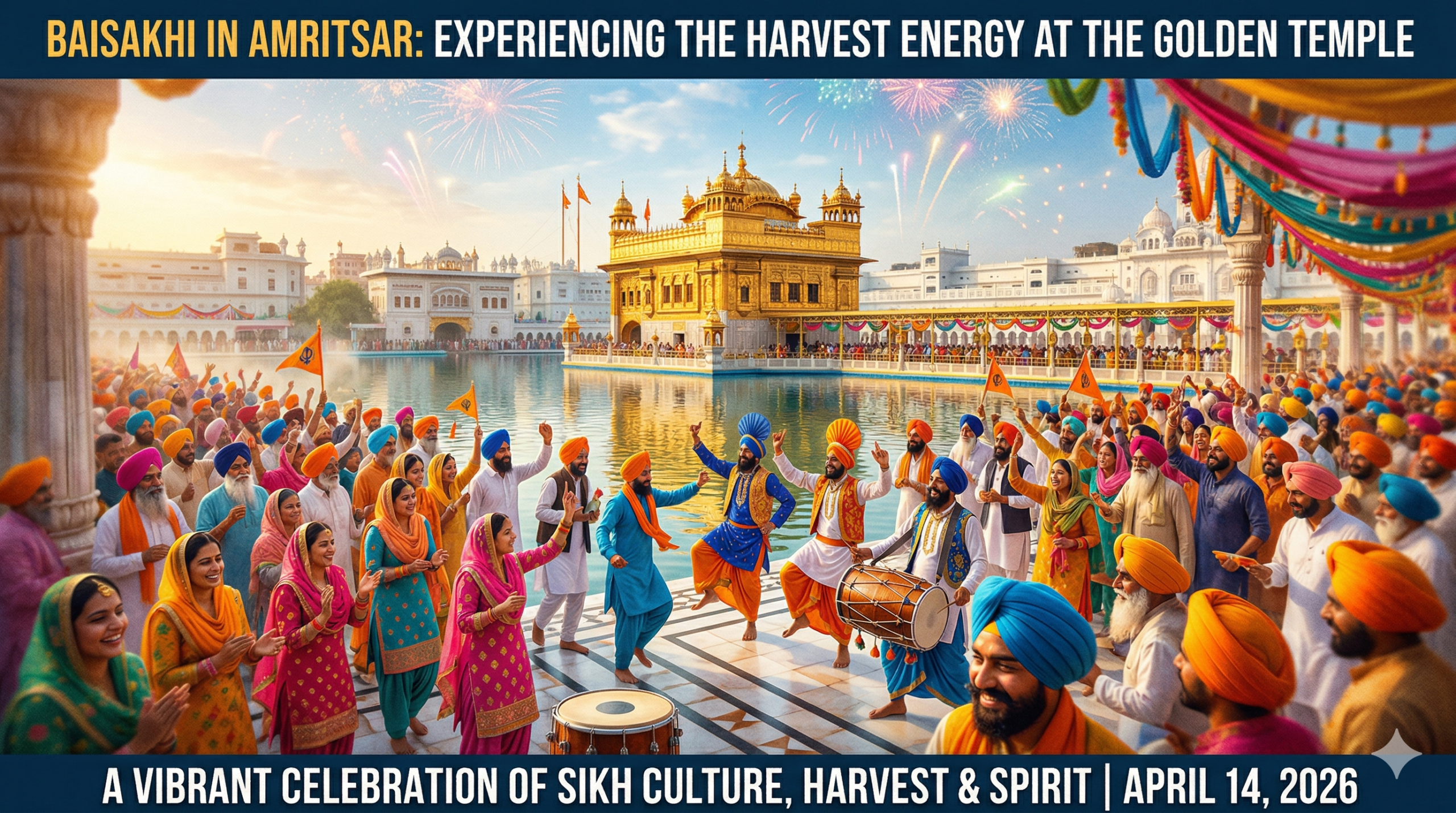
Baisakhi is not just a date on the calendar in Amritsar; it is a heartbeat. On April 14, 2026, the city will transform into a sea of saffron and gold as hundreds of thousands of pilgrims descend upon the Sri Harmandir Sahib (Golden Temple). This festival is a dual celebration of nature’s bounty and spiritual rebirth. For farmers, it marks the successful harvest of the rabi (winter) wheat, and for the Sikh community, it commemorates the birth of the Khalsa Panth in 1699.
Walking through the Heritage Street toward the temple on Baisakhi morning, you don’t just see the festival—you feel it. The air is thick with the scent of desi ghee from nearby sweet shops, the rhythmic beat of the dhol, and the soulful echoes of Gurbani (hymns). Whether you are there for a spiritual quest or to witness one of the world’s most vibrant cultural gatherings, Baisakhi in Amritsar is an experience that stays with you long after the golden dust settles.
Also Read:- 5 Must-Visit Spots in Amritsar for a One-Day Bus Excursion
1. The Spiritual Soul: Baisakhi at the Golden Temple
The Golden Temple is the epicenter of Baisakhi. While the festival is celebrated across Punjab, the energy here is unmatched. The day begins long before the sun rises with the Amrit Vela (the “Ambrosial Hours”). At around 3:00 AM, the holy book, Guru Granth Sahib Ji, is carried in a flower-adorned palanquin (Palki Sahib) from the Akal Takht to the main sanctum. On Baisakhi, this procession is even more grand, with devotees lining the causeway, showering rose petals and chanting in unison.
The significance of Baisakhi dates back to 1699 when Guru Gobind Singh Ji, the tenth Sikh Guru, called for a congregation at Anandpur Sahib and established the Khalsa. He initiated the Panj Pyare (the Five Beloved Ones), giving Sikhs a distinct identity characterized by the “Five Ks” and the values of equality and bravery. In Amritsar, this history is honored through Amrit Sanchar (baptism ceremonies) held within the complex, where many seekers choose this auspicious day to officially join the Khalsa brotherhood.
As the day progresses, the Parikrama (the marble walkway around the pool) becomes a living mosaic of colors. Families from rural Punjab arrive in their finest traditional attire—men in bright orange turbans and women in vibrant Phulkari suits. The “Pool of Nectar” (Amrit Sarovar) is filled with devotees taking a holy dip, believing that on this day, the water carries a special blessing for renewal. Despite the massive crowds, there is an underlying sense of disciplined peace. The sound of Kirtan (devotional music) is broadcast through speakers, wrapping the entire complex in a blanket of serenity that somehow mutes the chaos of the thousands present.
Quick Event Summary: Baisakhi 2026
| Feature | Details for April 14, 2026 |
| Best Time for Darshan | 3:00 AM – 5:30 AM (Amrit Vela) to avoid 4-hour queues. |
| Nagar Kirtan (Procession) | Starts around 9:00 AM from the Golden Temple through the Old City. |
| Special Food | Kada Prasad, Baisakhi Langar (Kheer, Jalebi, and Dal). |
| Evening Highlight | Fireworks over the Sarovar (typically 8:00 PM – 9:30 PM). |
| Wagah Border Timings | Gates open at 3:30 PM; Ceremony starts around 5:15 PM. |
2. The Cultural Carnival: Nagar Kirtan and Local Melas
Step outside the serene white walls of the temple, and you are thrust into the high-octane energy of a Punjabi harvest festival. The Nagar Kirtan is a massive religious procession that winds through the narrow, ancient lanes of the Walled City. It is led by the Panj Pyare, dressed in traditional saffron robes and carrying swords. Behind them, local schools, bands, and Gatka (Sikh martial arts) performers put on a show of incredible skill and discipline. Watching young boys and elders alike spin wooden staffs and swords in a blur of motion is a highlight you cannot miss.
Baisakhi is also the “Sikh New Year,” and the markets reflect this joy. Hall Bazaar and Katra Jaimal Singh become bustling hubs where shopkeepers display mounds of Pinni (wheat-based sweets) and Jalebis. This is the time of the Baisakhi Mela (fair). In the outskirts of the city and nearby villages, large open grounds are set up with giant ferris wheels, local wrestling matches (Dangal), and stalls selling everything from farm equipment to handmade trinkets.
The spirit of the harvest is best seen in the Bhangra and Giddha performances. Unlike the staged versions seen on TV, Baisakhi Bhangra is raw and spontaneous. Farmers celebrate the “Golden Crop” (wheat) by dancing to the beat of a live drum. It is a dance of gratitude—thanking the earth for its bounty. If you find yourself in a local market or a community gathering, don’t be surprised if a local grabs your hand and pulls you into the circle. The motto of Baisakhi is inclusivity; there are no strangers, only friends who haven’t danced together yet.
3. The World’s Largest Kitchen: Langar and Festive Feasting
You haven’t truly experienced Baisakhi until you’ve sat on the floor of the Guru-ka-Langar. On a normal day, the Golden Temple feeds about 100,000 people. On Baisakhi, that number can double. The scale of operation is mind-blowing: huge cauldrons of Dal (lentils) being stirred with paddles, and machines pumping out thousands of rotis per hour. On Baisakhi, the menu often gets a festive upgrade, including sweet rice (Meethe Chawal) or Kheer (rice pudding).
Eating here is a lesson in humility. You sit in a row (Pangat) regardless of your background, religion, or social status. Volunteers (Sevadars) move quickly between the rows, serving piping hot food with a smile. The efficiency is legendary, but the flavor is what surprises most—there is a richness to the food that comes from the “Seva” (selfless service) put into it.
Outside the temple, the food scene is equally legendary. Baisakhi is the perfect time to go on a Kulcha Trail. The Amritsari Kulcha—a flaky, clay-oven-baked bread stuffed with spiced potatoes and smothered in butter—is the unofficial breakfast of the festival. Pair it with a tall steel glass of chilled Lassi, and you’ll have enough energy to survive the afternoon heat. For dinner, traditional Punjabi homes and dhabas serve Sarson da Saag and Makki di Roti, even as the season starts to turn warm, honoring the final harvest of the winter crops.
Pros and Cons of Visiting During Baisakhi
| Pros | Cons |
| Electric Atmosphere: Witnessing Sikh culture at its most vibrant. | Massive Crowds: Expect shoulder-to-shoulder movement in the temple. |
| Special Rituals: Seeing fireworks and the Nagar Kirtan procession. | Long Wait Times: Darshan (entry to the inner shrine) can take 3–5 hours. |
| Cultural Immersion: Spontaneous Bhangra and festive melas. | Logistics: Hotels and cabs are expensive and booked months ahead. |
| Spiritual Energy: The feeling of collective prayer is incredibly moving. | Heat: April in Punjab can reach 35°C–40°C by mid-day. |
As a seasoned traveler who has witnessed Baisakhi in Amritsar multiple times, my biggest piece of advice is: Plan for the crowds, not against them. Many tourists arrive on April 14th expecting a standard sightseeing day, only to be overwhelmed by the sheer volume of people. To truly enjoy the day, you must embrace the “Mela” mindset.
The Strategy:
The “Sweet Spot” is between 3:00 AM and 6:00 AM. If you can make it to the temple by 3:30 AM, you will witness the Prakash ceremony (bringing out the Guru Granth Sahib). The air is cool, the lights of the temple reflect beautifully in the water, and the crowd—while large—is at its most manageable. By 9:00 AM, the heat and the influx of day-trippers from nearby villages make the temple complex very intense.
Where to Stay:
If possible, book a hotel on Heritage Street or within walking distance of the Golden Temple. On Baisakhi, many roads are blocked for the procession, and finding a rickshaw or taxi is nearly impossible. Being within walking distance allows you to retreat to your room for a mid-day nap when the sun is at its peak, and return to the temple for the evening fireworks.
Expert Tip: Don’t just stick to the Golden Temple. Visit Jallianwala Bagh (located right next door). While it is a place of somber history (the 1919 massacre also occurred on Baisakhi day), it provides a necessary perspective on the resilience of the Punjabi spirit. Also, if you plan to visit the Wagah Border in the evening, book your private cab weeks in advance. Public transport on Baisakhi is a gamble you don’t want to take.
5. What to Do and What NOT to Do
To ensure your visit is respectful and smooth, there are certain cultural protocols and practical tips you should follow. Amritsar is a very welcoming city, but Baisakhi is a religious peak, so sensitivity is key.
What to Do:
- Cover Your Head: This is mandatory for both men and women inside the temple. Use a clean scarf or a bandana. They are available for free at the entrance, but buying a bright orange or yellow one from the local market adds to the festive spirit.
- Wash Your Feet: Before entering the main complex, you must walk through a shallow pool of water to cleanse your feet. It’s a ritual of purification.
- Volunteer for Seva: Spend 30 minutes in the Langar hall peeling garlic or washing plates. It’s the best way to feel the “energy” of Baisakhi rather than just observing it.
- Stay Hydrated: The April sun is deceptive. Carry a water bottle, though free chilled water (Chabeel) is distributed by volunteers all over the city on this day.
- Keep Your Shoes Safe: Use the official “Joda Ghar” (shoe house) at the temple entrance. It’s free and very organized.
What NOT to Do:
- Don’t Take Photos Inside the Sanctum: Photography is strictly prohibited inside the main Golden Temple building. You can take photos in the outer Parikrama (the walkway around the water).
- Don’t Smoke or Consume Alcohol: These are strictly forbidden in and around the temple premises. Even outside, being under the influence during a religious festival is highly disrespectful.
- Don’t Wear Short Clothes: Dress modestly. Shoulders and knees should be covered. Traditional Indian wear is highly recommended and widely appreciated by locals.
- Don’t Be in a Hurry: If you are caught in a crowd or a queue, stay patient. Pushing or cutting lines is considered very rude and goes against the spirit of the day.
- Don’t Carry Large Bags: Security is tight on Baisakhi. Leave your heavy backpacks at the hotel; only carry essentials.
6. Closing the Day: Fireworks and Reflection
As the sun sets on April 14, the Golden Temple undergoes its final transformation. The entire complex is illuminated with thousands of lights, and at night, a spectacular fireworks display lights up the sky over the Sarovar. The reflection of the fireworks in the water, combined with the continuous chanting of Waheguru, creates a surreal, cinematic end to the festival.
Baisakhi in Amritsar is a sensory overload in the best possible way. It’s a celebration that reminds us of the cycle of life—the hard work of the harvest and the spiritual discipline of the faith. You will leave the city exhausted, yes, but you will also leave with a full stomach, a rested soul, and a camera roll full of golden memories.
Also Read:- Is a One-Day Bus Trip to Amritsar Worth It? My Honest Experience
