
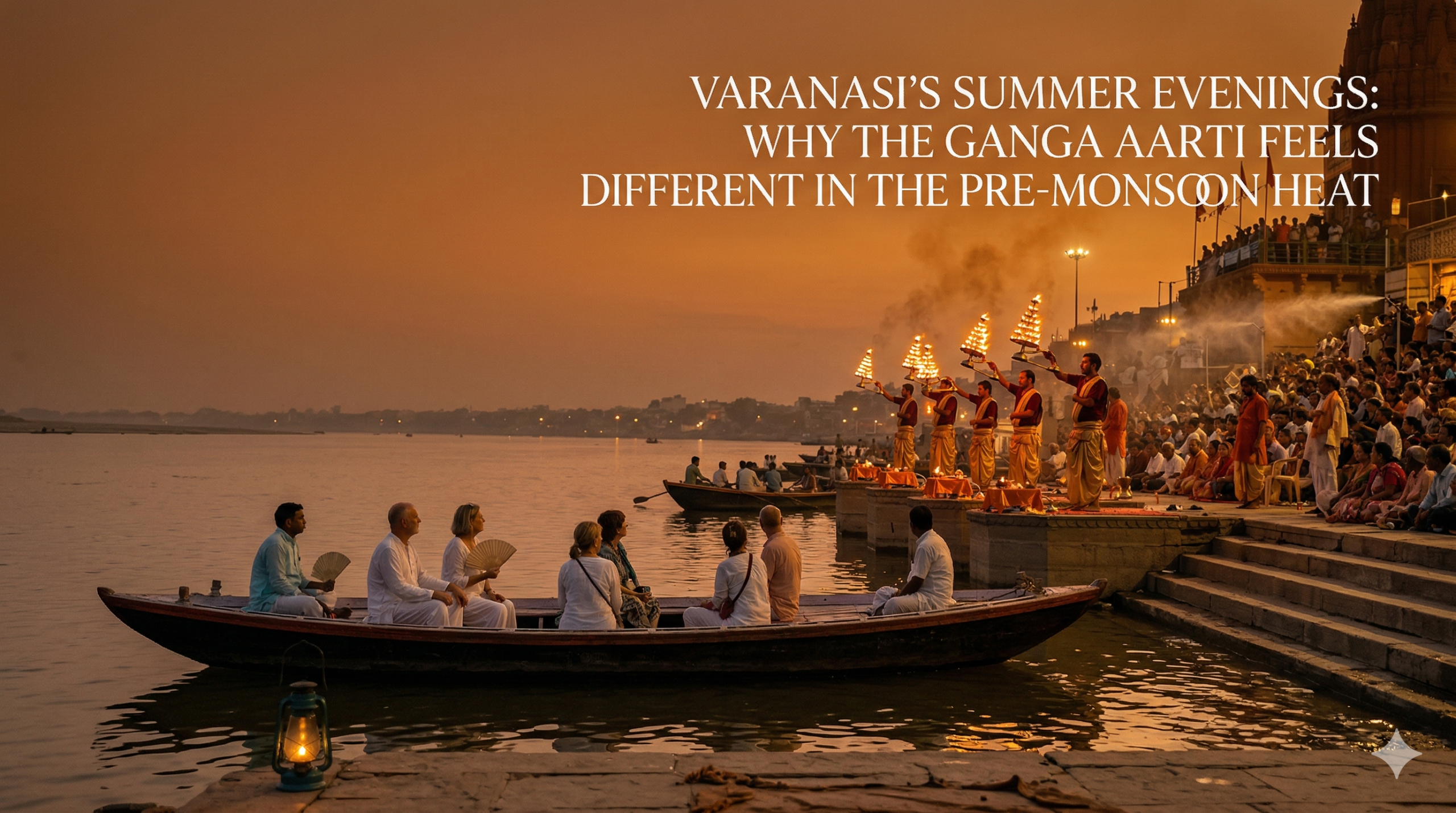
Varanasi, or Kashi, is a city that doesn’t just exist; it breathes. While most travelers flock to its ancient ghats in the cool winters, there is a raw, mystical intensity to the city during the pre-monsoon summer months (April to June). In 2026, as global travel shifts toward “slow” and “authentic” experiences, the summer evening Ganga Aarti has emerged as a deeply spiritual, albeit hot, pilgrimage.
The heat in Varanasi during May and June can be brutal, often crossing 40°C. However, as the sun dips below the horizon, the city undergoes a transformation. The thick, humid air carries the scent of incense and parched earth, creating an atmosphere that feels heavier, more ancient, and more grounded than any other time of year.
Also Read:- Varanasi, Prayagraj, and Ayodhya: The Ultimate UP Pilgrimage Route
1. The Atmosphere: Heat, Devotion, and the “Loo” Wind
Summer in Varanasi is defined by the Loo—the strong, hot, and dry summer wind from the west. By evening, this wind settles into a heavy stillness. For many, the idea of sitting on stone steps in 38°C heat sounds exhausting, but for the devotee and the seasoned traveler, this is when the “Soul of Kashi” is most visible.
In 2026, the pre-monsoon heat brings a specific type of clarity. There are fewer casual “weekend tourists” compared to December, meaning those present are there for the essence of the prayer. The sweat on your brow and the warmth of the stone beneath you become part of the penance. When the bells start ringing at Dashashwamedh Ghat, the sound seems to cut through the heavy heat with more vibration, creating a sensory overload that is both draining and exhilarating.
| Feature | Summer/Pre-Monsoon Condition | Impact on Experience |
| Crowd Density | Moderate to High (but local-heavy) | More authentic, less “commercial” feel |
| Temperature | 32°C – 38°C (Post-sunset) | Physically demanding but spiritually intense |
| River Levels | Lowest of the year | You can walk further out on the riverbed |
| Air Quality | Dusty but clear skies | Stunning, deep orange sunsets over the Ganga |
Pros and Cons
- Pros: Spectacular photography opportunities with the “golden hour” lasting longer. Easier to find front-row seating without arriving three hours early.
- Cons: High risk of dehydration and heat exhaustion. The stone ghats retain heat and can be very hot to sit on even at 7:00 PM.
Expert Review: “Summer in Kashi is for the brave. The heat strips away the fluff. You aren’t just watching a ceremony; you are enduring the elements alongside the priests. It makes the final ‘Shanti’ (peace) mantra feel earned.” — Dr. V. Pandey, Cultural Historian.
2. The Ritual: Dynamics of the 2026 Ganga Aarti
The Ganga Aarti at Dashashwamedh Ghat is a choreographed masterpiece. Seven young priests, draped in saffron and silk, perform a rhythmic salutation to the river, fire, and the universe. In the 2026 season, the ritual has remained traditional, but the logistics have become smarter.
Because the water level is at its lowest before the monsoons hit in July, the “stage” for the Aarti often feels more elevated and prominent. The massive brass lamps, filled with camphor and ghee, add significant heat to the immediate surroundings. In the summer, you can feel the literal warmth of the flames from 20 feet away. This “Agni” (fire) element feels much more powerful when the environment is already warm, symbolizing the burning away of the ego.
| Element | Summer Evening Ritual Detail | 2026 Logistics |
| Start Time | 7:00 PM – 7:15 PM | Adjusted for later sunset |
| Duration | 45 minutes | Remains consistent year-round |
| Best Vantage | From a boat on the river | Electric boats are now mandatory for lower noise |
| Priest Attire | Lightweight Silk/Cotton | Optimized for the heat |
Pros and Cons
- Pros: The low water level allows boats to park very close to the wooden platforms. The lack of fog (common in winter) ensures every mudra (hand gesture) is crystal clear.
- Cons: The combination of environmental heat and the heat from the large lamps can be overwhelming for those with low heat tolerance.
3. The River: A Low-Water Perspective
By June, the Ganga is at its narrowest. This reveals parts of the riverbed that remain hidden for the rest of the year. In 2026, this “low-water” phase is particularly interesting for photographers and geology enthusiasts. You can see the ancient foundations of the ghats and the sheer scale of the stone masonry.
The river moves slowly, almost lazily, reflecting the flickering lamps like a mirror. Because the current is weak, the boats stay perfectly still during the ceremony. This stillness is a hallmark of the pre-monsoon experience. There is no wind to ruffle the water, creating a perfect symmetry between the sky and the river.
| Activity | Summer Advantage | Booking Advice |
| Boat Ride | Extremely stable, no choppy waves | Book a “Bajra” (large wooden boat) for stability |
| Ghat Walk | More land area available to walk | Wear thick-soled sandals to avoid hot stones |
| Photography | No winter haze or monsoon clouds | Use a 50mm lens for low-light clarity |
Pros and Cons
- Pros: The river is calm, making it ideal for those who get motion sickness. You can often see the “Aarti” reflected perfectly in the water.
- Cons: The river banks can sometimes have a stronger odor in the heat before the monsoon flushes the system.
Expert Review: “The low water levels in May/June provide a unique architectural view of Varanasi. It’s the only time you realize how deep the history of these stones actually goes.” — Local Boatman Perspective.
Planning a summer visit to the Aarti requires a different strategy than a winter trip. In 2026, Varanasi has seen an upgrade in “Mist Cooling” systems at some private ghat sections, but the main public areas remain traditional.
You must think about your body’s “cooling time.” If you arrive at the ghat directly from the sun, you will struggle. The key is to spend the afternoon (1:00 PM to 4:00 PM) in an air-conditioned space or a cool temple interior, and only head to the river after 5:30 PM.
| Essential Gear | Why You Need It | 2026 Tip |
| Handheld Fan | Air is very still at the ghats | Battery-operated misting fans are best |
| Electrolytes | Sweat loss is high | Carry Nimbu Pani (Lemon water) with salt |
| Cotton Scarf | Protection from the Loo wind | Dip it in cold water and wrap your head |
| Wet Wipes | To clear dust and sweat | Cooling menthol wipes are a lifesaver |
Pros and Cons
- Pros: You learn the true Indian way of “Summer Living”—slow movements and frequent hydration.
- Cons: If you don’t prep, “Temple Fatigue” combined with heat can lead to fainting.
5. Beyond the Aarti: Summer Food and Night Markets
When the Aarti ends around 8:00 PM, the city doesn’t go to sleep; it actually wakes up. In the summer, the night is the only time it’s comfortable to explore the narrow lanes (Galais). The food in Varanasi also changes with the season.
In 2026, the street food scene remains vibrant. The winter Malaiyo (milk foam) is gone, replaced by thick, cold Lassi served in earthen cups and Aam Panna (green mango drink). The night markets stay open later in the summer, as locals prefer shopping when the sun is down.
| Summer Treat | Description | Where to Find |
| Banarasi Lassi | Thick curd with Rabri and Malai | Blue Lassi Shop / Siwon Lassi |
| Thandai | Cold milk with nuts and spices | Near Godowlia Crossing |
| Kulfi Falooda | Frozen milk dessert | Vishwanath Lane |
Pros and Cons
- Pros: Lassi tastes ten times better when it’s 35°C outside. The night vibe is electric and much more social.
- Cons: Street food can spoil faster in the heat; always choose shops with high turnover and fresh stock.
6. The Golden Rules: Dos and Don’ts for Summer Kashi
To truly enjoy the Ganga Aarti in the pre-monsoon heat, you must surrender to the city’s pace. Don’t try to “conquer” Varanasi in a day.
The “Dos” (What to Do)
- Do Book a Boat in Advance: In 2026, the demand for “Aarti Boats” remains high. Secure yours by 4:00 PM.
- Do Wear Natural Fabrics: Stick to 100% linen or cotton. Synthetics will make you miserable.
- Do Stay Hydrated: Drink water even if you aren’t thirsty. The dry wind dehydrates you silently.
- Do Explore the “Other Side”: Take a boat to the sandy banks across the river for a panoramic view of the Aarti.
- Do Respect the Silence: During the final moments of the Aarti, put the phone away and just listen.
The “Don’ts” (What NOT to Do)
- Don’t Walk Barefoot: Even in the evening, the stones can stay hot enough to blister skin. Wear socks if you must remove shoes.
- Don’t Eat Heavy Fried Foods: Stick to light meals during the day to avoid “Heat Heaviness.”
- Don’t Rush the Ghats: Move slowly. Walking fast in the humidity will lead to a headache.
- Don’t Forget Sunscreen: Even at 5:30 PM, the UV index can be high.
- Don’t Ignore the Monkeys: They are more active (and thirsty) in the summer. Keep your belongings and water bottles tucked away.
Also Read:- Best River View Cafes in Varanasi for Digital Nomads: Work with a View
