
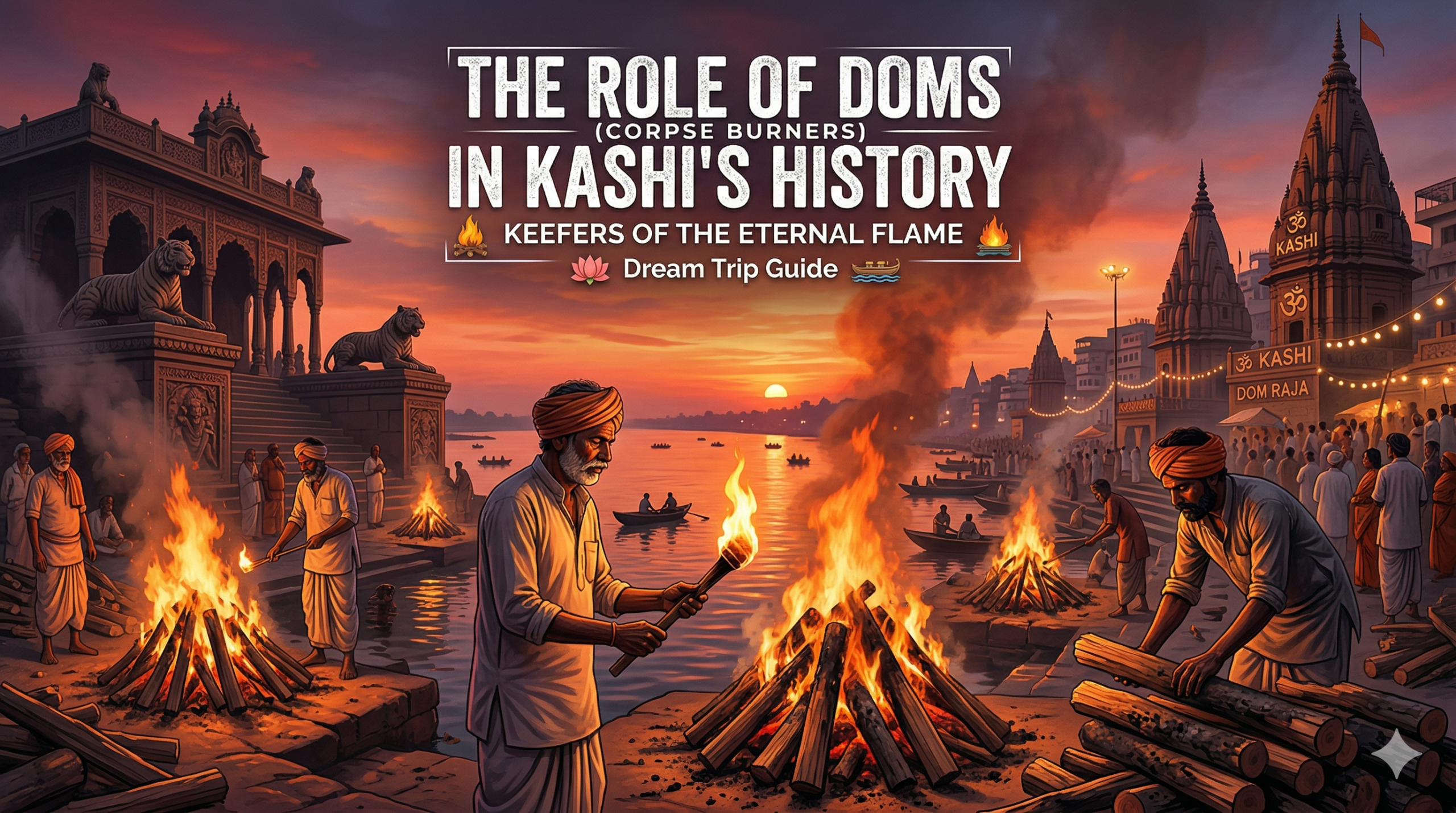
Varanasi, or Kashi, is often called the “City of Death,” but not in a macabre sense. It is the city of Moksha (liberation). At the heart of this spiritual machinery lies the Manikarnika and Harishchandra Ghats, where fires have burned continuously for thousands of years. But who keeps these fires alive?
The Dom community, often referred to as the “Lords of the Cremation Ground” or Dom Rajas, are the traditional custodians of the sacred fire. Despite being historically marginalized and labeled as “untouchable” in the complex social hierarchy of India, in the geography of the burning ghats, they are the ultimate authority. Without the fire from the Dom Raja’s hearth, it is believed a soul cannot attain liberation.
Also Read:- Instagram Spots in Varanasi: Where to Get the Best Shots
1. The Legend of the Dom Raja: A Royal Lineage
The history of the Doms is inextricably linked to the legend of King Harishchandra. According to Hindu mythology, the king, known for his unwavering commitment to truth, lost his kingdom and was sold into slavery to a Dom chieftain named Kallu Dom. The king worked at the cremation grounds, learning the profound lesson that death is the great equalizer.
Today, the head of the Dom community holds the title of Dom Raja. This is not just a ceremonial title; the Dom Raja family lives in a large house overlooking the Ganga, adorned with stone tigers. They are the keepers of the Agni (sacred fire) said to have been gifted by Lord Shiva himself. In the spiritual economy of Kashi, the Dom Raja is a central figure—every family, regardless of their caste or wealth, must negotiate with the Dom for the embers to light their loved one’s pyre.
| Aspect | Historical Context | Modern Reality (2026) |
| Social Status | Marginalized/Untouchable | Legally protected; socially complex but influential. |
| Economic Power | Dependent on “Daana” (alms) | Significant income from wood & fire rights. |
| Spiritual Role | Outcastes | Essential “gatekeepers” of Moksha. |
| Living Conditions | Segregated colonies | Mix of traditional dwellings and modern housing. |
2. The Ritual of Cremation: The Sacred Process
Cremation in Kashi is a meticulously organized ritual. The Doms are responsible for every stage of the physical process. While the Brahmin priests (Tirth Purohits) handle the Sanskrit chants and religious rites, the Doms handle the “heavy lifting” of death. They arrange the wood, ensure the body is properly placed, and most importantly, they provide the Eternal Flame.
The process begins with the “Dom-ka-Agni.” A family member of the deceased approaches the Dom’s hearth to receive a bundle of burning straw. This fire is then used to light the pyre. The Doms monitor the burning process, ensuring the fire is maintained until the “Kapal Kriya” (the breaking of the skull) is performed. In 2026, while electric crematoriums exist, the traditional wood pyre managed by Doms remains the preferred choice for those seeking the traditional path to liberation.
Expert Review: “To understand Kashi, one must look past the smoke. The Doms perform a labor that is both physically grueling and psychologically heavy. They are the only ones who see the raw reality of mortality 24/7, which gives them a unique, almost detached perspective on life.” — Dr. S. Mishra, Cultural Historian.
3. Untouchability and Social Transition
For centuries, the Doms lived a paradox: they were spiritually essential but socially excluded. Because they worked with “impure” elements—corpses and cremation—they were forced to live on the fringes of society. They were the “Untouchables of the Ghats.”
However, the 21st century has brought significant shifts. Education and government interventions have allowed the younger generation of the Dom community to seek work outside the ghats. The stigma is slowly fading, replaced by a recognition of their historical importance. Interestingly, the Dom Raja’s family remains one of the few instances where a marginalized community holds significant “soft power” over the upper echelons of society. When a billionaire or a high-ranking official comes to Kashi for a funeral, they must still stand before the Dom to ask for the fire.
The Pros and Cons of the Traditional System
| Pros | Cons |
| Cultural Preservation: Keeps a 3,000-year-old tradition alive. | Health Hazards: Constant exposure to smoke and heat. |
| Community Identity: Provides a strong sense of heritage for the Doms. | Social Stigma: Residual prejudice still exists in some circles. |
| Reliability: The system works 24/7, 365 days a year without fail. | Child Labor Risks: Traditionally, boys joined the work very early. |
4. The Ethics of “Death Tourism”
As Varanasi becomes a global tourist hotspot, the burning ghats have become a place of fascination. This has created a complicated dynamic for the Dom community. Tourists often want to photograph the pyres, which is strictly forbidden and seen as a violation of the dignity of the deceased.
The Doms have had to become “protectors” of the ghat’s sanctity. They often deal with “scams” where unauthorized people pretend to be Doms to ask tourists for money for “charity wood.” For a solo traveler, it is crucial to understand that the ghats are a place of mourning, not a spectacle. The Doms are doing a job that is sacred to them; they are not “exhibits.”
5. Visitor Etiquette: What to Do and What Not to Do
If you are visiting Manikarnika or Harishchandra Ghat as part of your “Dream Trip,” your behavior should reflect deep respect for the keepers of the flame and the families in mourning.
What to Do (The Do’s)
- Maintain Silence: The ghats are incredibly loud with the crackle of fire and chanting, but as a visitor, your silence is your respect.
- Watch from a Distance: Observe from the upper platforms or from a boat on the Ganga. Do not walk between the pyres.
- Acknowledge the Labor: Understand that the Doms are working in temperatures exceeding 50°C near the fire.
- Educate Yourself: Read about the legend of King Harishchandra before visiting to appreciate the history.
- Donate via Proper Channels: If you wish to contribute to the “wood fund” for the poor, do so through a verified temple or community leader, not someone who approaches you on the street.
What Not to Do (The Don’ts)
- Strictly No Photography: Taking photos of the burning bodies is the ultimate sign of disrespect. The Doms will confront you, and it can lead to serious trouble.
- Don’t Ask Personal Questions: Families are in the middle of a final goodbye; do not interrupt them to ask about the rituals.
- Avoid “Ghat Guides”: Many people will offer to take you “inside” the burning area for a fee. These are often scams and are not sanctioned by the Dom Raja.
- Don’t Display Pity: The Doms are proud of their role as the “Kings of the Cremation Ground.” They don’t want pity; they deserve professional and spiritual respect.
- No Pointing: In many Indian cultures, pointing at people or sacred fires is considered rude.
Also Read:- One Day in Sarnath: The Ultimate Day Trip Guide from Varanasi
