
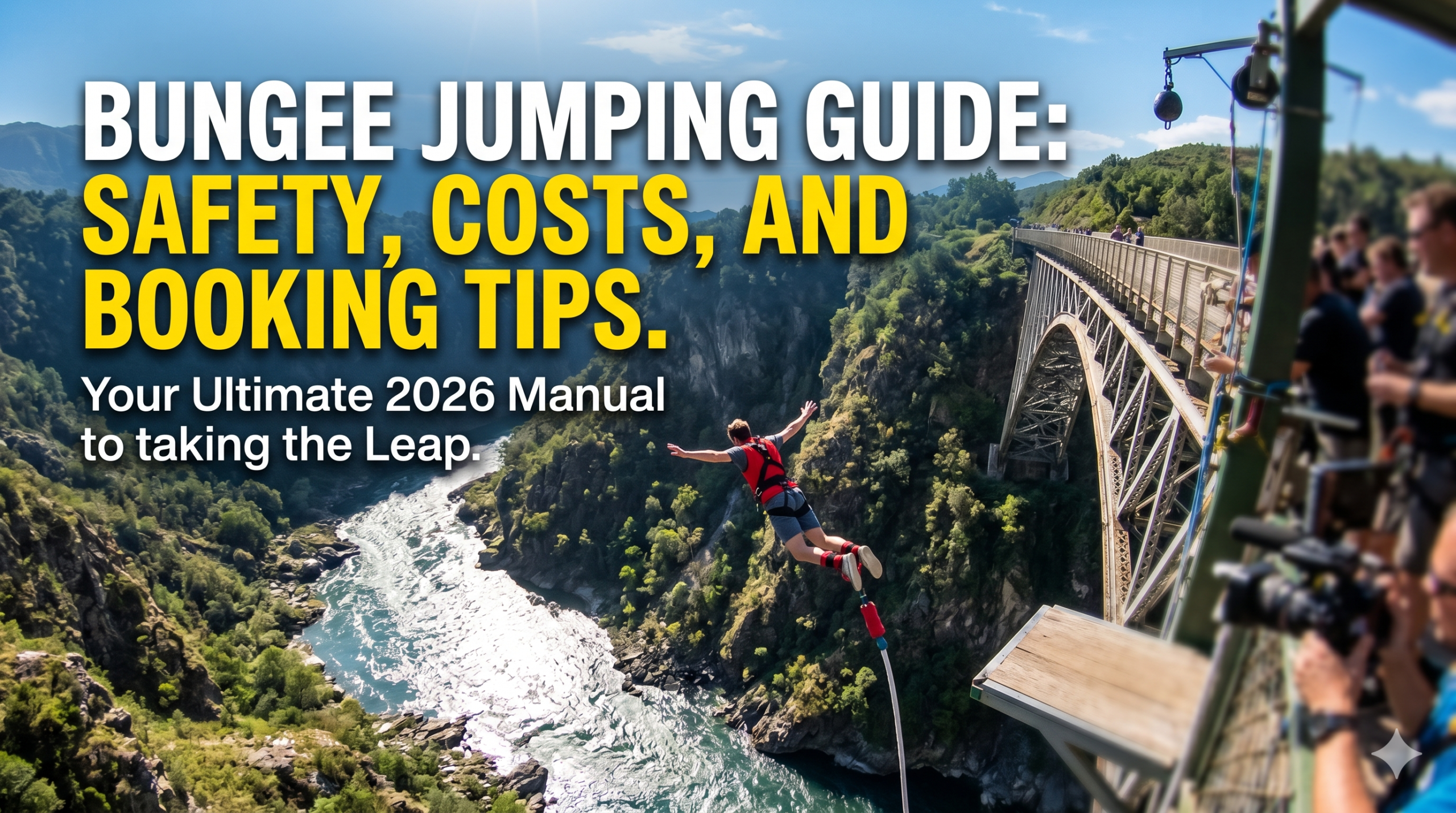
Whether you are an adrenaline junkie or someone looking to tick a major item off your bucket list, bungee jumping is the ultimate test of nerves. The sheer thrill of a free fall followed by the gentle rebound of a high-tech elastic cord is an experience that stays with you forever.
In this comprehensive 2026 guide, we break down everything you need to know about bungee jumping—from safety protocols and current costs to expert tips that will make your first jump seamless.
Also Read:- Camping in Rishikesh: Riverside vs. Forest Camps (Pros & Cons)
1. The Core of Bungee Jumping: Safety and Equipment
Safety is the most frequent concern for first-time jumpers. It is important to understand that modern bungee jumping is one of the most regulated adventure sports in the world. Operators today follow strict international standards, often based on the Australian and New Zealand safety manuals, which are considered the “Gold Standard” in the industry.
The Technology Behind the Leap
The primary piece of equipment is the bungee cord, which consists of hundreds of individual latex strands encased in a tough outer sheath. These cords are designed to stretch significantly—often up to three or four times their original length—to absorb the shock of the fall. In 2026, most top-tier operators use “braided” cords that offer an extra layer of redundancy.
Safety Checks and Staff Expertise
Before you even step onto the platform, a series of checks occurs. A Jump Master oversees the entire process. They are trained not just in the technical aspects of the equipment, but also in human psychology, helping nervous jumpers find the courage to leap. Equipment is retired based on “jump counts” or time—whichever comes first—ensuring that no cord is ever used past its peak performance.
Quick Safety Reference Table
| Feature | Standard Requirement |
| Bungee Cord Life | Usually retired after 150–500 jumps or 6 months. |
| Harness Type | Double-point (Ankle + Body harness) for maximum safety. |
| Backup Systems | Two independent attachment points at all times. |
| Staff Training | Must have documented hours and Jump Master certification. |
| Landing Zone | Over water (9ft+ deep) or an air bag/net over land. |
2. Understanding Costs and Booking Tips
Bungee jumping prices vary significantly depending on the height of the jump and the location’s prestige. In 2026, the price usually includes the jump itself, safety gear, and a completion certificate. However, extras like HD videos and professional photos are almost always additional.
Global vs. Local Pricing
In India, the hub for bungee jumping is Rishikesh, where the price for a jump from a fixed platform (83 meters) typically ranges between ₹3,500 and ₹4,000. If you are looking at international spots like the Kawarau Bridge in New Zealand or the Bloukrans Bridge in South Africa, expect to pay anywhere from $100 to $300 (₹8,000 – ₹25,000).
How to Save and Secure Your Slot
- Early Bird Booking: Most operators offer a 10–15% discount if you book at least two weeks in advance.
- Combo Deals: If you plan on doing a Giant Swing or Flying Fox, booking a “combo package” can save you up to ₹1,500.
- Avoid Weekends: Tuesday to Thursday bookings are often easier to secure and occasionally cheaper than the peak Saturday slots.
Estimated Cost Comparison (2026)
| Location | Height | Estimated Price (INR) | Best Known For |
| Rishikesh, India | 83 Meters | ₹3,500 – ₹4,000 | Highest fixed platform in India. |
| Goa, India | 61 Meters | ₹3,000 – ₹3,800 | Scenic jumps over Mayem Lake. |
| Queenstown, NZ | 43 Meters | ₹15,000+ | The birthplace of commercial bungee. |
| Pattaya, Thailand | 60 Meters | ₹4,500 – ₹6,000 | Most affordable international jump. |
| Bloukrans, SA | 216 Meters | ₹10,000 – ₹12,000 | Highest bridge jump in the world. |
3. Physical and Health Requirements
Bungee jumping is a high-impact activity. While you don’t need to be an athlete to jump, your body undergoes sudden deceleration and significant G-forces. Therefore, certain physical standards are non-negotiable for your safety.
Age and Weight Limits
Most operators require jumpers to be at least 12 years old. The upper age limit is usually around 45–50, though some places allow older jumpers if they have a medical clearance. Weight is equally important: the minimum is usually 40 kg, and the maximum is around 110–120 kg. This ensures the cord stretches exactly as intended for your body mass.
Medical Contraindications
If you have a history of heart trouble, high blood pressure, or neck/back injuries, bungee jumping is generally not recommended. The “jerk” at the bottom of the fall can exacerbate existing spinal issues. Always be honest on your medical waiver; the staff is there to keep you safe, not to judge your fitness level.
The Pros and Cons of the Experience
Pros:
- Mental Breakthrough: Overcoming the “fear of the edge” builds immense self-confidence.
- Pure Adrenaline: It is one of the fastest ways to trigger a dopamine and endorphin rush.
- Unique Perspective: You see the world from an angle few ever do.
- Low Skill Entry: Unlike skydiving, you don’t need hours of training; you just need courage.
Cons:
- Physical Strain: Can cause temporary neck soreness or “eye redness” due to pressure.
- Short Duration: The actual free fall only lasts 2–4 seconds.
- Cost per Second: It is a relatively expensive hobby for the amount of active time you get.
- Weather Dependent: Jumps can be cancelled last minute due to high winds or heavy rain.
4. Preparation: What to Do and What Not to Do
Success in bungee jumping starts on the ground. Your preparation dictates whether you enjoy the rush or spend the whole time in a state of panic.
The “Do’s” for a Perfect Jump
- Wear Tight Shoes: Lace-up sneakers are mandatory. If your shoes are loose, they will fall off during the rebound.
- Eat Light: Have a light meal about 2-3 hours before. Jumping on a completely empty stomach can lead to dizziness, while a very full one is… messy.
- Trust the Jump Master: When they say “1, 2, 3, JUMP,” go on three. The longer you stare at the ground, the harder it becomes.
- Look at the Horizon: Don’t look straight down at your feet. Look out at the distant mountains or trees; it helps reduce the sensation of vertigo.
The “Dont’s” to Remember
- No Loose Jewelry: Leave the watches, rings, and hanging earrings in your locker. They can get caught in the cord or fly off.
- Don’t Consume Alcohol: Operators have a zero-tolerance policy. If they smell alcohol, you will be disqualified without a refund.
- Don’t Close Your Eyes: You’re paying for the view! Keeping your eyes open helps your brain process the movement, which actually reduces the feeling of nausea.
- Don’t Carry Your Phone: Even if you have a “secure” pocket, the forces involved can easily snap a zipper or eject a phone.
5. Expert Review: Is It Worth It?
To wrap up this guide, let’s look at the “Expert Take.” Professional thrill-seekers and safety inspectors agree that while bungee jumping feels like a “death-defying” act, the statistical risk is incredibly low—comparable to a long-distance drive in a car.
The Expert Verdict
“Bungee jumping is 90% mental and 10% physical. The equipment used in 2026 is so advanced that mechanical failure is almost non-existent. The real ‘risk’ is the psychological barrier. For beginners, we always recommend starting at a mid-height site (like 50-60 meters) before attempting the 200-meter giants. It’s an essential life experience that teaches you how to manage fear under pressure.”
Final Checklist Before You Book
- Check Certification: Ensure the site is ISO certified or follows SANZ (Standards Association of New Zealand) guidelines.
- Read Recent Reviews: Check Google Maps or TripAdvisor for reviews from the last month to see if the equipment looks well-maintained.
- Confirm the Refund Policy: Ensure you can reschedule if the weather turns bad.
- Check Video Quality: If you want that Instagram-worthy shot, ask if they provide 4K GoPro footage.
Also Read:- River Rafting in Rishikesh: Which Stretch is Right for You? (Brahmpuri to Kaudiyala)
