
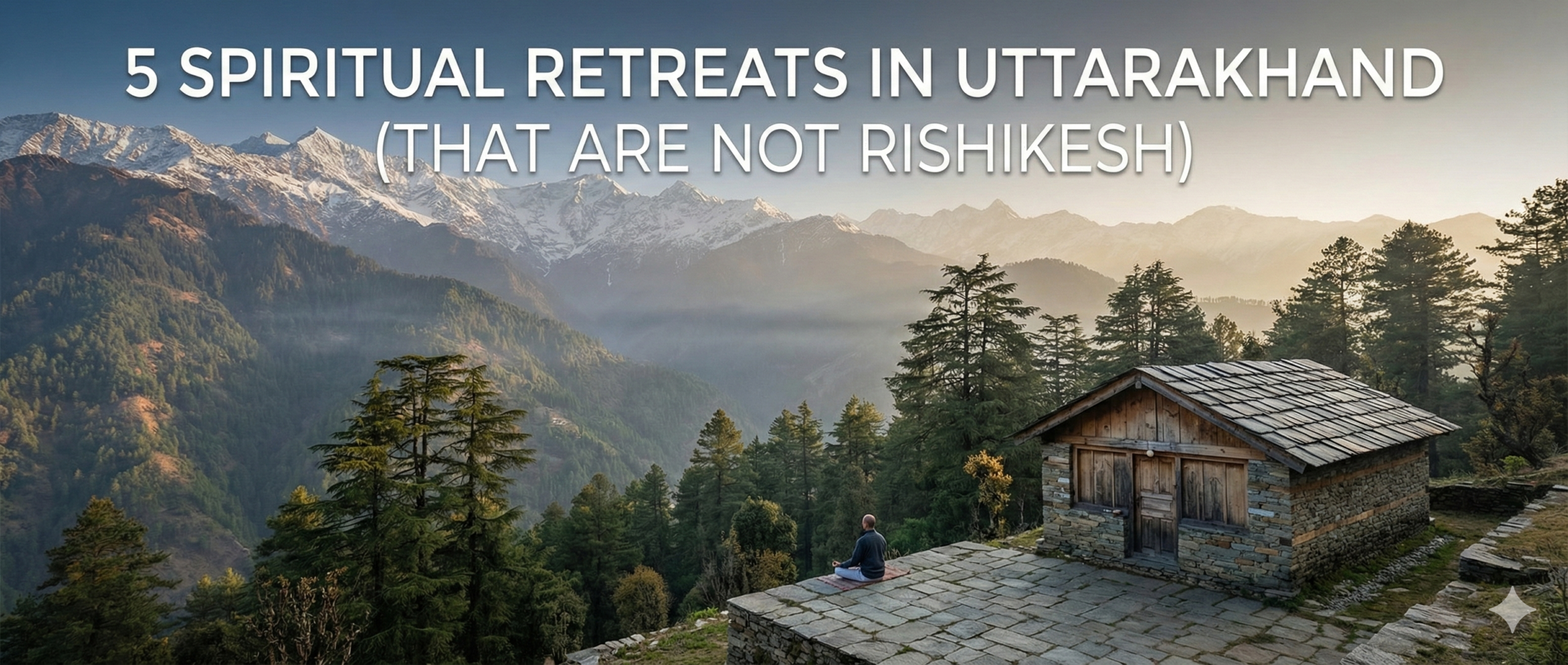
Rishikesh is beautiful, but let’s be honest—in 2026, it is no longer the quiet sanctuary it once was. The constant honking of scooters, the crowded ghats, and the “Instagram spirituality” can sometimes distract you from the very peace you came to find.
If you are looking for peaceful ashrams in Uttarakhand where the silence is loud and the air is clean, you need to look deeper into the Himalayas. You need places where you can hear your own breath.
This guide explores 5 hidden spiritual gems in Uttarakhand. These are not just tourist spots; they are energy centers. Whether you are a serious mediator or just a tired soul looking for a break, these places offer the solitude that Rishikesh often lacks.
Here is your guide to the best meditation retreats India 2026 has to offer—away from the crowds.
Read Also:- Delhi to Varanasi by Vande Bharat Express: Review, Food & Speed
1. Kasar Devi (Almora): The Magnetic Hippie Hill
The Vibe and Experience
Imagine standing on a ridge where the air feels electrically charged. You are surrounded by tall pine trees, and in front of you is a 180-degree view of the majestic Nanda Devi and Trishul peaks. This is Kasar Devi, a place that has pulled seekers, artists, and mystics for over a century.
This isn’t a traditional walled ashram with strict rules. The entire village is a “retreat.” Kasar Devi is famous for the “Van Allen Belt,” a zone of high geomagnetic fields. NASA scientists and spiritual gurus alike agree that the earth’s energy here is unique. It is one of only three places in the world with this specific magnetic pull (the others being Stonehenge in England and Machu Picchu in Peru).
When you arrive here, you don’t check into a schedule; you check into a vibration. The silence here is creative. This is where Swami Vivekananda meditated in the 1890s. This is where Bob Dylan and fierce thinkers of the 1960s came to write and think.
A typical day here involves waking up to the golden sunrise over the Himalayas, walking through the pine forests of “Crank’s Ridge,” and finding a quiet rock to meditate on. There are no loudspeakers here. The only sound is the wind whistling through the Deodar trees. You can visit the ancient Kasar Devi temple, which sits inside a cave-like formation. The energy inside is intense and perfect for deep meditation.
For those planning a Kasar Devi travel guide experience, know that this place allows you to be your own guru. You rent a small cottage, eat simple food at local cafes, and spend your days looking inward. It is freedom in its purest spiritual form.
Quick Information Guide
| Feature | Details |
| Location | 8 km from Almora, Kumaon Region |
| Best Time to Visit | March to June; September to November |
| Accommodation | Homestays, Guest Houses, Boutique Resorts |
| Ideal For | Creative writers, Solo mediators, Nature lovers |
| Budget | ₹1,500 – ₹6,000 per night |
Pros and Cons
- Pros:
- Incredible Himalayan views (Nanda Devi is clearly visible).
- Unique geomagnetic energy that aids deep meditation.
- A cool, bohemian cafe culture with healthy food.
- Very safe for solo female travelers.
- Cons:
- It requires a lot of walking/hiking to get around.
- Not a structured “Ashram” with gurus; you must guide yourself.
- Winters (Dec-Jan) can be freezing cold with no central heating.
Expert Review:
“Kasar Devi doesn’t force spirituality on you; it lets it happen. The magnetic energy is real—you will find your mind settling down much faster here than anywhere else. It is the best place in India to sit still and just ‘be’.”
2. Jageshwar Dham: The Ancient Cedar Forest
The Vibe and Experience
If you want to travel back in time to an era when spirituality was about stone, fire, and forest, Jageshwar Dham is your destination. Located about 35km from Almora, this is not just one temple; it is a cluster of over 120 ancient stone temples dating between the 7th and 12th centuries.
The drive to Jageshwar itself is a therapy. As you get closer, the forest changes. The pine trees disappear, replaced by massive, ancient Deodar (Cedar) trees that tower hundreds of feet high. The sunlight filters through them in beams, creating a cathedral-like atmosphere. The air smells of damp earth and cedar oil.
Jageshwar is one of the “Jyotirlingas” and is dedicated to Lord Shiva. But unlike the chaotic Shiva temples in cities, this place is wrapped in silence. The Jata-Ganga stream flows quietly right beside the temple complex. You can sit by the stream, dip your feet in the cold water, and meditate to the sound of the flowing river and distant temple bells.
Staying here means staying at the KMVN guest house or small private lodges right next to the temples. Your morning alarm is the sound of the morning Aarti (prayer). The routine here is simple: wake up, bathe, visit the temple for the morning rituals, and then walk into the deep forest behind the temple for solitary meditation.
There is a powerful “old world” energy here. It feels like the earth itself is meditating. The crowds are thin, usually only day-tourists who leave by evening. Once the sun sets, the entire valley falls into a profound, heavy silence that is perfect for spiritual introspection. It is raw, authentic, and incredibly grounding.
Quick Information Guide
| Feature | Details |
| Location | 35 km from Almora, 100 km from Kathgodam |
| Best Time to Visit | April to June; September to December |
| Accommodation | KMVN Tourist Rest House, Van Serai Lodge |
| Ideal For | Shiva devotees, History buffs, Silence seekers |
| Budget | ₹2,000 – ₹5,000 per night |
Pros and Cons
- Pros:
- Magical setting amidst ancient Deodar forests.
- Deeply historical and culturally rich.
- Very few tourists stay overnight, making evenings very private.
- The sound of the Jata-Ganga river provides natural white noise.
- Cons:
- Limited food options (mostly simple North Indian veg).
- Monkey menace can be an issue near the temple complex.
- No nightlife or cafes; it is strictly for quiet reflection.
Expert Review:
“Jageshwar is not for the tourist who wants luxury. It is for the soul who wants to connect with the roots of Yoga. The Deodar forest alone is worth the trip—the trees feel like ancient guardians. Sit by the stream at 6 PM; it is a life-changing experience.”
3. Dunagiri (Dwarahat): The Birthplace of Kriya Yoga
The Vibe and Experience
For followers of Autobiography of a Yogi by Paramahansa Yogananda, Dunagiri is holy ground. This secluded mountain area in the Dwarahat region is believed to be the place where Mahavatar Babaji, the deathless yogi, revived the ancient science of Kriya Yoga in 1861.
Dunagiri is not a town; it is a vibration on a mountaintop. It is located away from the main tourist circuits. The silence here is different—it is vast and expansive. When you look out from your retreat, you see layer upon layer of blue mountains fading into the snowy peaks of the greater Himalayas.
The main spiritual activity here revolves around the “Babaji’s Cave” and the Vaishnavi Devi temple. The trek to the cave is a pilgrimage. It takes about an hour of hiking through oak forests. The cave itself is small, silent, and charged with devotion. People travel from all over the world just to sit in this cave for 15 minutes.
Retreats here, such as the Dunagiri Retreat or local eco-lodges, are focused on silence and nature. There is no shopping, no distraction. A day here looks like this: Morning yoga facing the mountains, a healthy organic breakfast, a silent hike to the cave, hours of reading or meditation, and evenings spent watching the stars, which appear incredibly bright due to the lack of light pollution.
The area is also known as “Dronagiri” in the Ramayana (where Hanuman fetched the Sanjeevani herb). The flora here is rich with medicinal herbs. Just breathing the air here feels detoxifying. It is one of the most serious meditation retreats India 2026 has to offer for those dedicated to their practice.
Quick Information Guide
| Feature | Details |
| Location | 15 km from Dwarahat, 400 km from Delhi |
| Best Time to Visit | March to June; October to November |
| Accommodation | Dunagiri Retreat, Homestays near Kukuchina |
| Ideal For | Kriya Yoga practitioners, Hikers, Solitude lovers |
| Budget | ₹3,000 – ₹10,000 per night (depending on luxury) |
Pros and Cons
- Pros:
- Extremely quiet and offbeat; zero crowd.
- Rich connection to Mahavatar Babaji and Yogananda.
- Stunning, unblocked views of the Himalayan range.
- Great hiking trails that are safe and scenic.
- Cons:
- Remote location; takes a long time to reach from the train station.
- Limited medical facilities nearby.
- Hiking is required to reach the main spiritual spots (cave).
Expert Review:
“Dunagiri is the definition of ‘Shanti’ (Peace). It is one of the few places left where you can walk for hours without seeing another human being. If you practice Kriya Yoga, this is your Mecca. If you don’t, the nature alone will heal you.”
4. Sattal Christian Ashram: The Forest Fellowship
The Vibe and Experience
When people think of ashrams, they usually think of Hindu traditions. But one of the most peaceful and welcoming spots in Uttarakhand is the Sattal Christian Ashram. Located near the famous Sattal (Seven Lakes), this place is a hidden sanctuary of green.
Founded in the 1930s by E. Stanley Jones, a friend of Mahatma Gandhi, this ashram was designed as a place where nature and faith meet. It is built on the concept of the “Kingdom of God” in the forest. The architecture is simple, blending colonial bungalows with local stone structures.
The ashram is situated right next to the lakes and dense oak forests. The rule here is community and simplicity. It operates on a system of “family living.” Everyone eats together, prays together, and works together. However, you are free to spend your day how you like.
The highlight here is the “Quiet Time.” You can walk down to the lake, find a spot under a massive tree, and read or meditate. The birdlife here is spectacular—Sattal is a world-famous birdwatching destination. The sound of birds is the background music of your stay.
This is a great option if you want a retreat that is structured but not rigid. It is clean, safe, and very “gentle.” It doesn’t have the intense austerity of some yoga ashrams. It feels more like a spiritual summer camp for adults. You can stay in the cottages, enjoy the simple meals, and attend the evening fellowship if you wish. It is welcoming to people of all faiths.
Quick Information Guide
| Feature | Details |
| Location | Sattal Estate, near Bhimtal/Nainital |
| Best Time to Visit | March to June; September to mid-December |
| Accommodation | Ashram Cottages (Simple & Clean) |
| Ideal For | Families, Birdwatchers, Seekers of gentle peace |
| Budget | Donation based or Low fixed cost (approx ₹1,500/day) |
Pros and Cons
- Pros:
- Situated inside a dense, lush forest near lakes.
- Very organized and clean facilities.
- Welcoming to all religions; no pressure to convert.
- Excellent for birdwatching and nature walks.
- Cons:
- Strict rules regarding timings and campus discipline.
- It is a Christian foundation, so the prayers are Biblical (though meditation is universal).
- Gets booked out quickly in summer due to its popularity.
Expert Review:
“Sattal Ashram is a breath of fresh air. It teaches you that spirituality is also about community and nature. It is the perfect ‘soft landing’ for someone new to retreats who might be intimidated by hardcore austere ashrams.”
5. Anashakti Ashram (Kausani): The Gandhian Stillness
The Vibe and Experience
If your idea of spirituality involves simplicity, discipline, and breathtaking views, the Anashakti Ashram in Kausani is the place. This is where Mahatma Gandhi stayed in 1929. He was so captivated by the beauty of the place that he called Kausani the “Switzerland of India.”
This is not a luxury retreat. It is a place of history and austerity. The ashram sits on a hilltop with a commanding view of the Nanda Devi range. The sunrise view from the ashram’s prayer ground is legendary—the snow-capped peaks turn from purple to gold in minutes.
The “Retreat” here is the lifestyle. You stay in very simple rooms. There is a small museum dedicated to Gandhi’s life. The daily routine involves evening prayers (Sarvadharma Prarthana) where people of all faiths join to sing and sit in silence. The atmosphere is incredibly disciplined and quiet.
Staying here forces you to disconnect. There is no room service, no TV, and no luxury. You are here to read, to think, and to watch the mountains. Gandhi wrote his commentary on the Anashakti Yoga (The Yoga of Non-Attachment) right here at this spot. The energy of that intellectual and spiritual work still lingers.
It is one of the most affordable and accessible peaceful ashrams in Uttarakhand. It is perfect for writers or those who want to practice “Digital Detox.” The town of Kausani is sleepy and quiet, offering lovely walks through tea gardens nearby.
Quick Information Guide
| Feature | Details |
| Location | Kausani, Bageshwar District |
| Best Time to Visit | April to June; October to February (for snow views) |
| Accommodation | Simple Ashram Guest Rooms |
| Ideal For | Gandhians, Minimalists, Budget Travelers |
| Budget | Very Affordable (₹1,000 – ₹2,000 per night) |
Pros and Cons
- Pros:
- The best mountain views of any ashram on this list.
- Very affordable and easy to reach by road.
- Inspiring historical connection to Mahatma Gandhi.
- Located near Tea Gardens for pleasant evening walks.
- Cons:
- Accommodation is very basic (no luxury amenities).
- Strict rules regarding silence and conduct.
- Food is basic canteen style; you may need to eat in town.
Expert Review:
“Come here for the view, stay for the simplicity. Anashakti Ashram reminds you how little you need to be happy. Sitting on the terrace watching the sunset over Trishul peak is a meditation in itself.”
What to Do and What Not to Do
To make your spiritual trip to Uttarakhand smooth and respectful, keep these updated guidelines in mind.
✅ What to Do (Dos)
- Do Pack Woolens: Even in summer (May/June), these high-altitude retreats get cold at night. In 2026, weather patterns are unpredictable; always carry a jacket.
- Do Carry Cash: While UPI is popular, these remote ashrams and local village shops often struggle with network connectivity. Cash is king in the hills.
- Do Respect Silence: If you see someone sitting with their eyes closed, do not approach them. Silence is the currency of these places.
- Do Book in Advance: Places like Dunagiri and Sattal have limited rooms. For a trip in 2026, book at least 2 months ahead.
- Do Dress Modestly: Wear loose, covering clothes. It is respectful to the local culture and comfortable for meditation.
❌ What Not to Do (Don’ts)
- Don’t Expect Party Vibes: These are not “cool” hangouts. Alcohol and loud music are strictly prohibited and frowned upon in these zones.
- Don’t Wander Forests at Night: Leopards are very common in Kasar Devi, Mukteshwar, and Sattal. Stick to the retreat boundaries after sunset.
- Don’t Waste Water: Water is a scarce resource in the hills. Keep your showers short.
- Don’t Play Loud Music: Even on your headphones, keep the volume down. You are there to hear the birds, not the bass.
- Don’t Photograph People Without Permission: Especially Sadhus or people meditating. It is intrusive and rude.
Also Read:- 8 Hotel Room Safety Gadgets for Solo Female Travelers.
Final Thoughts
Uttarakhand has a secret: the further you go from the main highway, the closer you get to yourself.
While Rishikesh will always be the Yoga Capital, these 5 retreats—Kasar Devi, Jageshwar, Dunagiri, Sattal, and Kausani—offer something rarer: privacy. They offer you the space to unravel your thoughts without the noise of the world intruding.
In 2026, make a promise to yourself. Don’t just go on a vacation. Go on a journey inward.
Om Shanti.
