
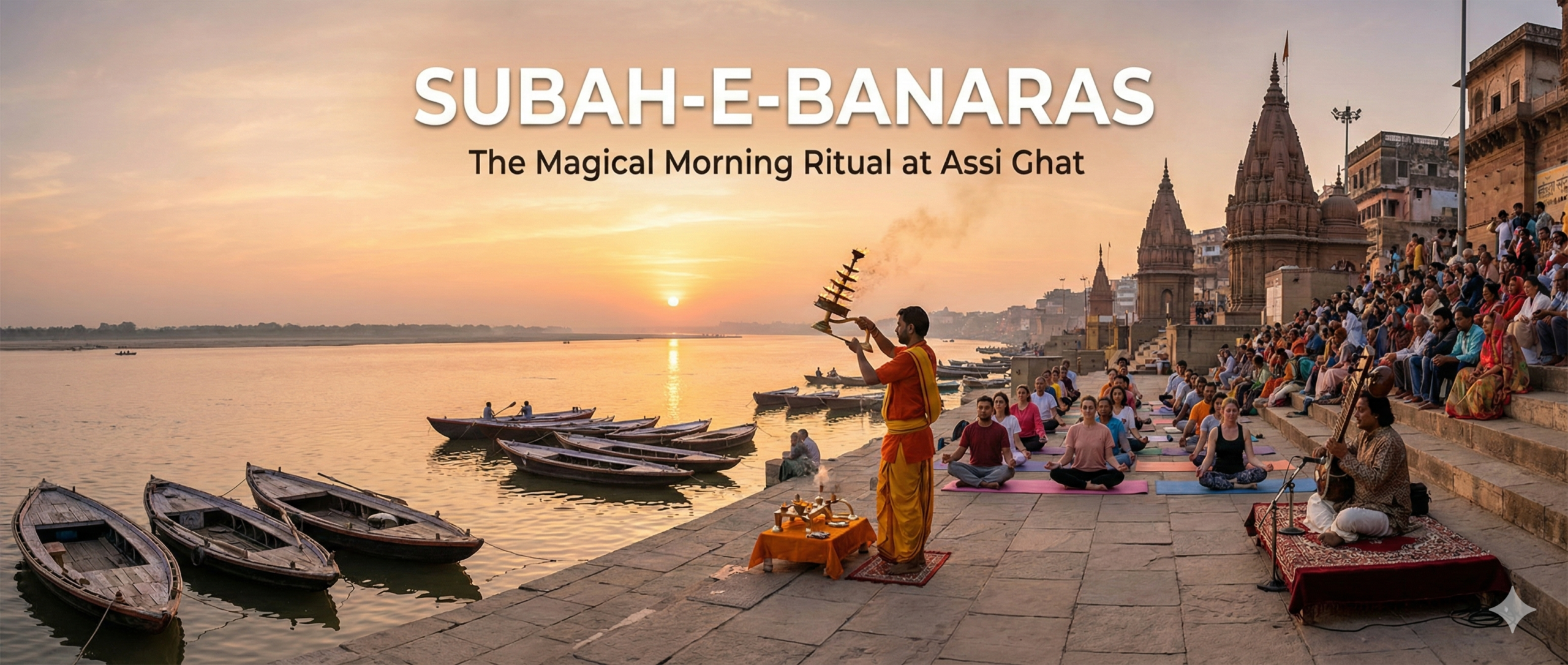
Varanasi is often called the city of death, but if you visit Assi Ghat at dawn, you will realize it is actually the city of life. While the rest of the world sleeps, the southern bank of the Ganga wakes up to a spectacle that is not just religious, but deeply spiritual and cultural. This is Subah-e-Banaras (The Morning of Varanasi).
In 2026, amidst the hustle of modern travel, this morning ritual has emerged as a sanctuary for those seeking peace. It is not just an Aarti; it is a meticulously curated cultural festival that happens every single morning. It combines the five elements of life—fire, water, earth, sky, and air—into a symphony of music, yoga, and prayer.
If you are planning a trip to Varanasi this year, you might be tempted to sleep in after a chaotic arrival. Don’t. Dragging yourself out of bed at 4:00 AM for Subah-e-Banaras will be the best decision of your trip. Here is everything you need to know about witnessing this magic.
Read Also:- Dashashwamedh Ghat Aarti vs. Assi Ghat Aarti: Which is Better?
What is Subah-e-Banaras? (The Soul of the Morning)
To understand Subah-e-Banaras, you have to understand that it is a relatively new tradition compared to the ancient city itself. While the Ganga Aarti has been performed for decades, the Subah-e-Banaras initiative was launched by the state government to showcase the softer, more intellectual side of Varanasi. It is not just about ringing bells; it is about starting the day with the right energy.
The program typically begins before the sun even hints at rising. The sky is a deep indigo, and the river is calm. The event takes place on a paved stage at Assi Ghat, which is the southernmost major ghat in Varanasi. Unlike the cramped steps of other ghats, Assi is wide, spacious, and cleaner.
The ritual is split into four distinct phases:
- The Ganga Aarti: A synchronized worship of the river using fire lamps.
- Vedic Chanting: Young students (Brahmacharis) in white robes reciting ancient Sanskrit mantras.
- Classical Music (Sangeet): A live performance by a maestro—could be singing, flute, sitar, or tabla.
- Yoga: A mass yoga session where everyone is invited to join.
For a traveler in 2026, this offers a crash course in Indian culture. You don’t just watch; you participate. You breathe in the cool river air, you stretch your body during the yoga, and you let the classical ragas calm your mind. It is completely free of cost, open to everyone regardless of religion, and devoid of the aggressive touts you might find elsewhere in the city.
The Ritual Breakdown: Step-by-Step Experience
The experience of Subah-e-Banaras flows like a well-scripted play. Here is what you will witness from the moment you arrive.
1. The Arrival (4:30 AM – 5:00 AM)
You arrive in the dark. The city streets are empty, except for a few cows and rickshaws. As you walk down the steps of Assi Ghat, you see a stage set up facing the river. People are already gathering—sitting quietly on mats or the stone steps. There is a sense of anticipation. The air smells of wet earth and marigold flowers.
2. The Shankh Naad & Aarti (Sunrise)
The ceremony begins with the blowing of the Conch Shell (Shankh). The sound is deep and primal, echoing over the water. Then, the Aarti begins. Unlike the evening Aarti at Dashashwamedh which uses massive, heavy lamps, the morning Aarti here is gentler. The priests wave smaller lamps to wake up the River Goddess. It is intimate. You can hear the crackle of the fire and the swish of the river.
3. The Vedic Chanting
Immediately after the fire ritual, a group of young students from local Sanskrit schools takes the stage. Dressed in pristine white, they recite verses from the Vedas. Even if you don’t understand Sanskrit, the rhythmic vibration of their voices is powerful. It feels like a sonic bath.
4. The Classical Concert (Subah-e-Banaras Stage)
This is the highlight for many. Varanasi is a UNESCO City of Music, and this is where they prove why. Every morning, a different artist performs. One day it might be a soulful flute recital that mimics the birds waking up; the next day it might be a high-energy tabla solo. Watching a live classical concert with the sunrise reflecting on the Ganges in the background is a visual and auditory masterpiece.
5. The Yoga Session
Finally, as the sun fully rises, a yoga instructor takes the stage. Mats are often provided, or you can find a spot on the floor. It’s a simple session—basic stretches, breathing exercises (Pranayama), and laughter therapy. Seeing hundreds of strangers—tourists, locals, monks, and students—breathing in unison is a powerful symbol of community.
Timings, Logistics & Best Season (2026 Update)
Timing is everything for Subah-e-Banaras. If you arrive late, you miss the magic. The timing changes based on the sun, so “sunrise” is a moving target.
The Golden Rule for 2026:
The program follows the sun. In summer, the sun rises early, so the program starts early. In winter, everything shifts back by about an hour.
- Summer (April to September): The program starts around 5:00 AM. You should leave your hotel by 4:30 AM.
- Winter (October to March): The program starts around 5:30 AM or 5:45 AM. However, winter mornings in Varanasi are famous for dense fog. Sometimes, you can’t even see the river until 8:00 AM! But the music and chanting continue regardless of the visibility.
Getting There:
- From Godowlia/Main City: Assi Ghat is about 3-4 km away. A cycle rickshaw will take 20 minutes. An auto-rickshaw (Tuk-Tuk) takes 10 minutes.
- Uber/Ola: In 2026, ride-hailing apps work well in Varanasi, but at 4:30 AM, availability can be spotty. It is safer to arrange a pickup with your hotel front desk the night before.
- Boat: If you are staying near the main ghats (like Munshi Ghat), you can take a boat upstream to Assi. However, most boats don’t start operating until there is a little light, so you might arrive mid-ceremony. It’s better to go by road to reach on time.
Seating:
There are no reserved seats. It is first-come, first-served. The steps of the ghat serve as the gallery. If you have knee problems, arrive early to grab one of the few plastic chairs usually kept on the side, or sit on the upper platform steps which are wider.
Why Assi Ghat is the Best Choice for Mornings
You might ask, “Can’t I just watch the sunrise from any ghat?” Yes, you can. But Assi Ghat has a specific vibe that the others lack.
The “Students & Seekers” Vibe:
Assi Ghat is located very close to Banaras Hindu University (BHU). This means the crowd is younger, more intellectual, and more artistic. You will see art students sketching the sunrise, philosophy students debating over tea, and foreign exchange students practicing meditation. It feels less like a tourist trap and more like a cultural hub.
Cleanliness & Space:
Let’s be honest—some parts of Varanasi can be dirty and crowded. Assi Ghat underwent a massive renovation a few years ago. In 2026, it remains one of the cleanest ghats. The silt is cleared regularly, and there are dustbins (which people actually use!). The wide concrete platform allows for personal space, something that is a luxury in the narrow lanes of the old city.
The Breakfast After:
The ritual ends around 7:00 AM or 7:30 AM. This is the perfect time for breakfast. Assi Ghat is famous for its breakfast spots.
- Lemon Tea: Start with the famous lemon tea sold in small earthen cups (kulhads) by vendors right on the ghat.
- Kachori Sabzi: Just a 2-minute walk from the ghat are famous stalls selling hot Kachori (fried bread) and spicy potato curry.
- Pizzeria Vaatika: For those craving western food, this legendary cafe overlooks the river and offers the best apple pie in town.
Quick Guide: Subah-e-Banaras at a Glance
| Feature | Details |
| Location | Assi Ghat, Varanasi (Southernmost Ghat) |
| Timing (Winter) | 5:30 AM – 7:30 AM |
| Timing (Summer) | 5:00 AM – 7:00 AM |
| Entry Fee | Free (Open to all) |
| Main Components | Ganga Aarti, Vedic Chanting, Classical Music, Yoga |
| Crowd Level | Moderate (Peaceful compared to evening) |
| Best For | Spiritual seekers, Photographers, Music lovers |
| Dress Code | Modest / Comfortable for Yoga (Optional) |
| Photography | Allowed (No flash recommended) |
| Wheelchair Access | Possible via the ramp, but can be steep. |
Pros, Cons, and Expert Review
To give you a balanced view, here is an honest assessment of the experience.
Pros (Why you must go)
- Soul-Stirring Music: The quality of musicians invited here is top-tier. Listening to a Raga flow with the river current is hypnotic.
- No Commercialization: Unlike other tourist spots, no one will try to sell you a boat ride during the ceremony. It is respectful.
- The Yoga Factor: It is a great way to stretch your body after a long flight or train journey.
- Photographer’s Paradise: The soft morning golden hour light provides the best photos of your entire trip.
Cons (Things to consider)
- The Wake-Up Call: Waking up at 4:00 AM is painful. There is no way around it.
- Fog Issues: In December and January, the fog can be so thick you can’t see the sunrise. The music still happens, but the visual magic is reduced.
- Language: The commentary and chanting are in Hindi and Sanskrit. Non-Indian speakers might miss the context of the verses (though the vibe transcends language).
Expert Review
“Subah-e-Banaras is the antithesis of the chaotic India stereotype. It is organized, quiet, and deeply moving. While the evening Aarti at Dashashwamedh is a performance for the eyes, the morning Aarti at Assi is a performance for the soul. In 2026, as travelers seek more ‘mindful’ experiences, this stands out as the single best activity in Varanasi. Don’t just go to watch; take a yoga mat and join in.”
Dos and Don’ts for a Perfect Morning
What Should You Do?
- DO bring a light jacket: Even in summer, the river breeze at 5:00 AM can be chilly. In winter, wear layers!
- DO carry water: You will be there for 2 hours. Stay hydrated, especially if you do the yoga.
- DO respect the silence: While it’s an open space, people are meditating. Keep your conversations to a whisper.
- DO explore the nearby lanes: After the Aarti, walk into the lanes behind Assi Ghat to find hidden shrines and old wrestling pits (Akhadas).
What Should You NOT Do?
- DON’T use flash: The light is low, and flash ruins the ambiance for everyone. Use “Night Mode” on your phone instead.
- DON’T step on mats with shoes: If you enter the yoga area or the stage, take off your shoes. It is considered a sacred space.
- DON’T rush: This is “Slow Travel.” Don’t plan a boat ride for 6:00 AM. Let the ritual finish, then take the boat.
- DON’T ignore the monkeys: Assi Ghat has monkeys. They are generally harmless but hide your food and hold on to your glasses.
Conclusion
Subah-e-Banaras is more than just a tourist attraction; it is a reminder of why people have traveled to this riverbank for thousands of years. It resets your internal clock. When the sun finally breaks the horizon and the music reaches its crescendo, you will feel a connection to the universe that is hard to describe but impossible to forget. So, set that alarm clock. The magic is waiting.
Read Also:- The Mystery of Kaal Bhairav: The Kotwal of Kashi
