
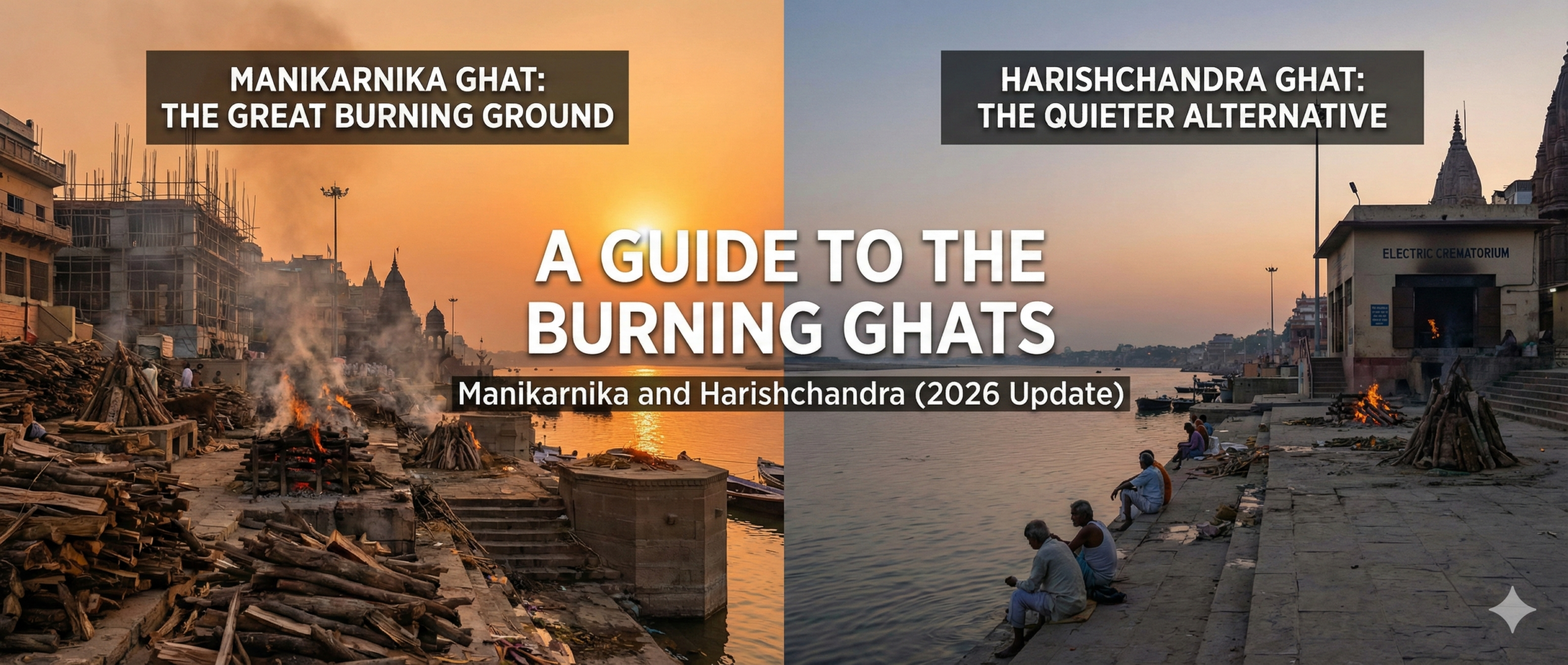
In Varanasi, death is not hidden behind hospital curtains or sterilized walls. It is celebrated, respected, and displayed openly on the riverbanks. For a traveler, this can be shocking. For a seeker, it is liberating.
As we step into 2026, the experience of visiting the Burning Ghats—Manikarnika and Harishchandra—is changing. With the massive “Kashi Vishwanath Corridor” style redevelopment currently transforming Manikarnika Ghat, the ancient lanes are meeting modern infrastructure.
This guide is not just about history; it is about how to navigate these sacred spaces right now, with respect, safety, and understanding. Here is everything you need to know about the “Mahashmashana” (The Great Cremation Grounds).
Read Also:- Subah-e-Banaras: The Magical Morning Ritual at Assi Ghat
The Concept: Why Death is Celebrated Here
“Kashyam Maranam Mukti” — Death in Kashi is Liberation.
Before you visit, you must understand the philosophy. Hindus believe that Varanasi (Kashi) stands on the “Trident of Shiva,” separate from the rest of the earth. It is believed that if a person dies here and is cremated on these ghats, they break the cycle of life and death (Samsara). They attain Moksha (Salvation).
Legend says that Lord Shiva himself whispers the Taraka Mantra into the ear of the deceased at the moment of cremation, granting them instant liberation. This is why you will see families not wailing in despair, but chanting “Ram Naam Satya Hai” (The Name of Ram is Truth) with a sense of finality and peace.
Manikarnika Ghat: The Great Burning Ground
The “Mahashmashana” where the fire never dies.
Manikarnika is the oldest and most sacred cremation ground in the world. It is said that the funeral pyres here have been burning continuously for over 3,000 years.
The Legend:
Mythology states that Goddess Sati’s ear ornament (Manikarnika) fell here while Lord Shiva was carrying her burning body. Another legend says Lord Vishnu dug a well here (the Manikarnika Kund) for Shiva and Parvati to bathe.
The Experience (2026 Update):
If you visited years ago, be prepared for a surprise. In 2026, Manikarnika is in the middle of a massive redevelopment project.
- The Construction: The government is building a “Manikarnika Corridor” to connect the ghat directly to the Kashi Vishwanath Temple. Expect construction barricades, cranes, and diversions in the narrow lanes leading to the ghat.
- The Atmosphere: Despite the construction, the energy is intense. Piles of mango wood stack up like towers. The “Dom Raja” family (keepers of the flame) manages the sacred fire. You will see 20-30 pyres burning simultaneously, day and night.
- The Viewing: You can watch from a distance from the upper floors of nearby buildings (often called “watch towers”) or, more respectfully, from a boat on the river.
Expert Note: The Manikarnika Kund (sacred pond) is believed to be older than the Ganges itself. Despite the ash and heat, pilgrims still take a holy dip here.
Harishchandra Ghat: The King of Truth
The quieter, “modern” alternative.
Located further upstream, Harishchandra Ghat is named after the mythological King Harishchandra, who worked as a cremation assistant here to uphold the virtue of Truth (Satya).
The Difference:
While Manikarnika is chaotic and raw, Harishchandra is relatively organized. It was one of the first ghats to adopt an Electric Crematorium alongside the traditional wood pyres to reduce pollution.
The 2026 Upgrade:
This year, Harishchandra Ghat is also seeing upgrades with new “Green Cremation” systems (gas-based) being installed to further reduce carbon emissions. It is less crowded than Manikarnika, making it a place where you can sit quietly and contemplate mortality without being jostled by crowds.
Comparison: Manikarnika vs. Harishchandra (2026)
| Feature | Manikarnika Ghat | Harishchandra Ghat |
| Primary Vibe | Intense, Chaotic, Raw, Historic. | Somber, Quieter, Organized. |
| Crowd Level | Extremely High. 24/7 activity. | Moderate. Busy mostly in mornings/evenings. |
| Cremation Method | 90% Traditional Wood Pyres. | Mix of Wood, Electric, and Gas. |
| Infrastructure (2026) | Heavily under construction (Corridor project). | Semi-modern facilities available. |
| Best Way to View | From a Boat (safest & most respectful). | From the Steps (sit at a distance). |
| Scam Risk | High (Fake guides, wood donations). | Low (Fewer touts). |
| Best For | Witnessing the sheer scale of ancient rituals. | Quiet reflection on life and death. |
Pros and Cons of Visiting
Pros (The Transformative Value)
- Reality Check: It changes your perspective on life. Seeing the body reduced to ash reminds you of the impermanence of ego and material wealth.
- Cultural Immersion: You witness rituals (Kapal Kriya – breaking of the skull) that have remained unchanged for millennia.
- Historical Depth: The temples around Manikarnika (like the leaning Ratneshwar Mahadev) are architectural marvels.
Cons (The Challenges)
- Emotional Weight: It is not for the faint-hearted. The sights (shrouded bodies) and smells (burning flesh/wood) can be overwhelming.
- Air Quality: The smoke is thick. If you have asthma or breathing issues, wear a mask or view from a boat.
- Aggressive Touts: Especially at Manikarnika, you will be approached for money.
Expert Review
“Manikarnika is not a ‘tourist attraction’ in the traditional sense. It is a working open-air mortuary. The best way to visit in 2026 is to take a sunset boat ride. Ask your boatman to stop 50 meters away. Observe the flames against the darkening sky. Do not step onto the cremation area unless you are with a trusted local guide. Harishchandra, on the other hand, is where you go if you want to sit on the steps and meditate on the philosophy of death.”
The “Hospice of Salvation”: Kashi Labh Mukti Bhawan
A unique feature of Varanasi is the “Death Hotels.” Mukti Bhawan (Salvation House) is a hostel where people come waiting to die. They check in only if doctors say they have less than 15 days to live. If they don’t pass away within that time, they are gently asked to leave to make space for others. It is a fascinating place near the ghats that highlights the city’s acceptance of death.
Vital Dos and Don’ts (Strictly Follow These)
Visiting these ghats requires the highest level of etiquette. One wrong move can offend grieving families or lead to a scam.
What You Should DO
- DO Dress Modestly: Shoulders and knees must be covered. No beachwear.
- DO Stay Quiet: This is a funeral. Speak in whispers.
- DO Keep a Distance: Stay at least 20-30 feet away from active pyres.
- DO Watch Your Step: The floor can be slippery with water, ash, and cow dung.
- DO Donate (Carefully): If you want to donate wood for the poor, do it through a registered organization or the main office, not to random people on the street.
What You Should NOT Do
- DON’T TAKE PHOTOS: This is the Golden Rule. Photography of cremation pyres is strictly forbidden and deeply offensive. Families can get aggressive if they see a camera lens. If you are on a boat, keep your camera down when passing the main burning area.
- DON’T Fall for the “Wood Scam”: A common scam at Manikarnika involves a “volunteer” taking you to a high vantage point, explaining the history, and then aggressively demanding money to buy wood for “poor people.” Decline firmly.
- DON’T Touch Anything: The wood, the ashes, and the items on the ground are part of the ritual.
- DON’T Laugh or Joke: It might be a spectacle for you, but it is a tragedy for someone else.
Conclusion
A visit to Manikarnika or Harishchandra ghat is not about morbidity; it is about facing the ultimate truth of humanity. It is intense, chaotic, and smoky, but it is also strangely peaceful. In 2026, as the city modernizes around these ancient fires, the flames of Kashi continue to burn as a beacon of faith, reminding us that every end is just a new beginning.
Read Also:- Dashashwamedh Ghat Aarti vs. Assi Ghat Aarti: Which is Better?
