
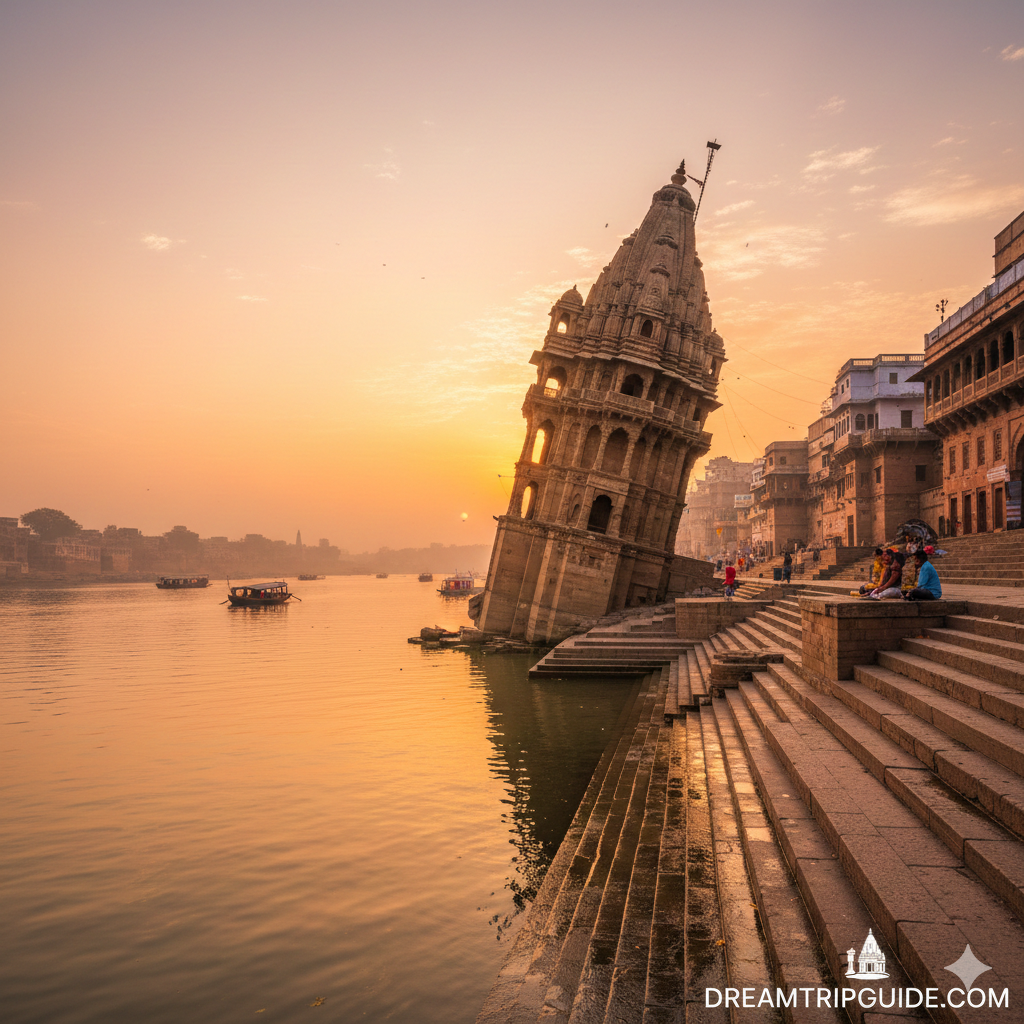
Varanasi, the spiritual heart of India, is a city where every stone tells a story of life, death, and rebirth. Among its eighty-four ghats, Scindia Ghat stands out—not just for its grandeur, but for a peculiar sight that defies gravity: the Ratneshwar Mahadev Temple. Half-submerged in the Ganges and leaning at a sharp angle, this temple is often called the “Leaning Temple of Varanasi.”
While the Leaning Tower of Pisa is famous worldwide, this 19th-century marvel remains a hidden gem for many. In this blog, we will dive deep into the legends, the history, and the architectural mystery of Scindia Ghat and its submerged sanctuary.
Read Also:- Exploring Hidden Ghats of Varanasi: Quiet Spots Beyond the Crowds
The Legend and History of Scindia Ghat
Scindia Ghat was originally known as Vireshwara Ghat, named after the Vireshwara temple located above it. However, its current name and structure are tied to the Scindia dynasty of Gwalior. In 1830, Maharani Baiza Bai of Gwalior undertook the massive project of constructing the ghat and the surrounding edifices.
The history of this ghat is one of persistence and partial tragedy. During its construction, the sheer weight of the massive stone masonry caused the ghat to sink into the soft silt of the riverbed. This led to many of the original structures being damaged or partially buried. Despite this, the Scindia family continued their patronage, making it one of the most aesthetically pleasing and spiritually significant spots on the riverbank.
Legend says that Agni, the God of Fire, was born here. This makes the ghat particularly sacred for devotees who come to seek blessings for purity and strength. Unlike the bustling Dashashwamedh Ghat, Scindia Ghat offers a more serene and contemplative atmosphere. It sits adjacent to Manikarnika Ghat—the great cremation ground—serving as a peaceful buffer where the living and the eternal meet.
Historically, the ghat has been a hub for scholars and ascetics. The narrow alleys leading up from the stone steps are lined with ancient temples and “mathas” where Sanskrit is still taught. It represents the “Vidhya” (knowledge) aspect of Kashi, contrasting with the “Mukti” (liberation) focus of its neighbor.
The Mystery of the Ratneshwar Mahadev Temple
The Ratneshwar Mahadev Temple is a structural enigma. While most temples in Varanasi are built high on the ghats to avoid the rising tides of the Ganges, this temple sits at the very edge, almost inside the water. It leans at an angle of roughly 9 degrees—more than the Leaning Tower of Pisa, which leans at about 4 degrees.
The Curse of the Mother
Local folklore provides a dramatic explanation for the lean. It is said that a servant of the Raja of Gwalior built the temple for his mother, Ratna Bai. He boasted that he had finally “paid his debt” to his mother by building such a magnificent shrine. However, a mother’s debt can never be repaid. Legend has it that the temple began to lean and sink as a result of his arrogance, symbolizing that the “Matru-Rin” (debt to a mother) remains forever heavy and unpaid. Thus, the temple is also known as “Kashi Karvat” (The Lean of Kashi).
The Scientific Perspective
Geologists and architects believe the lean is due to a combination of architectural planning and natural forces. The temple was built on the lower level of the ghat, where the silt is extremely unstable. Over centuries, the weight of the stone combined with the shifting currents of the Ganges caused the foundation to settle unevenly. Interestingly, despite being submerged under water for several months every year during the monsoon, the temple remains structurally sound. The “Shikhara” (spire) emerges from the water as the river recedes, standing as a testament to the incredible quality of 19th-century Indian craftsmanship.
Key Information at a Glance
| Feature | Details |
| Location | Scindia Ghat, Varanasi, Uttar Pradesh |
| Main Deity | Lord Shiva (Ratneshwar Mahadev) |
| Architectural Style | Nagara Style with Phamsana Shikhara |
| Estimated Age | Built around 1830s |
| Angle of Lean | Approximately 9 Degrees |
| Current Status | Partially submerged; Sanctorum is underwater most of the year |
| Best Time to Visit | October to March (When water levels are low) |
| Nearby Landmarks | Manikarnika Ghat, Kashi Vishwanath Temple |
The Experience: What to Expect When Visiting
Visiting Scindia Ghat is like stepping back in time. As you walk down the steep stone steps, you are greeted by the sight of the leaning temple. Depending on the time of year, you might see only the top of the spire or the entire structure covered in silt and algae.
The atmosphere is heavy with the scent of incense and the sound of bells from the Vireshwara Temple above. Because it is located next to the cremation ghat, you will often see processions passing by, but the ghat itself remains a place of meditation. Many pilgrims believe that taking a dip in the Ganges here is particularly purifying due to the presence of the submerged Shiva Lingam.
The architecture of the surrounding buildings is also worth noting. The stone carvings at Scindia Ghat are some of the most intricate in Varanasi, featuring celestial beings, lions, and floral patterns. During the morning “Subah-e-Banaras,” the rising sun hits the leaning temple at an angle that makes the stone glow gold, providing a breathtaking view for photographers and soul-seekers alike.
Pros and Cons of Visiting Scindia Ghat
Pros
- Unique Architecture: You won’t see another temple like the Ratneshwar Mahadev anywhere else in the world.
- Peaceful Vibe: It is significantly less crowded than the main tourist ghats.
- Cultural Depth: Great place to observe traditional Sanskrit students and ancient rituals.
- Photography: The leaning temple against the backdrop of the Ganges is a world-class photo opportunity.
Cons
- Slippery Surfaces: Because the temple is often underwater, the steps are covered in silt and can be very slippery.
- Flooding Issues: During the monsoon (July-September), the ghat is almost entirely inaccessible as the water levels rise.
- Proximity to Cremations: Sensitive travelers might find the nearby Manikarnika Ghat (cremation site) emotionally overwhelming.
Expert Review: A Heritage Perspective
“The Ratneshwar Mahadev Temple is a masterpiece of the Nagara style, even in its ‘fallen’ state. What fascinates historians is not just the lean, but the durability of the stone. Most modern structures would crumble if submerged in a high-velocity river like the Ganges for six months a year. This temple is a silent witness to the hydrological engineering of the 1800s. While people focus on the ‘curse,’ the real story is the resilience of Kashi’s heritage.” — Heritage Consultant & Historian
The Do’s and Don’ts for Travelers
What to Do
- Take a Boat Ride: To get the best view of the leaning angle, hire a boat from Dashashwamedh Ghat and view the temple from the river.
- Wear Grip Shoes: The wet silt is dangerous; wear shoes with good traction.
- Respect the Sanctity: Remember this is a living place of worship. Dress modestly.
- Visit at Sunrise: The light is perfect, and the temperature is cool.
What Not to Do
- Don’t Swim Near the Temple: The currents around the submerged structure can be unpredictable and dangerous.
- Don’t Take Photos of Cremations: While the leaning temple is fair game, taking photos of the nearby cremation ceremonies at Manikarnika is strictly prohibited and disrespectful.
- Don’t Rush: Varanasi is best experienced slowly. Sit on the steps of Scindia Ghat for at least 30 minutes to soak in the energy.
Read Also:- Walking the Ghats: A North to South Walking Tour Itinerary
