
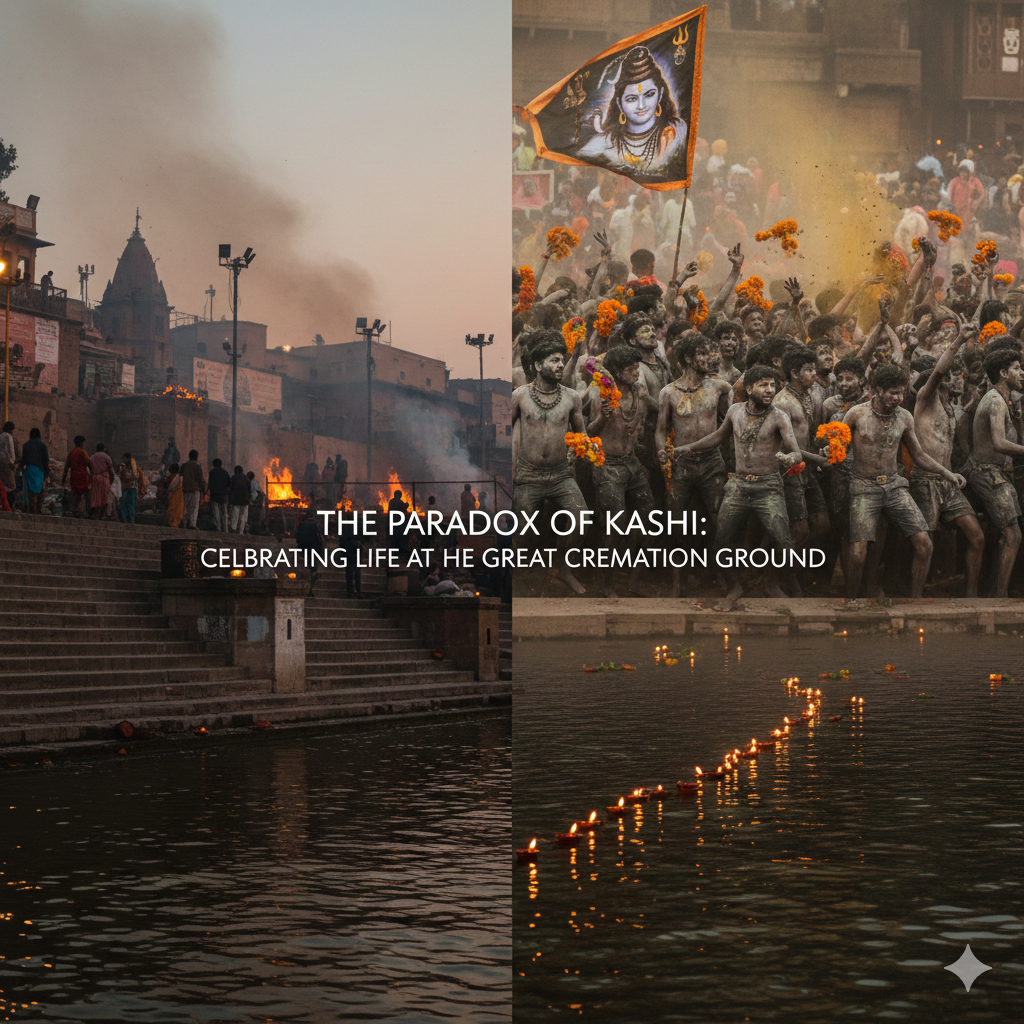
In most parts of the world, a cremation ground is a place of hushed whispers, somber faces, and the heavy weight of grief. But in Varanasi—the ancient city of Kashi—the rules of the “ordinary” world simply don’t apply. Here, death isn’t the end of the story; it’s the climax of a spiritual journey.
Kashi is known as Mahashmashan, or the “Great Cremation Ground.” While that might sound morbid to a visitor, to a seeker, it is the most auspicious place on Earth. It is the only city where death is celebrated with music, color, and even ashes. This paradox reaches its peak during Masaan Holi, a festival where devotees play with the ashes of the departed. It sounds jarring, but beneath the surface lies a profound philosophical truth: to truly live, one must embrace the reality of death.
Read Also:- The History of Scindia Ghat and the Mysterious Leaning Temple of Varanasi
The Concept of Mahashmashan: Why Kashi Never Sleeps
To understand Kashi, you have to understand the concept of the Mahashmashan. In Hindu cosmology, the entire universe is subject to cycles of creation and destruction. While most places are meant for the living, Kashi is believed to be the eternal abode of Lord Shiva, sitting outside the boundaries of ordinary time and space.
The City that Defies Death
Legend says that when the world faces Pralaya (great dissolution), Kashi remains standing, held up by Shiva on his trident. Because Shiva is the Lord of Destruction (and subsequently, Rebirth), his home is a perpetual cremation ground. At Manikarnika Ghat, the funeral pyres have burned continuously for thousands of years.
Life and Death as Neighbors
In Kashi, the boundary between the “sacred” and the “profane” is blurred. You will see children flying kites, vendors selling spicy chaat, and cows wandering the alleys—all just a few feet away from a burning pyre. This isn’t out of disrespect; it’s a constant reminder that life and death are two sides of the same coin. By naming the whole city a cremation ground, the philosophy of Kashi strips away the fear of the end. It teaches us that death is not a “secret” to be hidden away in sterile hospitals, but a natural transition to be faced with dignity and awareness.
| Feature | Ordinary View of Death | The Kashi (Mahashmashan) View |
| Location | Isolated, outskirts of town | The heart of the city |
| Atmosphere | Mourning and silence | Chanting, ritual, and “Utsav” (celebration) |
| Symbolism | Loss and finality | Liberation (Moksha) and transition |
| Presence | Avoided until necessary | Integrated into daily life |
Masaan Holi: The Dance of Ash and Spirit
If you visit Varanasi during the spring, you’ll witness something that defies logic: Masaan Holi. While the rest of India plays with vibrant powders and water, the devotees at Manikarnika Ghat gather to smear themselves with Bhasma—the sacred ash from funeral pyres.
The Origin of the Tradition
The tradition is rooted in the belief that after celebrating Holi with his consort Parvati, Lord Shiva visits the cremation ground to play Holi with his “Ganas” (ghosts, spirits, and outcasts) who couldn’t join the mainstream festivities. It is a celebration of inclusivity. In Shiva’s eyes, no one is “untouchable” or “unholy”—not even the dead.
Bridging the Gap to Moksha
Masaan Holi is the ultimate bridge between the material world and Moksha (spiritual liberation). When a devotee covers themselves in ash, they are performing a symbolic “death” of their ego. The ash represents the final residue of the human body—what remains after all worldly desires, beauty, and status have been burned away. By playing with ash, the people of Kashi are saying, “I am not this body; I am the eternal spirit.” It is a joyful, chaotic, and deeply spiritual act that turns a symbol of mourning into a tool for enlightenment.
Pros, Cons, and the Philosophical Weight
Like any ancient and intense tradition, celebrating life in a cremation ground comes with a complex set of perspectives. It is not for the faint of heart, but for those who engage with it, the rewards are often life-changing.
Pros: The Spiritual Gains
- Fearlessness: Constant exposure to death reduces the “Death Anxiety” that plagues modern society.
- Perspective: It’s hard to stress about a promotion or a minor argument when you are standing amidst the smoke of pyres. It resets your priorities instantly.
- Cultural Preservation: Kashi remains one of the few places on Earth where ancient Vedic rituals are practiced exactly as they were 3,000 years ago.
Cons: The Modern Challenges
- Environmental Impact: The massive demand for wood for traditional pyres has led to deforestation and air pollution. (Note: Many are now moving toward “Green Crematoria” or electric options).
- Tourist Overcrowding: The “spectacle” of death attracts many who come for photos rather than prayers, which can sometimes disrupt the sanctity of the space.
Expert Review: A Sociological Perspective
“Kashi functions as a ‘liminal space’—a threshold where the physical and metaphysical meet. By celebrating Masaan Holi, the community processes collective trauma and mortality through ritualized joy. It is perhaps the world’s most effective form of communal therapy.” — Dr. A. Sharma, Cultural Anthropologist.
Varanasi is a city of high energy. If you plan to witness the Mahashmashan or the rituals of Masaan Holi, you must approach it with a specific mindset. It is not a “tourist attraction”; it is a living, breathing sanctuary.
What to Do
- Observe Silently: If you are at the cremation ghats, find a spot to sit and just watch. The scale of the ritual is enough to speak for itself.
- Seek a Guide: A local who understands the philosophy can explain the difference between the Antyesti (last rites) and the celebratory aspects.
- Dress Modestly: This is a place of deep religious significance. Cover your shoulders and knees.
- Embrace the Dust: Kashi is dusty, crowded, and loud. Accepting the chaos is the first step to enjoying the city.
What NOT to Do
- Photography of the Dead: This is the most important rule. Taking photos of burning bodies or grieving families is strictly prohibited and deeply disrespectful.
- Treating it Like a Party: While Masaan Holi is a celebration, it is a sacred one. Don’t behave like you’re at a music festival.
- Interfering with Rituals: Families are performing the most important duty of their lives. Give them space and path.
Read Also:- Exploring Hidden Ghats of Varanasi: Quiet Spots Beyond the Crowds
Conclusion: The Final Lesson of the Ash
The Paradox of Kashi is that it uses the imagery of death to teach us how to live more fully. When you stand at the edge of the Ganges, smelling the sandalwood and the smoke, you realize that the “Great Cremation Ground” isn’t a place of darkness. It is a place of clarity.
Kashi tells us that our time here is short, our bodies are borrowed, and our egos are illusions. By celebrating with ashes, the people of Varanasi aren’t being morbid—they are being honest. They are celebrating the fact that even though the body ends, the soul’s journey toward Moksha continues.
