
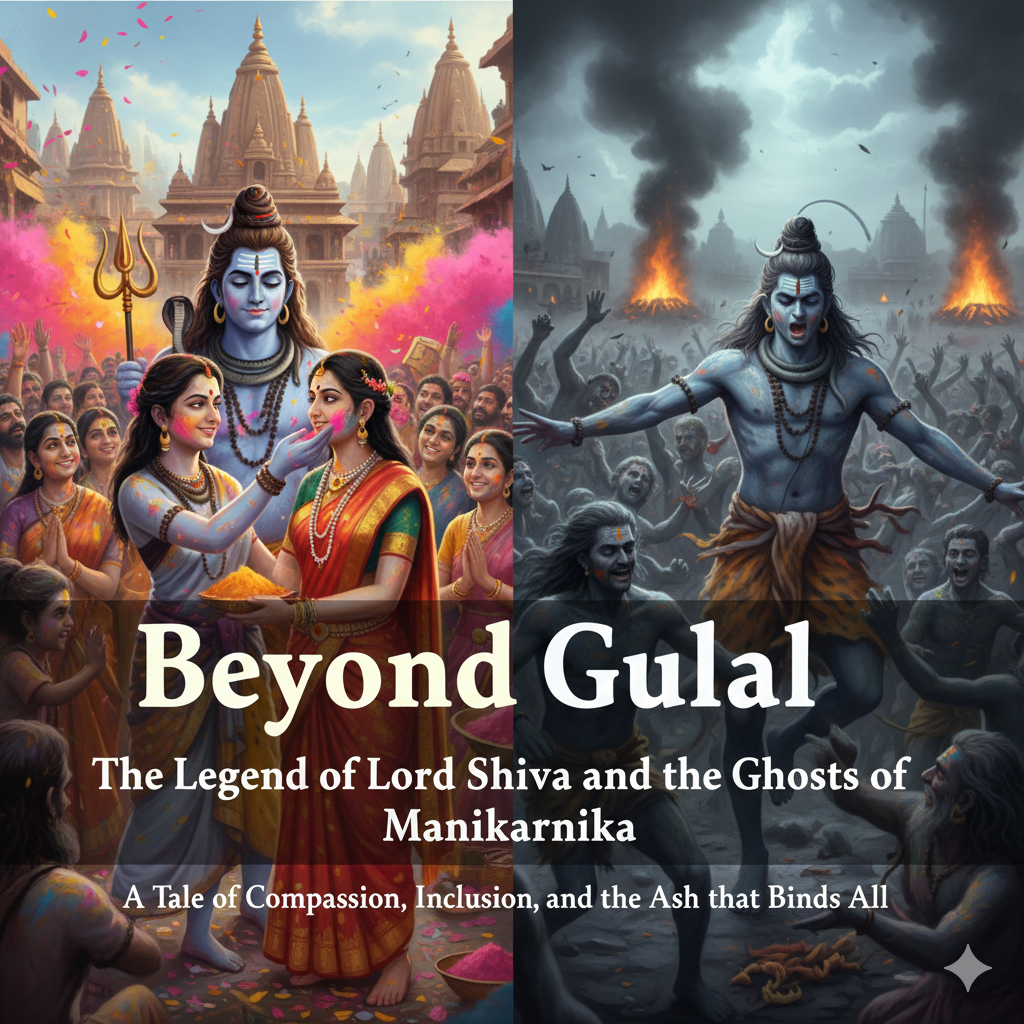
In the heart of Varanasi, where the Ganges flows with ancient secrets, there is a day when the air isn’t filled with the bright pinks and yellows of typical Holi powders. Instead, it is thick with the grey, mystical swirl of Bhasma (cremation ash). This is Masaan Holi, a ritual that feels like a scene from another world. But why would the God of Gods, Mahadev, choose to play with the remnants of the dead?
To understand this, we have to look past the physical rituals and into a deep, hauntingly beautiful legend. It is a story of a God who refuses to leave anyone behind—even those the rest of the world has forgotten. While the world celebrates with Gulal (colored powder), Kashi celebrates with the essence of the soul.
Read Also:- The Paradox of Kashi: Celebrating Life at the Great Cremation Ground
The Backstory: Rangbhari Ekadashi and the Divine Exclusion
The story begins on Rangbhari Ekadashi, the day Lord Shiva officially brought Goddess Parvati to his home in Kashi after their marriage. The entire city was decorated with flowers, and the air was sweet with perfume. The gods, the humans, and the celestial beings all played Holi with the finest colors to welcome the divine couple.
The Loneliness of the Ganas
However, amidst this grand celebration, there was a group that stood at the outskirts, watching from the shadows. These were the Ganas—the ghosts, spirits, ghouls, and supernatural entities that form Shiva’s unconventional army. Because they looked “frightening” or were associated with the “unclean” world of the afterlife, they were not invited to the mainstream celebrations in the city.
Shiva’s Compassion
Lord Shiva, known as Ashutosh (the one who is easily pleased) and Bholenath (the innocent one), noticed the sadness of his loyal companions. He realized that while the world had colors for the “beautiful,” it had none for the “rejected.” In an act of ultimate compassion, he decided that if his Ganas couldn’t play Holi with the living, he would play Holi with them at the cremation ground. This was his way of showing that in the eyes of the Divine, every soul—living or dead, beautiful or terrifying—is equally worthy of celebration.
| Entity | Role in Mythology | Why They Were Excluded | Shiva’s Perspective |
| Ganas | Shiva’s loyal attendants | Seen as “frightening” or “unholy” | His most devoted followers |
| Pretas (Ghosts) | Souls in transition | Associated with death and mourning | Beings seeking liberation |
| Aghoris | Devotees of Shiva | Break social taboos | High-level spiritual seekers |
The Great Celebration at Manikarnika Ghat
The following day, after the city had finished its colorful festivities, Lord Shiva descended upon Manikarnika Ghat, the most sacred cremation ground in the world. This is where the legend of “Masaan Holi” (Holi of the Crematorium) truly comes to life.
The First Masaan Holi
Shiva didn’t bring flowers or powders. Instead, he took the cold, grey ash from the funeral pyres—the Bhasma—and threw it into the air. The Ganas joined in, dancing with abandon, their forms covered in the white dust of the departed. This was not a dance of death, but a dance of inclusion. By playing with ash, Shiva declared that the cremation ground is not a place of horror, but a place of final truth.
The Symbolism of the Ash
In Hindu philosophy, ash is the only thing that cannot be changed further. You can burn wood to ash, but you cannot burn ash. It represents the Atman (soul) which is eternal and indestructible. When Shiva plays Holi with ash, he is celebrating the part of us that never dies. For the ghosts and spirits of Kashi, this was the greatest gift—the recognition that they, too, were part of the cosmic play of the Universe.
Pros, Cons, and the Spiritual Impact of the Legend
The legend of Shiva and his Ganas provides a framework for how we view the “darker” sides of life. It challenges our definitions of what is pure and what is polluted.
Pros: Lessons from the Legend
- Radical Inclusivity: The story teaches that God belongs to everyone, especially the outcasts and the marginalized.
- Overcoming Fear: It transforms the image of a “ghost” from a scary entity into a devotee, helping people process their fear of the unknown.
- Acceptance of Reality: It forces us to look at the “end” of life not as a tragedy, but as a stage where even God is present.
Cons: Potential Misunderstandings
- Morbid Perception: To those who don’t know the legend, the ritual can look dark or “satanic,” leading to unfair stigma.
- Commercialization: As the legend becomes more famous, the sacred ritual at Manikarnika is sometimes treated as a “photo op” by influencers, losing its deep mythological weight.
Expert Review: A Mythologist’s View
“The legend of Shiva playing Holi with his Ganas is the ultimate subversion of social hierarchy. It tells us that the Divine exists even in the most avoided places. It is a psychological tool that allows the human mind to find joy in the face of inevitable mortality.” — Rajesh V., Cultural Historian.
What to Do and What Not to Do: Honoring the Legend
If you find yourself in Kashi during this time, or if you are sharing this story, it is vital to respect the “why” behind the “what.”
What to Do
- Read the Puranas: To truly appreciate the legend, read the stories of Shiva and Sati, which explain his deep connection to the cremation grounds.
- Acknowledge the Spirits: In Kashi, it is believed the spirits of the ancestors are present. Offer a silent prayer for their peace when visiting the ghats.
- Reflect on Equality: Use the story as a meditation on how you treat “outcasts” in your own life.
What NOT to Do
- Mock the Ritual: Never laugh at or mock those smearing ash; for them, it is a direct connection to the legend of Mahadev.
- Forget the Context: Don’t separate the Holi from the philosophy. Without the legend of the Ganas, Masaan Holi is just playing with dirt; with the legend, it is a spiritual awakening.
- Assume it’s “Dark Magic”: This is a celebration of the soul’s liberation, not a practice of black magic. Avoid spreading misinformation.
Read Also:- The History of Scindia Ghat and the Mysterious Leaning Temple of Varanasi
