
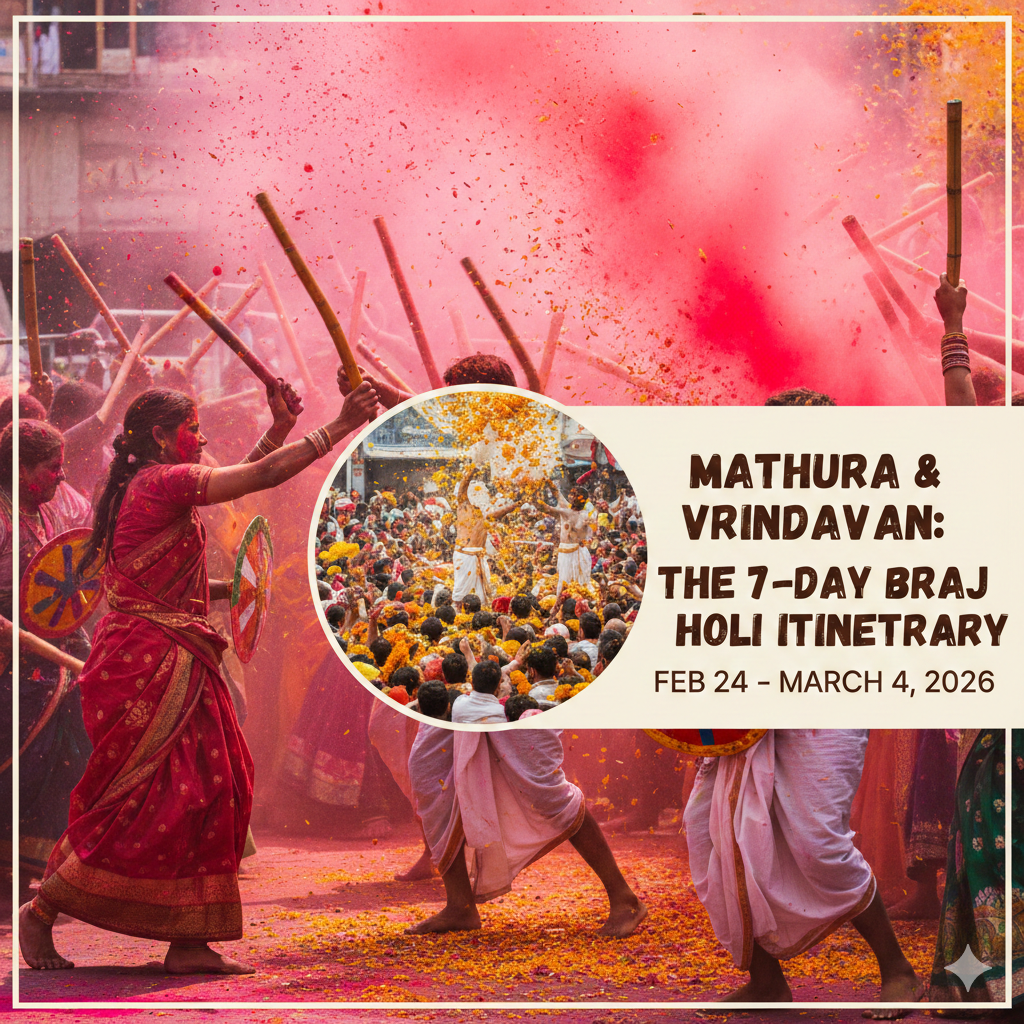
Experience the world’s most vibrant and chaotic festival in the heart of Braj. While the rest of India celebrates for a day, the towns of Mathura, Vrindavan, Barsana, and Nandgaon immerse themselves in color for over a week. This 2026 itinerary is designed to help you navigate the divine madness of Braj Holi with ease.
Read Also:- Top 5 Peaceful Holi Getaways for Solo Travelers
Overview of the Braj Holi 2026 Schedule
| Date (2026) | Event Name | Primary Location | Key Ritual |
| Feb 24 (Tue) | Laddu Holi | Shriji Temple, Barsana | Priests throw sweets (laddus) at devotees. |
| Feb 25 (Wed) | Lathmar Holi | Barsana | Women hit men with sticks; men use shields. |
| Feb 26 (Thu) | Lathmar Holi | Nandgaon | The “return match” at Nand Bhawan. |
| Feb 27 (Fri) | Phoolon Wali Holi | Banke Bihari, Vrindavan | Priests shower devotees with fresh flower petals. |
| Feb 28 (Sat) | Widow’s Holi | Gopinath Temple, Vrindavan | Breaking taboos with white-clad widows playing color. |
| March 3 (Tue) | Holika Dahan | Mathura/Vrindavan | Sacred bonfires and the “Dola” procession. |
| March 4 (Wed) | Dhulandi (Main Holi) | All over Braj | The main day of colors, water, and “Brij madness.” |
Subtitle 1: The Lathmar Legend (Barsana & Nandgaon)
The Lathmar Holi is the soul of Braj. According to legend, Krishna visited Barsana to tease Radha, and in response, the women of the village chased him away with sticks. Today, this is reenacted with fervor. On February 25 (Barsana) and February 26 (Nandgaon), thousands gather to watch the “battle” of the sexes. In Barsana, the narrow uphill climb to the Shriji Temple becomes a sea of humanity. Men from Nandgaon (representing Krishna’s friends) arrive with shields, while the women of Barsana stand ready with long bamboo poles (lathis).
The atmosphere is electric, filled with folk songs (Hori) and clouds of red gulal. However, navigating this requires immense patience. The lanes are barely five feet wide, and the rush starts as early as 9:00 AM for an afternoon event. If you are a photographer, getting a “balcony spot” is crucial, but expect to pay a small “donation” to local homeowners for the privilege. In Nandgaon the next day, the roles reverse, and the energy is just as high but slightly more spread out within the village.
Subtitle 2: Floral Divinity and Social Change (Vrindavan)
Vrindavan’s Holi is more poetic. On February 27, the Banke Bihari Temple hosts Phoolon Wali Holi. For a brief 15–20 minutes after the temple gates open, the priests shower the crowd with quintals of marigold, rose, and jasmine petals. It is a sensory explosion that feels far more spiritual than the rowdy street celebrations. Because it lasts such a short time, you must be inside the temple courtyard by 3:00 PM.
Another significant event is the Widow’s Holi on February 28. Historically, widows in India were barred from celebrations. Now, at the Gopinath Temple, hundreds of widows dressed in white break this tradition, dancing and throwing colors. It is a moving experience that highlights the evolving nature of the festival. This event is generally less chaotic than the Lathmar Holi and is highly recommended for those who want to witness the “emotional” side of Braj.
Subtitle 3: Travel Logistics (Delhi/Noida to Mathura)
Getting to the epicenter of Holi is relatively straightforward but requires booking months in advance.
- By Train: This is the fastest method. From New Delhi (NDLS) or Hazrat Nizamuddin (NZM), take the Gatimaan Express or Shatabdi to Mathura Junction. The journey takes about 90–120 minutes. From Noida, you can board at Ghaziabad or take a cab to NZM station.
- By Road: Use the Yamuna Expressway. It is a smooth 3-hour drive (approx. 160 km) from Noida. However, during Holi week, expect heavy police checkpoints.
- Local Navigation: Private cars are useless inside the towns. Most roads are barricaded 2-3 km away from the temples. Your best friends are E-rickshaws and your own feet. For Barsana and Nandgaon, you must leave Mathura/Vrindavan by 6:00 AM to beat the road closures.
Subtitle 4: Where to Stay (The Base Camp Strategy)
Choosing between Mathura and Vrindavan as your base is vital.
- Mathura: Best if you want to cover the entire region (Gokul, Nandgaon, Barsana). It has better connectivity and more “proper” hotels like Nidhivan Sarovar Portico or Best Western.
- Vrindavan: Best if you want to be within walking distance of the Banke Bihari and ISKCON temples. It offers a more authentic “ashram” vibe. Look for stays near the Parikrama Marg; this allows you to exit the town more easily when the inner lanes are choked.
- Avoid: Do not stay in Barsana or Nandgaon. They lack basic infrastructure, and you might find yourself “locked in” for hours due to the sheer volume of people.
The “narrow lanes” of Vrindavan are legendary and treacherous during Holi. Here is the reality: at peak times, you won’t be walking; the crowd will be moving you.
- The “Gully” Guide: Stay to the sides of the lanes, not the middle. If you feel a surge, duck into a shop or a temple doorway.
- Protect Your Belongings: Use a chest bag worn under your shirt. Pickpockets are common in the dense crowds.
- Communication: Mobile networks often jam due to the density. Fix a meeting point with your group (like a specific sweet shop) in case you get separated.
- Footwear: Wear cheap Crocs or old sneakers you can throw away. You will be walking through a mix of colored water, mud, and flower pulp.
Subtitle 6: Photography & Gear Protection
Holi is a “camera killer.” The fine gulal powder can enter your lens barrels, and the colored water can short-circuit electronics.
- The DIY Rain Cover: Use a heavy-duty plastic bag and duct tape. Cut a hole for the lens and secure it with a UV filter. Never change lenses in the field.
- Expert Review Tip: “Use a fixed focal length (like a 35mm or 50mm) to avoid zoom barrels sucking in dust. If you must use a zoom, tape the barrel. And always carry a dry microfiber cloth in a sealed Ziploc bag.” — Travel Photographer Insight.
Pros and Cons of Braj Holi
| Pros | Cons |
| Unmatched cultural immersion. | Extreme crowds and physical exhaustion. |
| Incredible photography opportunities. | High risk of damage to expensive gear. |
| Deeply spiritual and energetic atmosphere. | Rowdy behavior in some street areas. |
| Unique rituals found nowhere else in the world. | Prices for stays triple during this week. |
Do’s and Don’ts
The “Do” List:
- Apply Oil: Cover your hair and skin in mustard or coconut oil. It creates a barrier against harsh chemicals.
- Wear White: Traditional cotton Kurta-Pyjamas look best in photos and are breathable.
- Carry Cash: Digital payments often fail due to poor network or wet hands.
- Respect the Local Women: While the festival is playful, always maintain a respectful distance unless invited to play.
The “Don’t” List:
- Don’t Wear Contacts: Gulal in the eye is painful; use glasses or sunglasses instead.
- Don’t Fight the Crowd: If you get pushed, go with the flow. Fighting the current leads to injury.
- Don’t Consume ‘Bhang’ Alone: If you try the local Thandai, ensure you are in a safe, known environment.
- Don’t Take Valuables: Leave your passport and extra cash in the hotel safe.
Expert Review
“Braj Holi is not a vacation; it’s an endurance test. The reward is a soul-stirring experience that stays with you forever. My top advice for 2026? Arrive two days before the Lathmar Holi to get acclimated to the local geography. The best moments often happen in the quiet temple corners, not just the loud street fights.”
— Braj Cultural Consultant
Read Also:- Celebrating Holi 2026: Vrindavan vs. Pushkar – The Ultimate Guide
