
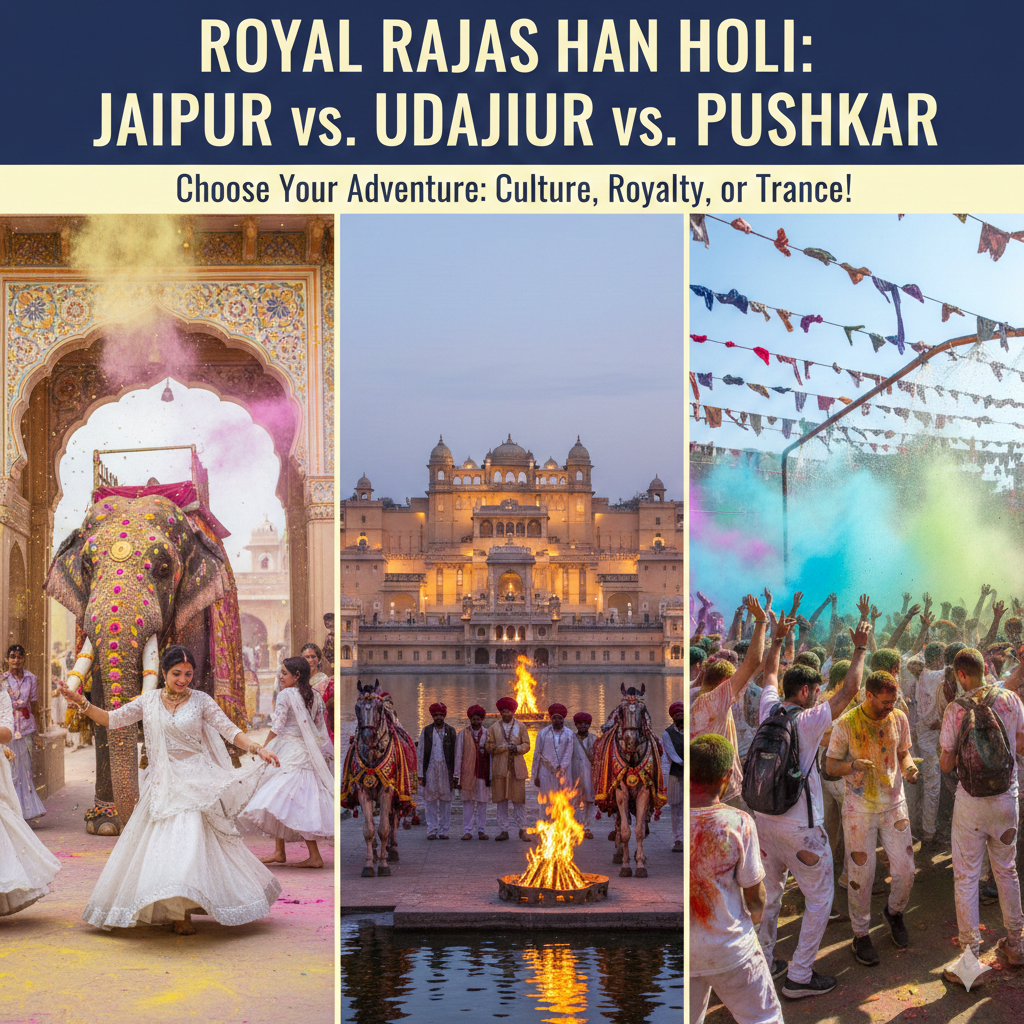
Holi in Rajasthan isn’t just a festival; it is a shift in the soul of the desert state. As the winter chill fades, the “Land of Kings” erupts into a kaleidoscope of colors, each city offering a distinct flavor of celebration. Whether you seek the regal grace of a king’s court, the high-octane energy of a global rave, or a balanced cultural immersion, Rajasthan has a destination for you.
In 2026, Holi falls on March 3rd (Holika Dahan) and March 4th (Dhulandi). If you are planning to visit, here is your ultimate guide to the “Royal Trinity” of Rajasthani Holi: Jaipur, Udaipur, and Pushkar.
Read Also:- Mathura & Vrindavan: The 7-Day Braj Holi Itinerary (2026)
1. Jaipur: The Pink City’s Cultural Grandeur
Jaipur offers a Holi that is perfectly balanced—structured enough for families and first-time travelers, yet vibrant enough to satisfy any thrill-seeker. Historically, the highlight was the Elephant Festival, where majestic pachyderms paraded in “Gaj Shringar” (jewelry and floral paint).
The Elephant Festival Update
In 2026, the celebration has evolved. While the large-scale “Elephant Festival” at the Polo Ground has seen changes due to animal welfare norms, Jaipur has replaced it with massive cultural festivals at Khasa Kothi and the City Palace. You will still see decorated elephants at private heritage properties and near Amber Fort, but the focus has shifted toward folk dances like Ghoomar and Kalbelia, puppet shows, and “Tamasha” (traditional folk theater).
Where to Celebrate
The City Palace remains the heart of royal celebrations. On the eve of Holi, the royal family leads the Holika Dahan bonfire. On the main day, the palace courtyards open for a sophisticated play of organic colors. For those wanting a more “local” feel without the chaos, heritage hotels like Narain Niwas or Diggi Palace host curated parties that blend traditional music with modern DJ sets.
The Vibes
Jaipur is “organized fun.” You can enjoy the madness of the streets in Johari Bazaar in the morning and retreat to a luxury brunch by the afternoon. It is the best place to witness the Dhulandi tradition, where the entire city turns a dusty shade of pink and gold.
2. Udaipur: The Regal Lake City Elegance
If you want to feel like a guest of the Maharana, Udaipur is your destination. Udaipur doesn’t just “play” Holi; it performs it. The city’s celebration is defined by the Mewar Royal Procession, which is arguably the most prestigious Holi event in India.
The Royal Procession
On March 3rd, 2026, the celebration begins at the City Palace. The current titular Maharana and the royal family lead a magnificent procession from the Shambhu Niwas Palace to the Manek Chowk. Expect rows of caparisoned horses, traditional musicians playing the Nagada (drums), and royal guards in ceremonial attire. The Holika Dahan here is a spiritual spectacle, with a massive bonfire reflecting off the stone walls of the palace.
Lake Pichola Festivities
The morning of March 4th brings a different charm. The celebrations move to the Ghats of Lake Pichola. At Gangaur Ghat, locals and tourists mingle as colors fly against the backdrop of the white palaces and the blue water. It is sophisticated, scenic, and surprisingly safe for solo travelers and couples.
The Vibes
Udaipur is for the “Luxury Traveler.” The energy is more about the beauty of the ritual than the intensity of the party. It is a photographer’s dream, offering a “slow-burn” festive experience that prioritizes heritage over high-volume music.
3. Pushkar: The Backpacker’s “Trance Holi”
Pushkar is the wild card of Rajasthan. This small, sacred town transforms into a massive, open-air dance floor. If Jaipur is a melody and Udaipur is a symphony, Pushkar is a heavy-bass trance track.
The “Kapda Phaad” Tradition
Pushkar is famous for its high-energy street parties, particularly in the Main Market Square. Here, thousands of travelers from across the globe gather for the “Trance Holi.” The “Kapda Phaad” (shirt-tearing) tradition is a local phenomenon where, in the heat of the dance and color, men playfully tear their shirts and hang them on overhead wires—a symbol of shedding the old and embracing the new.
The Global Gathering
Unlike the royal vibes of other cities, Pushkar is democratic. There are no VIP sections in the streets. You’ll find Israeli backpackers, European digital nomads, and local villagers all dancing to Psytrance and Bollywood remixes under giant “rain dance” sprinklers. The narrow lanes become rivers of liquid color, and the atmosphere is electric from 8:00 AM until the sun begins to set.
The Vibes
Pushkar is “Pure Adrenaline.” It is loud, crowded, and incredibly intense. Because Pushkar is a dry town (alcohol is officially prohibited), the “high” comes from the music, the Bhang Thandai (legal in specific government shops), and the sheer collective energy of thousands of people.
Quick Comparison Table
| Feature | Jaipur (Cultural) | Udaipur (Royal) | Pushkar (Backpacker) |
| Main Attraction | Folk Festivals & Khasa Kothi | Royal Procession & City Palace | Trance Party & Kapda Phaad |
| Crowd Type | Families & First-Timers | Couples & Luxury Seekers | Backpackers & Youth |
| Intensity | Moderate | Low to Moderate | Very High |
| Cost (Events) | ₹500 – ₹5,000 | ₹2,500 – ₹8,000 | Mostly Free (Streets) |
| Best For | Heritage & Photos | Tradition & Elegance | Party & Socializing |
Pros and Cons
Jaipur
- Pros: Well-connected; great shopping; safe, organized events.
- Cons: Can feel a bit “touristy”; traffic can be heavy.
Udaipur
- Pros: Most stunning backdrops; safe for women; deeply traditional.
- Cons: Very expensive hotel rates; City Palace tickets sell out months in advance.
Pushkar
- Pros: Unmatched energy; very budget-friendly; global social vibe.
- Cons: Extremely crowded; can be overwhelming for those with sensory issues.
Expert Review: Which one is for you?
“If you are visiting Rajasthan for the first time, start with Jaipur for a comfortable introduction. However, if you are a culture enthusiast who appreciates the ‘old world’ charm, Udaipur’s royal ceremony is unmissable. For the young at heart who want a bucket-list party experience, Pushkar is the only answer. Just remember: in Pushkar, your clothes will not survive!” — Travel Expert, Dream Trip Guide
Dos and Don’ts for Holi 2026
What to Do
- Apply Oil: Put coconut oil in your hair and on your skin before playing; it makes the color wash off much easier.
- Wear White: It’s the unofficial uniform. It makes the colors “pop” in your photos.
- Book Early: For 2026, hotels in Pushkar and Udaipur are already filling up. Book by December 2025.
- Use Organic Gulaal: Protect your skin and the environment by using herbal colors.
What NOT to Do
- Don’t Carry Electronics: Unless they are in a high-quality waterproof pouch, the colored water will find a way in.
- Don’t Play Alone: Always stay in a group, especially in the crowded streets of Pushkar.
- Don’t Force Color: If someone says “no,” respect it. Most people are there for fun, but consent is key.
- Don’t Drink and Drive: Rajasthan police are extra vigilant during Holi. Use local rickshaws or walk.
Read Also:- Varanasi Holi Guide: A Spiritual Celebration on the Ghats
