
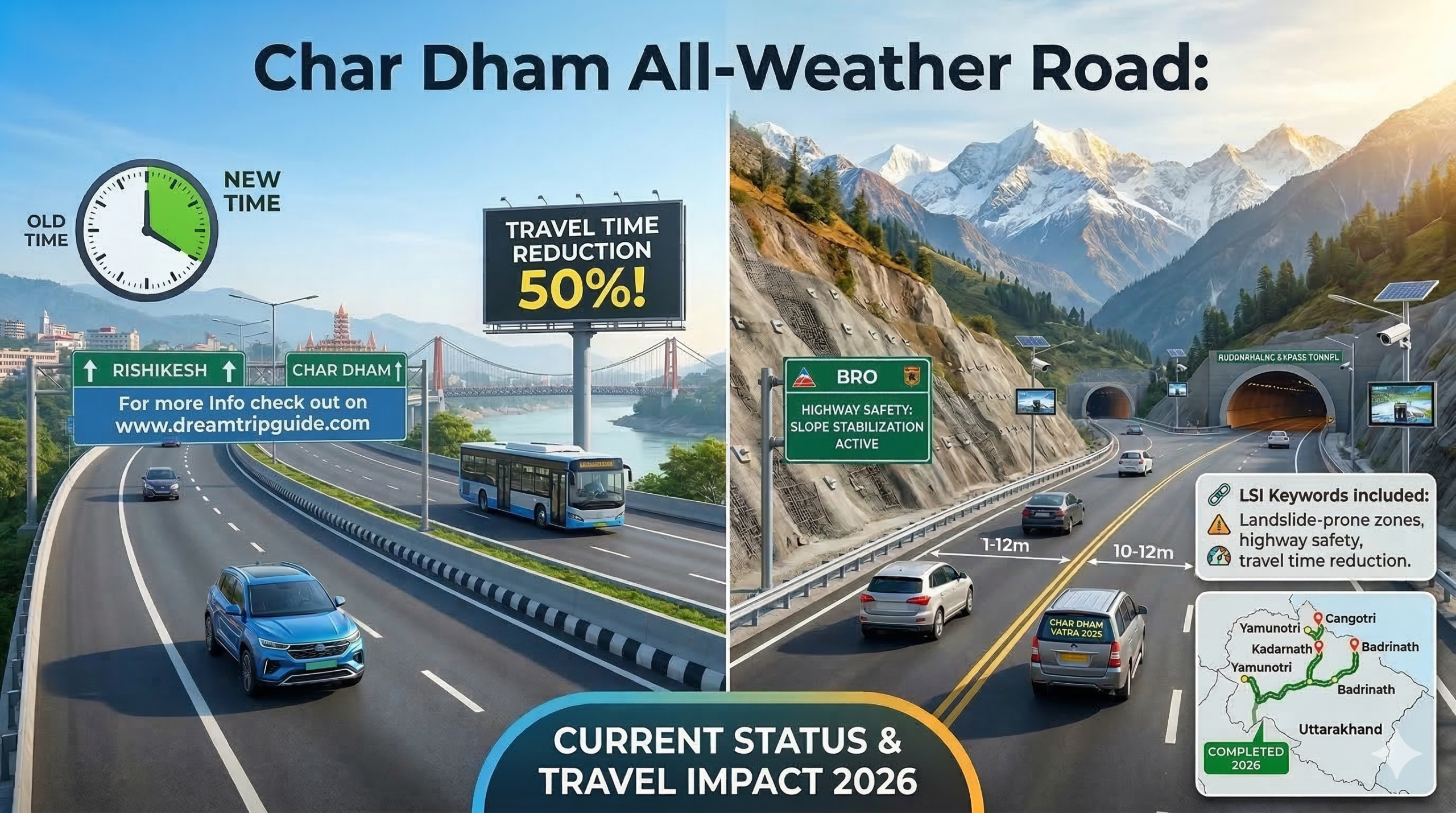
The year 2026 marks a historic turning point for the Char Dham Yatra. If you have ever dreamt of visiting Yamunotri, Gangotri, Kedarnath, and Badrinath, this is the year the “Himalayan commute” finally transforms. Gone are the days when reaching these shrines required 12-hour bone-rattling journeys on narrow, broken paths.
In this guide, we provide a comprehensive Char Dham road update 2026, covering the impact of the newly operational Delhi to Rishikesh expressway, the reality of landslide-prone zones, and how your travel time is about to be cut in half.
Read Also:- What to Pack for Kedarnath in May vs. October 2026
1. The Game Changer: Delhi to Dehradun/Rishikesh Expressway
The most significant impact on your 2026 pilgrimage happens before you even reach the mountains. As of February 2026, the Delhi-Dehradun Expressway is fully operational, and it is a total game-changer for pilgrims.
Massive Travel Time Reduction
Previously, the drive from Delhi to Rishikesh or Dehradun took anywhere from 5 to 7 hours due to heavy traffic in towns like Meerut, Muzaffarnagar, and Saharanpur. In 2026, you can zip through this distance in just 2.5 hours. This expressway isn’t just a road; it’s a high-speed corridor with a 100 km/h speed limit that bypasses all major city traffic.
Strategic Connectivity
The expressway features the Saharanpur-Roorkee-Haridwar spur, which connects directly to the gateway of the Char Dham. This means pilgrims from the National Capital Region (NCR) can now reach the base of the Himalayas by breakfast and start their mountain ascent on the very same day. For those who prefer a “spiritual weekend,” reaching Haridwar for the evening Aarti is now easier than ever.
Modern Amenities & Safety
The 210-km stretch includes wayside amenities every 30 km, EV charging stations, and smart parking for 3,000 vehicles. It also houses Asia’s longest wildlife elevated corridor (12 km), ensuring that while we travel faster, the local ecology remains undisturbed. However, quality comes at a price—be prepared for toll rates around ₹675 for a one-way trip.
2. Char Dham All-Weather Road: 2026 Status Update
The ambitious ₹12,000 crore Char Dham Pariyojana is nearing its final stages of completion in 2026. While most of the 825-km network is finished, some critical “strategic” and “ecologically sensitive” stretches are still under refinement.
Current Completion Status
As of March 2026, nearly 90% of the project is functional. The road widening to 10–12 meters has been completed on major stretches connecting Rishikesh to all four Dhams. The most recent focus has been on the Bhagirathi Eco-Sensitive Zone, where special permissions were granted in late 2025 to widen the road for national security and pilgrim safety.
New Tunnels and Bypasses
To avoid the most treacherous mountain bends, several tunnels have been opened. A major highlight is the planned 7-km twin-tube tunnel connecting Chaumasi to Sonprayag, which will eventually revolutionize the access to Kedarnath. Bypasses around congested towns like Rudraprayag and Srinagar have significantly reduced the “bottleneck effect” that used to cause 4-hour traffic jams during peak season.
All-Weather vs. Extreme Weather
While the project is called “All-Weather,” it is important to understand that the Himalayas are still alive and shifting. The roads are built to be resilient, featuring better drainage and slope stabilization, but “all-weather” does not mean “invincible” against extreme cloudbursts. However, the recovery time after a minor landslide has improved from days to just a few hours.
3. Highway Safety & Landslide-Prone Zones
Despite the wide, smooth tarmac, safety remains the top priority. The 2026 season sees more technology-driven safety measures than ever before, but the geography remains a challenge.
Identifying Landslide Hotspots
Widening roads in the Himalayas is a double-edged sword. While it makes travel faster, it also disturbs the slopes. Experts have identified over 125 vulnerable locations across the route.
- Rishikesh to Dharasu: This section remains a significant landslide hotspot due to exposed geological structures.
- Badrinath Highway (NH-7): The area near the Patalganga-Langsi Tunnel is still being monitored for “rock-cum-debris” avalanches.
- Gaurikund Road: The final stretch to the Kedarnath base is prone to soil erosion during heavy rains.
2026 Safety Innovations
The Uttarakhand government has implemented a “Digital Safety Shield” for the 2026 yatra:
- Slope Stabilization: Use of “Shotcreting” (spraying concrete) and heavy-duty steel nets to hold loose rocks in place.
- Real-time Monitoring: AI-powered cameras at landslide zones detect early movements and alert the nearest Border Roads Organization (BRO) post.
- Crash Barriers: Thousands of kilometers of new, reinforced crash barriers have been installed, replacing the old, unreliable stone walls.
Travel Fatigue: The Hidden Danger
With smoother roads, drivers tend to overspeed or skip rest stops. It is essential to remember that mountain driving requires 100% focus. Even on the “All-Weather” road, sharp curves and steep gradients remain.
4. Summary Table: Travel Impact 2026
| Feature | Pre-2024 Status | 2026 Status | Travel Impact |
| Delhi to Rishikesh | 6–7 Hours | 2.5 Hours | Saves 4+ hours; less fatigue. |
| Road Width | 5–7 Meters (Narrow) | 10–12 Meters (Double Lane) | Easier overtaking; fewer jams. |
| Pavement Quality | Frequent potholes | Paved shoulders/Premium bitumen | Smooth ride; suitable for sedans. |
| Monsoon Safety | Roads closed for days | Rapid response; tunnels open | Higher reliability for pilgrims. |
| Connectivity | Fragmented | Integrated Highway System | Direct access to all 4 Dhams. |
5. Pros, Cons, and Expert Review
Is the new road system perfect? Not quite. Here is a balanced look at the 2026 travel reality.
Pros and Cons
Pros:
- Massive Time Saving: You can now complete the entire Char Dham circuit in 8–10 days, compared to the traditional 12–14 days.
- Better Health: Reduced travel fatigue means fewer cases of altitude sickness and back pain for senior citizens.
- Economic Boost: Better roads have led to new, high-quality hotels and restaurants opening along the route.
Cons:
- Environmental Cost: Extensive tree felling and slope cutting have increased the frequency of minor landslides in certain zones.
- Higher Costs: Between expressway tolls and increased fuel/parking fees, the yatra has become more expensive.
- Overcrowding: Faster roads mean more people. Expect the shrines to be more crowded than ever in 2026.
Expert Review: A Geologist’s Perspective
“The Char Dham road project in 2026 is a masterpiece of engineering, but we must respect the ‘Main Central Thrust’ (MCT) of the Himalayas. While the roads are wide, the slopes above them are still adjusting. I advise pilgrims to prioritize ‘Safe Speed’ over ‘Top Speed’ and always check the daily landslide advisory before leaving their morning halt.” — Dr. S. Negi, Himalayan Geotechnical Expert
6. The “Do’s” and “Don’ts” for 2026 Travelers
What You Should Do:
- Register Early: Mandatory online registration is strictly checked at entry points like Haridwar and Rishikesh.
- Use Local Drivers: Even with better roads, local drivers understand the “rhythm” of the mountains and the current status of landslide zones.
- Carry a FASTag: The Delhi-Dehradun expressway and various mountain tolls are 100% digital.
- Check the Weather App: The Uttarakhand Govt’s official yatra app now provides live road status updates every hour.
What You Should Not Do:
- Don’t Drive at Night: Despite the “All-Weather” tag, night driving in the Himalayas is still restricted and dangerous due to falling rocks.
- Don’t Ignore “Sink Zones”: If you see a sign for a sinking zone, do not stop your vehicle there for photos.
- Don’t Commercialize Private Cars: Authorities in 2026 are strictly fining private vehicles used for commercial tours without “Green Cards.”
- Don’t Forget Buffers: Always keep 1–2 “buffer days” in your itinerary. A 3-hour landslide clearance can still happen.
Read Also:- eSwasthya Dham: Managing Your Health via ABHA Card in 2026
Conclusion
The Char Dham road update 2026 is overwhelmingly positive. The combination of the Delhi-Rishikesh expressway and the widened Himalayan highways has made the sacred journey accessible to millions who previously feared the arduous travel. However, the mountain remains the master—travel with respect, stay informed, and enjoy the new, smoother path to the divine.
Would you like me to help you calculate the total toll and fuel costs for a Char Dham road trip from Delhi in 2026?
