
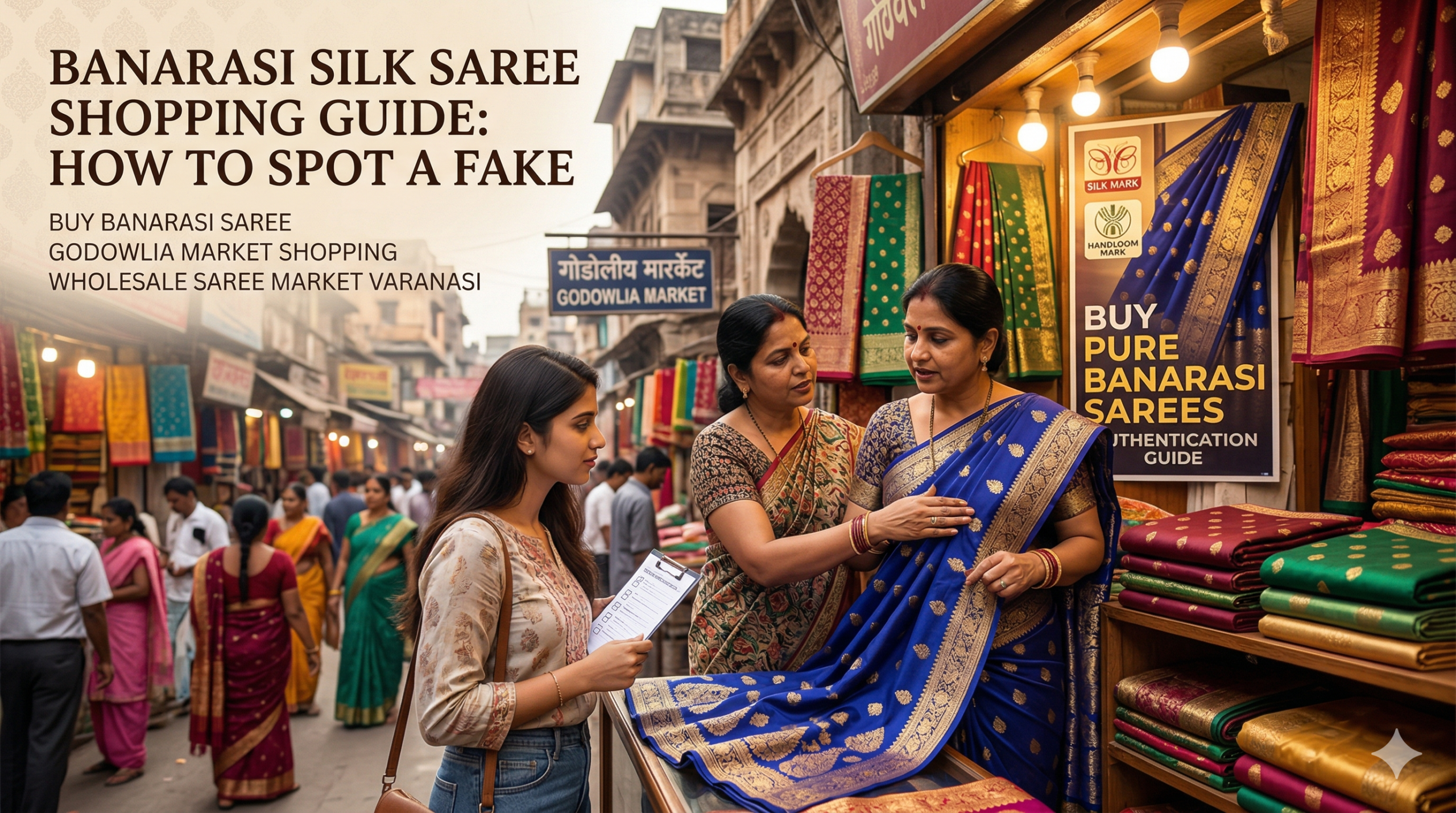
Buying a Banarasi silk saree is more than just a purchase; it is an investment in a piece of Indian heritage. Known for their opulent gold and silver brocade, or zari, and fine silk, these sarees have been the crown jewel of Indian weddings for centuries. However, as the demand grows, so does the market for clever imitations. Whether you are navigating the narrow lanes of the Godowlia market or exploring the wholesale saree market in Varanasi, being armed with the right knowledge is essential to avoid being duped by powerloom “art silk” masquerading as handwoven masterpieces.
Also Read:- Top Weekend Getaways Near Me: Best 2-Day Trips & Budget
The Heritage of Banarasi Silk: Why Authenticity Matters
The Banarasi saree is a marvel of human skill. Traditionally woven in Varanasi (Benaras), these sarees are categorized by the motifs, the weight of the silk, and the purity of the zari. In 2026, the value of an authentic handwoven Banarasi has surged, not just as a fashion statement but as a collectible.
Authentic sarees are protected by a Geographical Indication (GI) tag, which ensures that the product was actually made in the Banaras region using traditional methods. When you buy a fake, you aren’t just getting inferior fabric; you are missing out on the breathability, the “fall,” and the longevity that real silk offers. A genuine silk saree can last for generations, often becoming a family heirloom. Synthetic versions, while shiny at first, lose their luster quickly and can feel prickly or overly hot against the skin.
Comparison: Real vs. Fake at a Glance
| Feature | Authentic Banarasi Silk | Fake/Synthetic (Art Silk) |
| Material | 100% Pure Mulberry Silk | Polyester, Nylon, or Viscose |
| Zari Quality | Real Gold/Silver or High-Grade “Tested” Zari | Lacquered Plastic or Copper-coated thread |
| Reverse Side | Floats of threads and “hairy” appearance (Handloom) | Smooth, uniform finish (Powerloom/Machine) |
| Scent Test | Smells like burnt hair when a thread is lit | Smells like burnt plastic or chemicals |
| Weight | Substantial and heavy due to metal zari | Lightweight or stiffly heavy with starch |
| Certification | Silk Mark & Handloom Mark/GI Tag | None or counterfeit stickers |
How to Spot a Fake: The 5-Minute Inspection Guide
You don’t need to be a textile expert to identify a genuine saree. The “5-minute check” involves your senses: sight, touch, and smell.
- The Reverse Side Check: This is the “gold standard” of testing. Turn the saree over. A hand-knotted, hand-woven Banarasi will have floats of silk and zari threads across the back. You will see the “imperfections” of human hands—small knots and loose ends. A machine-made fake will be perfectly smooth on the back because the patterns are printed or mechanically woven with surgical precision.
- The Burn Test: If the shopkeeper allows it, pull a single thread from the fringe. Burn it. Pure silk will curl away from the flame and smell like burning hair. It leaves a powdery black ash that crumbles. Synthetic fakes will melt into a hard plastic bead and smell like chemicals.
- The Touch Test: Real silk is sensitive to temperature. If you rub the fabric with your palm, it should feel warm after a few seconds. If it stays cold or feels slippery and “rubbery,” it is likely synthetic.
Expert Review: The Artisan’s Perspective
“A real Banarasi saree ‘breathes.’ When you drape it, the weight is distributed evenly because of the density of the silk. Machine-made sarees often use ‘stiffeners’ to mimic this weight, but they lack the fluid drape of a handloom piece. Always look for the ‘Silk Mark’—it is the only legal guarantee of fiber purity in India.” — Master Weaver, Varanasi.
Exploring the Wholesale Saree Market in Varanasi
Varanasi is home to several specialized markets. While Godowlia is the most famous for tourists, those looking for wholesale rates often head to Chetganj or Madanpura. These areas are the heart of the weaving community. In the wholesale market, you aren’t just buying from a retailer; you are often buying from a “Gaddi” (a traditional wholesale house).
Shopping in the wholesale sectors requires a different approach. You won’t find fancy air-conditioned showrooms here. Instead, you sit on white floor cushions while weavers display stacks of “Katan” (pure silk), “Organza,” and “Georgette” Banarasis. Prices here can be 30% to 50% lower than retail showrooms in Delhi or Mumbai, but the risk of “mixed” fabric is also present. Always ask for the “Silk Mark” even in wholesale shops.
Pros and Cons of Wholesale Markets
Pros:
- Massive Variety: Access to thousands of designs not yet in retail.
- Direct Pricing: Elimination of the middleman markup.
- Customization: Some wholesalers allow you to order specific colors if you have 10-15 days.
Cons:
- Overwhelming: The sheer volume of shops can be confusing.
- Aggressive Touts: Beware of rickshaw pullers who insist on taking you to “their uncle’s shop”—they get a 20% commission added to your bill.
- No Return Policy: Most wholesale deals are final.
Godowlia Market: The Heart of the Shopping Experience
Godowlia Market is the most iconic shopping destination in Varanasi. Located near the Dashashwamedh Ghat, it is a bustling hub where the old world meets the new. This is where most tourists end up, and for good reason: the proximity to the Ganga makes it convenient. However, because of the high footfall, it is also the place where “art silk” (fake silk) is most commonly sold to unsuspecting buyers.
In Godowlia, you will see sarees starting from ₹1,000 and going up to ₹1,00,000. Note: A genuine pure silk Banarasi will rarely cost less than ₹10,000–₹12,000 in 2026. If a shop in Godowlia offers you a “Pure Silk” saree for ₹3,000, it is a blend or a high-quality polyester.
What to Do and What NOT to Do
| What to Do | What NOT to Do |
| Do look for the Silk Mark Organization of India (SMOI) hologram. | Don’t follow rickshaw or auto drivers to “factory outlets.” |
| Do check the “pallu” (the decorative end) for intricate zari work. | Don’t buy under yellow or dim lighting; check in natural light. |
| Do haggle. Even in big shops, a 10-15% discount is standard. | Don’t rush. A good purchase takes at least 45 minutes of inspection. |
| Do ask about the “weaving time”—a real saree takes 15-30 days. | Don’t assume a heavy saree is real; metal zari adds weight, but so does starch. |
Understanding Price Points: What Are You Paying For?
The price of a Banarasi saree is determined by three factors: the silk, the zari, and the weaving technique.
- Katan Silk: This is pure silk without any twists. It’s the most traditional and expensive.
- Zari Types: “Real Zari” uses silver thread electroplated with gold. “Tested Zari” is copper-coated and is much cheaper but still looks beautiful. “Imitation Zari” is plastic and will turn black/green within a year.
- Techniques: Kadwa (where motifs are woven individually) is more expensive than Phekwa (where threads run across the width).
Shopping Tips for 2026
In recent years, “Semi-Pars” (Semi-Pure) sarees have become popular. These are a mix of silk and synthetic fibers. They look 90% like the real thing and are great for budget weddings, but a transparent seller will tell you they are “Semi.” Always ask: “Is this pure silk (tana-bana) or mixed?”
Final Checklist for Your Varanasi Shopping Trip
Before you finalize your purchase in the wholesale saree market of Varanasi, run through this final checklist:
- The GI Tag: Does the shop have a registration for GI products?
- Drape Test: Does the saree sit well on the shoulder? Pure silk is soft; fakes are springy or stiff.
- The Plain Silk Patch: On the inner end of the saree (the part that is tucked in), there should be a few inches of plain silk. If the design starts from the very edge, it’s often a sign of machine-cut mass production.
- Water Test: Pure silk is highly absorbent. A tiny drop of water should disappear into the fabric instantly. On synthetic silk, it will often bead up.
