
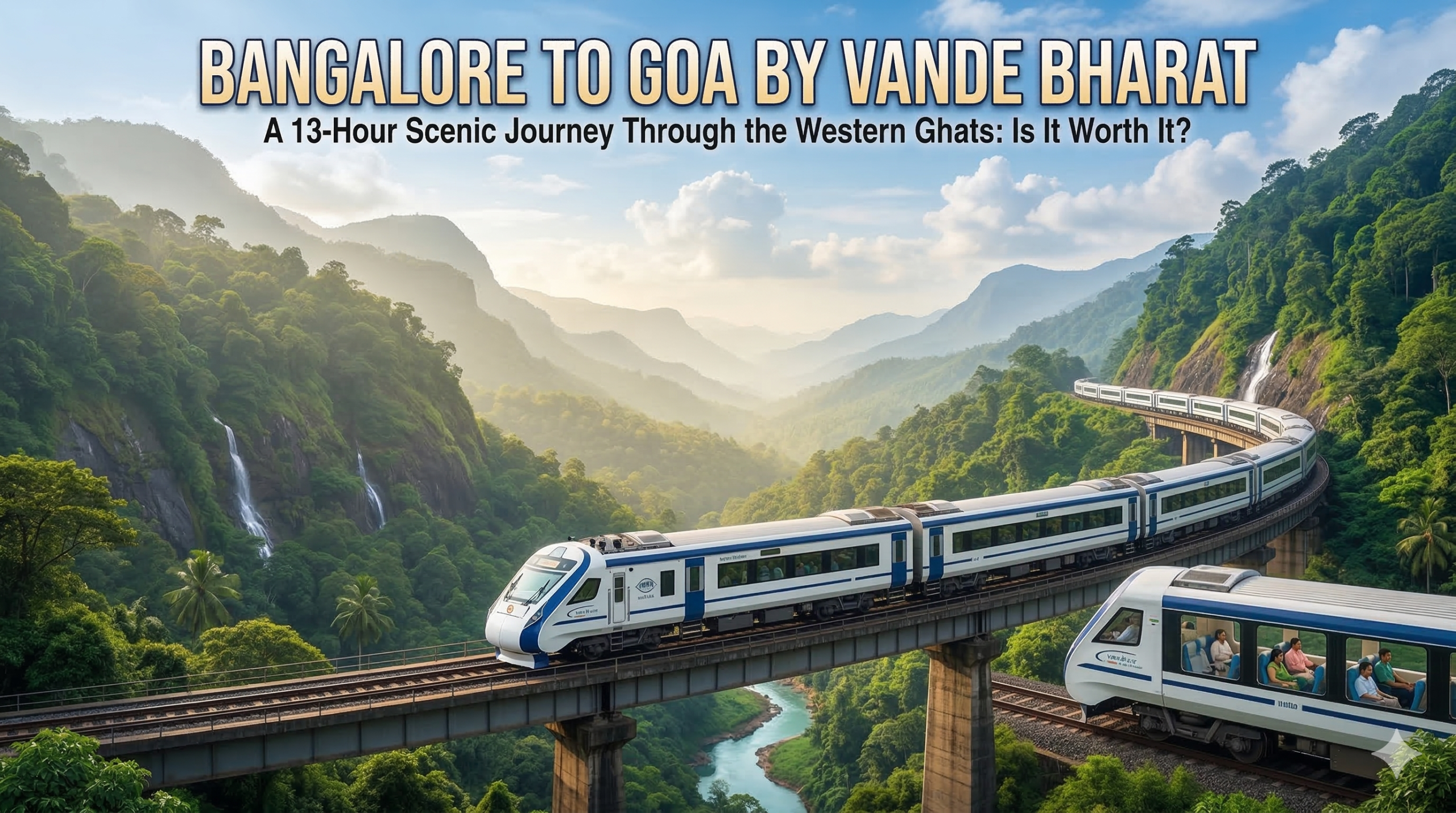
Traveling from the tech corridors of Bangalore to the sun-soaked beaches of Goa is a rite of passage for every South Indian traveler. Traditionally, this meant a 1-hour flight or a grueling 12-hour overnight bus. However, the introduction of the Bangalore to Goa Vande Bharat Express (Yesvantpur–Madgaon) has shifted the conversation toward “Slow Travel.”
If you are wondering whether a 13-hour journey on a high-speed train is worth it, this guide breaks down the schedule, the scenery, and the experience for the 2026 season.
Read Also:- 5 Best Vande Bharat Routes from Bangalore for a Quick Weekend Escape
1. The Route: Why 13 Hours for 700 Kilometers?
The Yesvantpur–Madgaon route is one of the most unique in the Vande Bharat network. While Vande Bharats on the plains of North India often cruise at 130 km/h, this specific journey is a different beast altogether. The train covers roughly 700 km, passing through Hassan, Sakleshpur, and the coastal hub of Mangaluru (via the Padil bypass) before entering Goa.
The “Speed Paradox” of the Western Ghats
The primary reason for the 13-hour duration is the Sakleshpur–Subrahmanya Road Ghat section. This 55-km stretch is one of the most challenging railway terrains in India. In 2026, even with electrification and infrastructure upgrades, safety protocols limit the speed here to 30–40 km/h. The train isn’t “slow” because of lack of power; it’s slow to ensure safety through 57 tunnels and over 100 bridges that carve through the mountains.
A Masterclass in Slow Travel
For the modern traveler, this 13-hour window is being rebranded as the ultimate “Slow Travel” experience. Instead of a dark overnight bus journey, the Vande Bharat offers a front-row seat to the Western Ghats’ biodiversity. You aren’t just commuting; you are sightseeing through the “Green Route” from the comfort of an ergonomic, air-conditioned chair car.
| Feature | Details (March 2026) |
| Origin Station | Yesvantpur Junction (YPR), Bangalore |
| Destination Station | Madgaon Junction (MAO), Goa |
| Average Speed | ~50 km/h (dropping to 30 km/h in Ghats) |
| Frequency | 6 Days a week (Except Tuesdays) |
| Intermediate Stops | Hassan, Sakleshpur, Subrahmanya Road, Padil, Udupi |
2. The Experience: Comfort vs. Traditional Trains
When we talk about the Bangalore to Goa Vande Bharat, we aren’t comparing it to the local passenger trains. We are comparing it to the high-pressure environment of airports and the back-breaking jolts of sleeper buses.
On-Board Amenities
The 2026 rakes feature improved Executive Class (EC) and Chair Car (CC) seating. The Executive Class offers 180-degree rotating seats, allowing you to face the window directly as the train snakes through the misty forests of Sakleshpur. The large panoramic windows are a massive upgrade over the small, often scratched windows of the older Express trains.
Food and Hygiene
One of the highlights is the curated catering. Passengers are served breakfast shortly after leaving Yesvantpur, a heavy lunch near Mangaluru, and high tea as the train enters the Konkan region. The bio-vacuum toilets and “odour control” systems—standard in Vande Bharat—make a 13-hour journey significantly more hygienic than any other rail option on this route.
The Silent Revolution
The Vande Bharat is a self-propelled trainset, meaning it doesn’t have a loud locomotive at the front. The cabin is remarkably quiet. This “silent” movement, combined with the lack of jerks during acceleration, makes it an ideal “work-from-train” environment for the first few hours before the scenery becomes too distracting to ignore.
3. Comparing the Alternatives: Flight, Bus, or Rail?
Is the Vande Bharat the best way? It depends on your priority. If you value time above all else, the flight is unbeatable. But if you value the journey, the Vande Bharat wins.
Flight vs. Vande Bharat
A flight takes 1.5 hours, but when you add the 2-hour commute to Kempegowda International Airport (BLR), 2 hours for check-in, and the 1-hour drive from North Goa (MOPA) to your resort, you are already at 6–7 hours. The Vande Bharat takes double that time but offers 100% relaxation and zero “airport anxiety.”
Bus vs. Vande Bharat
Overnight buses are the most popular choice for budget travelers. However, the winding roads of the Ghats at night are notorious for motion sickness. The Vande Bharat provides a stable, jerk-free ride with ample legroom—something you won’t find even in a premium multi-axle Volvo bus.
| Mode of Travel | Total Time (Door-to-Door) | Comfort Level | Cost (Approx.) |
| Vande Bharat (CC) | 13.5 Hours | High | ₹1,500 – ₹1,800 |
| Vande Bharat (EC) | 13.5 Hours | Ultra-High | ₹2,800 – ₹3,200 |
| Flight | 6 – 7 Hours | Medium | ₹4,500 – ₹8,000 |
| Overnight Bus | 12 – 14 Hours | Low/Medium | ₹1,200 – ₹2,500 |
4. Pros, Cons, and Expert Review
Before you book your ticket on the Yesvantpur–Madgaon route, let’s weigh the practicalities of 2026 travel.
Pros and Cons
| Pros | Cons |
| Spectacular Views: Best way to see the Dudhsagar-adjacent valley and the Ghats. | Long Duration: 13 hours is a full day of travel; you lose one “holiday day.” |
| Gourmet Catering: High-quality meals included in the ticket. | Day Journey Only: Unlike sleeper trains, you can’t sleep your way through the trip. |
| Punctuality: Vande Bharat is prioritized by controllers over other trains. | Connectivity: Yesvantpur is far for residents of East/South Bangalore. |
Expert Review: The Travel Blogger’s Take
“The Bangalore-Goa Vande Bharat is not a ‘fast train’ in the traditional sense; it is a luxury cruise on tracks. If you are a photographer or a nature lover, the 3-hour stretch through the Sakleshpur Ghats is worth the entire ticket price alone. However, for business travelers or those with only a 48-hour weekend, the flight remains the logical choice. Book the Vande Bharat for the return leg when you want to unwind after a hectic Goa trip.” — Khushi Thakur, Founder of Dream Trip Guide
5. Survival Guide: What to Do and What Not to Do
To make the most of your 13-hour journey, follow these updated tips for 2026.
What to Do:
- Book the Window Seat: In Chair Car, try to get a ‘K’ or ‘A’ seat. In Executive Class, the rotating seats make this less of an issue.
- Carry a Power Bank: While there are charging points, 13 hours of heavy phone usage for photos/videos will drain your battery.
- Download Content: Mobile network is virtually non-existent in the tunnels of the Western Ghats. Download your movies or maps beforehand.
- Stretch Often: Use the wide aisles to walk every 2 hours to avoid stiffness.
What Not to Do:
- Don’t Expect High-Speed WiFi: Despite the “Smart Train” branding, the satellite/onboard WiFi is often patchy in the mountain regions.
- Don’t Skip the Morning Meal: The breakfast served after Yesvantpur is usually the best meal of the trip.
- Don’t Carry Excess Luggage: The overhead racks are spacious, but Vande Bharat is not designed for the heavy “trunk-style” luggage common in sleeper classes.
- Don’t Forget Your Camera: You will pass through some of India’s most Instagrammable railway bridges. Keep your lens clean!
The Bangalore to Goa Vande Bharat is a bold experiment in Indian rail travel. It asks you to slow down and enjoy the scenery. If you have the luxury of time, it is undoubtedly the most beautiful way to reach the coast.
Read Also:- The Ultimate Guide to Vande Bharat Destinations from Bangalore
Would you like me to generate a 13-hour itinerary for this journey, including the best landmarks to look out for through your window?
