

India is a sensory explosion of color, culture, and history. For a solo backpacker, the chaos is part of the charm. But when you are traveling with children or elderly parents, the priorities shift. You need safety, comfort, and predictability. You want to avoid the scorching heat that leads to cranky toddlers and the heavy monsoons that keep you trapped indoors.
This guide acts as your ultimate Dream Trip Guide, breaking down the complex Indian climate to help you decide the Best time to visit india with family. From the snow-capped peaks of the Himalayas to the tropical backwaters of Kerala, here is how to plan a memorable and stress-free vacation.
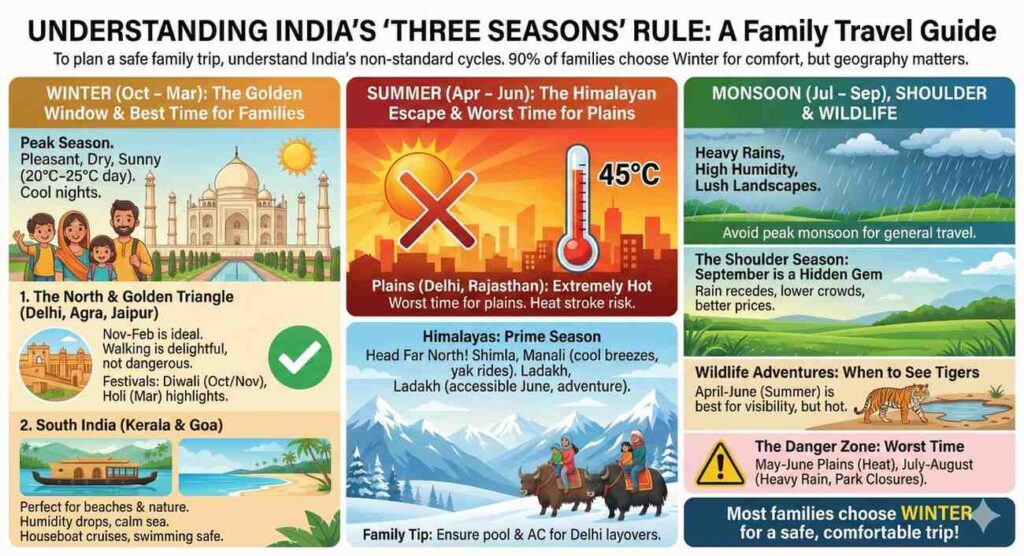
Understanding India’s “Three Seasons” Rule
To plan a safe family trip, you must first understand that India doesn’t follow the standard four-season cycle of the West. Broadly, the country operates on three distinct cycles:
- Winter (October to March): The peak tourist season. Pleasant, dry, and sunny.
- Summer (April to June): Extremely hot in the plains; perfect for the mountains.
- Monsoon (July to September): Heavy rains, high humidity, and lush landscapes.
For 90% of families, the Best time to visit India is during the winter months. However, India is a subcontinent, meaning the weather in the north can be vastly different from the south.
The Golden Window: Winter (October – March)
Why it is the Best Time to Visit India with Family
If you are looking for the definitive answer to “When should we go?”, this is it. The months between October and March offer the most comfortable climate for children. The days are sunny but not scorching (ranging from 20°C to 25°C in the day), and the nights are cool.
1. The North & The Golden Triangle
For most first-timers, a family trip revolves around Delhi, Agra, and Jaipur. The Best time to visit India Golden Triangle is undoubtedly November to February.
- Why for Families? You will be doing a lot of walking. exploring the sprawling Amber Fort in Jaipur or standing in line at the Taj Mahal is delightful in December but physically dangerous for children in May when temperatures hit 45°C.
- Festivals: This period hosts Diwali (Festival of Lights) in October/November and Holi (Festival of Colors) in March. Celebrating these with a local family can be a highlight for kids.
2. South India (Kerala & Goa)
If your family loves beaches and nature, the south is perfect in winter. The humidity drops, and the Arabian Sea is calm.
- Kerala: A houseboat cruise in Alleppey is magical in December or January. The weather is cool enough to sleep on the deck.
- Goa: While December is crowded, it is the perfect beach weather. The sea is safe for swimming, and all beach shacks are open.
The Summer Escape: April to June
Heading to the Himalayas
Many travelers assume summer is the Worst time to visit India. While that is true for the plains (Delhi, Rajasthan), it is actually the prime season for the Himalayas.
If your school holidays fall in May or June, do not despair. Head North—far North.
- Shimla & Manali: These hill stations offer colonial charm and cool breezes. Kids can enjoy yak rides, apple picking, and easy treks.
- Ladakh: This high-altitude desert is inaccessible in winter due to snow. June is the perfect time to visit for older children interested in adventure, monasteries, and stunning landscapes.
Family Tip: If traveling in summer, ensure your hotel has a swimming pool and 24/7 air conditioning if you have a layover in Delhi.
The Shoulder Season: Why September is a Hidden Gem
There is a common misconception that you must avoid the monsoon entirely. However, the tail end of the monsoon offers a unique opportunity. The Best time to visit india in september is a secret weapon for savvy family travelers.
Why Choose September?
- Lush Greenery: After three months of rain, places like Kerala and Rajasthan are verdant green. The desert literally blooms.
- Lower Crowds: The peak winter rush hasn’t started. You can get photos of your family at the Taj Mahal without fighting thousands of people.
- Better Prices: Luxury hotels (Palaces in Rajasthan or Resorts in Kerala) often run “monsoon end” discounts, making a luxury family trip affordable.
- Weather: By late September, the rains in North India (Rajasthan/Delhi) have mostly stopped, leaving behind clean air and washed monuments.
Caveat: Avoid the heavy rainfall regions like Mumbai or the Northeast in September, as they may still be experiencing the retreat of the monsoon.
Wildlife Adventures: When to See Tigers
For many children, the Jungle Book comes alive in India. If your priority is wildlife, the timing shifts slightly.
The Best time to visit India to see tigers is actually during the hotter months of April, May, and early June.
- The Logic: In the winter, water is everywhere in the jungle, so tigers stay hidden deep in the foliage. As the heat rises in April and May, the small water holes dry up. Tigers and leopards are forced to come out to the few remaining large water bodies to drink, often 2-3 times a day.
- The Trade-off: It will be hot. Very hot.
- Family Compromise: If traveling with young kids who can’t handle the heat, aim for March. It is the sweet spot—warm enough to dry out the grass for better visibility, but cool enough to enjoy the open-top jeep safari.
Top Parks for Families:
- Ranthambore (Rajasthan): easiest to combine with the Golden Triangle.
- Jim Corbett (Uttarakhand): offers overnight stays inside the park.
- Kanha (Madhya Pradesh): The inspiration for The Jungle Book.
The Danger Zone: The Worst Time to Visit India
Honesty is key for a safe family trip. There are specific months you should strictly avoid unless you are visiting specific high-altitude regions.
The Worst time to visit India for a standard sightseeing tour (Delhi/Agra/Jaipur/Mumbai) is May and June.
- Heat Stroke Risk: Temperatures regularly exceed 45°C (113°F). Dehydration is a serious risk for children.
- The “Loo”: This is a dry, hot wind that blows across North India in summer. Exposure can make children instantly sick.
Similarly, the peak monsoon months of July and August can be challenging.
- Hygiene Issues: Waterborne diseases are more common during the rains.
- Travel Disruption: Flights get cancelled, and traffic in cities like Mumbai or Delhi can gridlock due to waterlogging.
- Park Closures: Most National Parks (tiger reserves) are closed during the monsoon for breeding season.
Regional Cheat Sheet for Families
To make your planning easier, here is a quick breakdown based on popular family destinations:
| Region | Best time to visit india with family | Avoid | Why? |
| Golden Triangle (Delhi-Agra-Jaipur) | Oct – Mar | May – Jun | Sightseeing involves walking outdoors; heat is dangerous in summer. |
| Kerala (Backwaters & Tea) | Sep – Mar | Jun – Jul | Heavy monsoon rains can keep you stuck in the hotel. |
| Goa (Beaches) | Nov – Feb | Jun – Aug | Rough seas make swimming dangerous; beach shacks close in monsoon. |
| Himalayas (Ladakh/Shimla) | Apr – Jun | Jan – Feb | Winters are too cold; snow blocks roads. Summer is perfect. |
| Wildlife Parks (Ranthambore) | Mar – Apr | Jul – Sep | Parks close in monsoon. Apr-May is best for sightings but hot. |
LSI & Semantic Planning: Ensuring Comfort & Safety
When using a Dream Trip Guide approach to planning, weather isn’t the only factor. Here are “Semantic” factors—logistics that impact the “feeling” of the weather.
1. Acclimatization
If you arrive in Delhi in May, the heat shock can be intense. If you arrive in January, the smog/fog can be surprising. Plan a “rest day” on arrival before rushing to the Taj Mahal.
2. Hydration & Hygiene
Regardless of the season, the rule of thumb for safe family travel is: Boiled or Bottled.
- In the Worst time to visit India (Summer), hydration is life-saving. Carry Oral Rehydration Salts (ORS) for kids.
- In the Monsoon, avoid raw salads and street food to prevent tummy bugs.
3. Transport Choices
- Winter: Trains are romantic but often delayed by dense fog in North India (especially December/January). A private car is more reliable.
- Summer: Ensure your vehicle has a powerful AC. Request an “Innova Crysta” (a specific car model) as it has the best rear-seat air conditioning for kids.
Detailed Month-by-Month Family Planner
October: The Festive Start
The monsoon leaves, and the air cools.
- Highlight: Diwali preparations.
- Verdict: Great for Golden Triangle and Himalayas foothills.
November: The Peak Begins
The weather is crisp.
- Highlight: Pushkar Camel Fair (kids love the camels!).
- Verdict: Excellent for the whole country.
December & January: Peak Winter
Pack woolens for the North.
- Highlight: Christmas in Goa or exploring Rajasthan forts without sweating.
- Verdict: Most popular, but most expensive. Book early.
February: The Sweet Spot
Warmer than January, but not yet hot.
- Highlight: The Desert Festival in Jaisalmer.
- Verdict: Arguably the absolute best month for a multi-region trip.
March: The Colorful Transition
The heat starts creeping in by mid-March.
- Highlight: Holi Festival (Safety tip: Celebrate at your hotel or a private event with kids, not on the streets).
- Verdict: Last chance for the South and Golden Triangle before the heat.
April: Wildlife & Mountains
- Highlight: Best time to visit India to see tigers.
- Verdict: Head to the hills or the jungles.
May & June: The Furnace
- Verdict: Avoid the plains. Go to Ladakh, Kashmir, or Sikkim.
July & August: The Rains
- Verdict: Good for Ayurveda retreats in Kerala, bad for general sightseeing.
September: The Shoulder Season
- Highlight: Best time to visit india in september for budget luxury travelers.
- Verdict: Lush landscapes and great deals.
Final Thoughts: Designing Your Dream Trip
India is a destination that rewards planning. By choosing the Best time to visit india with family, you eliminate the biggest stress factors heat and rain.
- For the Classic Route: Stick to the winter months (Nov-Feb).
- For Adventure: Tackle the Himalayas in Summer (Apr-Jun).
- For Wildlife: Brave the rising heat of March/April for the best tiger photos.
- For Value: Consider the Best time to visit india in september to mix luxury stays with lower costs.
Ultimately, there is no single “wrong” time, only the wrong place at the wrong time. With this Dream Trip Guide, you can navigate the seasons and ensure your family vacation is filled with wonder, not weather worries.
Here is the detailed Family Trip Planner Table, including distances from Delhi, estimated costs converted from USD to INR, and key family-friendly activities.
Exchange Rate Used: $1 USD ≈ ₹86 INR. Note: Costs are estimated for a Family of 4 (2 Adults + 2 Kids) for a standard trip duration.
India Family Trip Planner: Distance, Cost & Activities
| Region / Trip | Best Time (Family) | Travel from Delhi (Distance/Time) | Est. Budget Cost (3-Star) (Family of 4) | Est. Luxury Cost (5-Star) (Family of 4) | Top Family Activity |
| Golden Triangle (Delhi-Agra-Jaipur) | Oct – Mar | ~750 km Circuit (4-5 hrs drive between cities) | $800 – $1,200 (₹68,800 – ₹1,03,000) | $2,500 – $4,000 (₹2,15,000 – ₹3,44,000) | Taj Mahal Visit Kids love the Tonga (horse cart) ride to the gate. |
| Kerala (Munnar & Alleppey) | Sep – Mar | Flight: 3h 15m (Delhi to Cochin) | $1,000 – $1,500 (₹86,000 – ₹1,29,000) | $3,000 – $5,000 (₹2,58,000 – ₹4,30,000) | Houseboat Cruise Sleep on a boat in the backwaters. |
| Ranthambore (Tiger Safari) | Mar – Apr (Best Visibility) | ~380 km (Train: 5 hrs / Car: 6 hrs) | $600 – $900 (₹51,600 – ₹77,400) | $1,800 – $2,500 (₹1,54,800 – ₹2,15,000) | Jungle Safari Spotting Tigers in an open Jeep (Gypsy). |
| Shimla / Manali (Himalayas) | Apr – Jun (Summer Escape) | ~340 km (Car: 8-9 hrs / Toy Train) | $500 – $800 (₹43,000 – ₹68,800) | $1,500 – $2,200 (₹1,29,000 – ₹1,89,000) | Toy Train Ride UNESCO World Heritage train ride in Shimla. |
| Goa (Beaches) | Nov – Feb | Flight: 2h 40m (Delhi to Goa) | $900 – $1,300 (₹77,400 – ₹1,11,800) | $2,800 – $4,500 (₹2,40,800 – ₹3,87,000) | Water Sports Banana boat rides and dolphin watching. |
Activity Price List (Detailed Breakdown)
Here are the specific costs for the “Must-Do” activities mentioned above.
| Activity | Location | Cost (USD) | Cost (INR) | Details |
| Taj Mahal Entry | Agra | $15 (Foreigner) $0.60 (Indian) | ₹1,300 ₹50 | Free for children under 15 years. |
| Tiger Safari (Gypsy) | Ranthambore | $60 – $75 per person | ₹5,000 – ₹6,500 | Price for foreigners. Book 3 months in advance. |
| Houseboat Stay | Kerala (Alleppey) | $120 – $250 per night | ₹10,000 – ₹22,000 | Includes all meals (Lunch, Dinner, Breakfast). |
| Ski Pass (Phase 1) | Gulmarg (Kashmir) | $12 per day | ₹1,000 | Gondola ride to the snow slopes. |
| Amber Fort Elephant | Jaipur | $15 (for 2 people) | ₹1,100 | Morning ride up to the fort. |
| Rickshaw Ride | Delhi (Chandni Chowk) | $2 – $4 | ₹200 – ₹350 | Fun ride through the narrow markets. |
Quick Tips for Families
- Kids enter Free: At almost all monuments in India (like Taj Mahal), children under 15 enter for free (or a nominal fee).
- Safari Booking: For Ranthambore, you must book the “Gypsy” (small jeep) 90 days in advance. The “Canter” (big bus) is less fun for kids.
- Flight Costs: Domestic flights (Indigo/Air India) average $60 – $100 (₹5,000 – ₹8,500) per person one-way if booked early.
Frequently Asked Questions: Traveling India with Family
1. Is street food safe for my children?
Answer: Generally, no. It is best to avoid street food for young children as their stomachs may not be accustomed to the local water and spices.
- Recommendation: Stick to freshly cooked, piping hot food from busy restaurants or your hotel. Avoid cut fruits, salads, and anything with ice sold on the street.
2. Do I need to bring a car seat for my toddler?
Answer: Yes, highly recommended.
- Reality: Most standard taxis and Uber/Ola cars in India do not provide car seats, and rear seatbelts are sometimes tucked away or non-functional in older budget cars.
- Solution: If you book a private tour (luxury/mid-range), request a car with working rear seatbelts explicitly. Bring a portable travel car seat or a “mifold” grab-and-go booster for ease.
3. What should I do if my child gets sick in India?
Answer: Do not panic; medical care in major cities is world-class.
- Healthcare: Private hospital chains like Apollo, Max, and Fortis in cities like Delhi, Mumbai, and Bangalore offer excellent pediatric care comparable to the West.
- Pharmacy: Pharmacies are open late and widely available. Carry a basic kit with you (ORS, fever reducers, anti-allergy meds) for minor issues.
4. Can I find diapers and baby food easily?
Answer: Yes, in cities and tourist hubs.
- Availability: International brands like Pampers, MamyPoko, Huggies, Cerelac, and Gerber are available in supermarkets and chemists in Delhi, Jaipur, Goa, and Kerala.
- Tip: If you are heading to remote areas (like a desert camp in Jaisalmer or high Himalayas), stock up beforehand.
5. Is it safe to travel by train with a family?
Answer: Yes, if you book the right class.
- Best Class: Book AC 1st Class (1A) or AC 2 Tier (2A). These are air-conditioned, provide clean bedding, have lockable doors (in 1A), and are much less crowded.
- Avoid: General Class or Sleeper Class (SL) if traveling with kids, as they can get extremely crowded and chaotic.
6. What vaccinations does my family need before the trip?
Answer: Consult your doctor 6-8 weeks before travel.
- Common Recommendations: Routine vaccines (MMR, Diphtheria-Tetanus-Pertussis) should be up to date. Most travelers also get Hepatitis A and Typhoid shots due to food/water risks. Malaria pills depend on the region and season.
7. Is tap water safe for brushing teeth?
Answer: No.
- Rule: Use bottled water (brands like Bisleri, Kinley, Aquafina) even for brushing teeth to avoid “Delhi Belly.”
- Bath Time: Teach kids not to swallow water during showers.
8. Is breastfeeding in public acceptable?
Answer: India is conservative.
- Advice: It is legal, but discretion is the norm. It is best to use a nursing cover or scarf.
- Facilities: Malls and airports usually have dedicated “Baby Care” rooms which are clean and private. In temples or rural areas, find a private corner.
9. What is the dress code for children?
Answer: Kids can wear whatever they are comfortable in.
- Relaxed: Shorts, t-shirts, and dresses are fine for children everywhere.
- Temples: For teenagers and adults, modesty is key. Shoulders and knees should be covered when entering religious sites (temples, mosques, gurudwaras).
10. Can we get milk for my toddler?
Answer: Yes, widely available.
- Types: You can easily buy Tetra-pack milk (brands like Amul or Nestle) which is pasteurized and does not need boiling.
- Caution: Avoid loose milk sold in bags unless you have the facilities to boil it thoroughly. Hotels will happily provide warm milk upon request.
Visit The Other Place – The Ultimate Travel Guide to North India
