
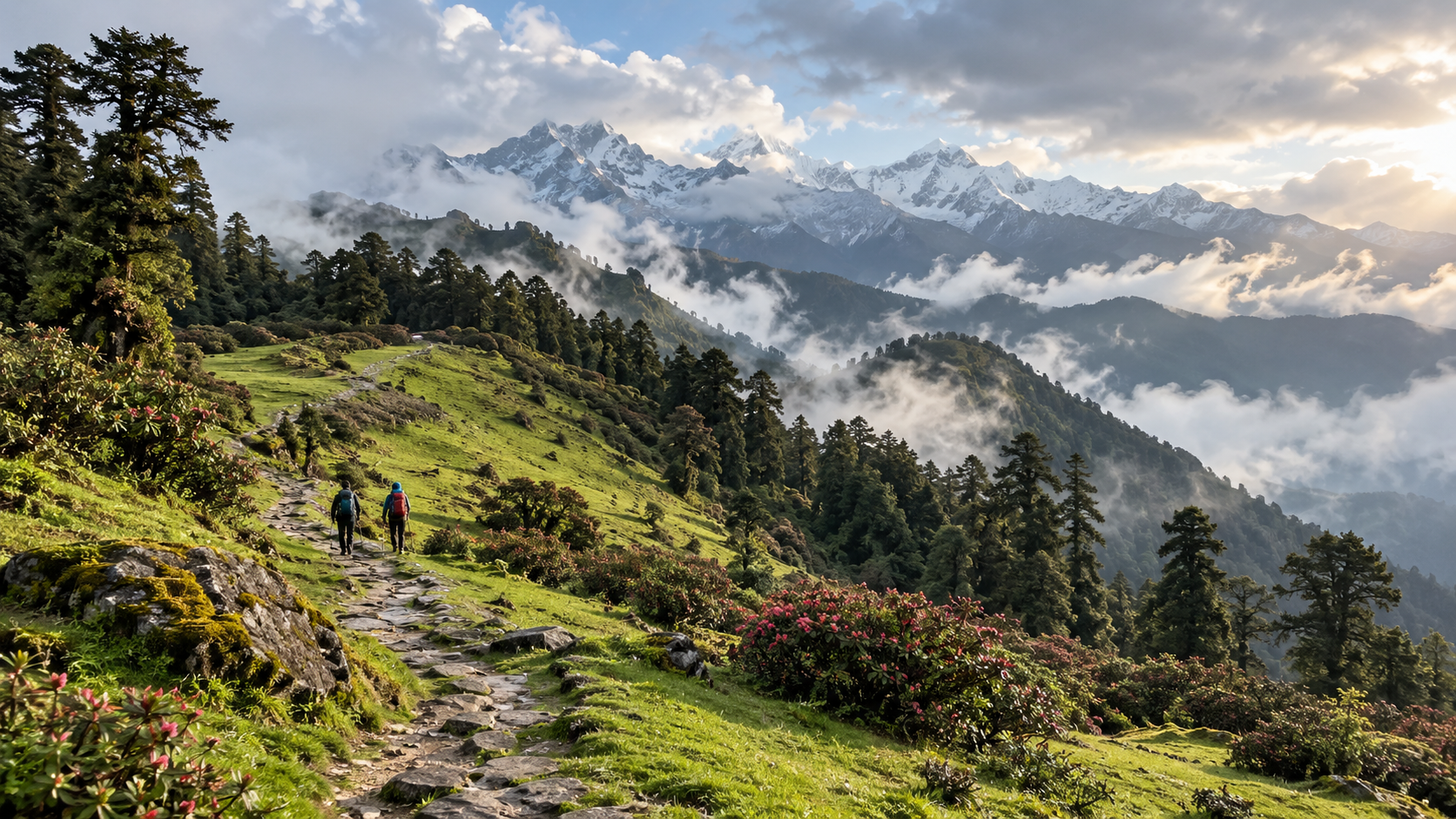
Chopta in September offers green meadows, misty forests, pleasant trekking weather and beautiful Himalayan views. It is the month when the monsoon slowly begins to leave Uttarakhand and the autumn season starts. However, weather conditions can differ greatly between early and late September.
During the first half of the month, travellers may experience rain, clouds, wet roads and slippery trekking trails. The second half generally offers clearer skies, cooler mornings and better mountain visibility. This combination makes September a rewarding but slightly unpredictable time to visit Chopta.
Located in the Rudraprayag district of Uttarakhand, Chopta is known for its peaceful environment, alpine meadows and access to the Tungnath–Chandrashila trek. It is also promoted as an all-season destination by Uttarakhand Tourism.
This complete Chopta travel guide explains September weather, trekking conditions, travel routes, estimated expenses, accommodation, packing essentials, advantages, risks and practical safety tips.
1. Chopta Weather in September: Temperature, Climate & Real-Time Conditions
September marks the official transition from monsoon to autumn in the Garhwal Himalayas. During the first week of September, you might encounter lingering, light monsoon drizzles. However, by mid-to-late September, the rain clouds retreat, giving way to crisp mountain air, brilliant sunshine, and unhindered views of Himalayan peaks like Chaukhamba, Nanda Devi, and Trishul.
Because Chopta sits inside the Kedarnath Wildlife Sanctuary at an altitude of 2,680 meters (8,790 feet), the climate turns rapidly cold as soon as the sun dips below the horizon. Daytime temperatures remain pleasant, making it comfortable for long-distance hiking, but night temperatures drop close to single digits.
📊 Chopta September Weather & Climate Metrics
| Climate Parameter | Early September (1st – 10th) | Mid September (11th – 20th) | Late September (21st – 30th) |
|---|---|---|---|
| Average Daytime Temperature | 18°C to 22°C | 15°C to 19°C | 12°C to 16°C |
| Average Night Temperature | 10°C to 12°C | 6°C to 9°C | 3°C to 6°C |
| Precipitation Probability | Moderate (35% – 40%) | Low (15% – 20%) | Very Low (Under 5%) |
| Visibility & Peak Clarity | Morning clear / Evening fog | High clear views all day | Sharp crystal-clear horizons |
| Trek Trail Condition | Slightly damp / Wet stones | Dries up completely | Firm, dry, and ideal grip |
| Recommended Clothing Layer | Light windcheater + Fleece | 2-Layer Thermal + Jacket | 3-Layer Heavy Down Jacket |
☀️ What Makes September Special for Travelers?
- Post-Monsoon Greenery: The iconic alpine meadows (Ukhimath-Chopta Bugyals) are lush, vibrant, and alive with wild mountain flora.
- Cascading Waterfalls: Seasonal mountain streams along the Rishikesh-Rudraprayag highway flow at full capacity, creating scenic pitstops.
- Low Tourist Crowds: Unlike the chaotic peak summer months of May and June, September sees peaceful trail footfalls, lower homestay tariffs, and no traffic congestion at the base camps.
2. Trekking Chopta to Tungnath & Chandrashila in September
The trail starting from Chopta base to the sacred Tungnath Temple (the highest Lord Shiva temple in the world at 3,680 meters) and further up to the Chandrashila Summit (4,000 meters) is one of the most rewarding beginner-to-intermediate trekking routes in India. September is widely considered one of the best months to execute this climb due to high atmospheric clarity and stable ground footing.
The entire trail spans roughly 5 kilometers one-way (3.5 km to Tungnath + 1.5 km to Chandrashila) with an elevation gain of over 1,300 meters. The stone-paved trail up to the temple features well-laid concrete railings, making it accessible even for beginners and fit senior citizens. However, the final 1.5 km stretch from Tungnath to the Chandrashila summit transforms into a steep, unpaved rocky ridge where trekking poles and anti-slip shoes are necessary.
📊 Chopta-Tungnath-Chandrashila Route & Terrain Breakdown
| Trail Segment | Distance (One-Way) | Elevation Reached | Terrain Difficulty | Expected Time Taken |
|---|---|---|---|---|
| Chopta Base to Monal Dhabas | 1.0 KM | 2,900 Meters | Easy paved steps | 30 to 45 Mins |
| Monal Dhabas to Devdarini Viewpoint | 1.5 KM | 3,250 Meters | Moderate incline curves | 45 to 60 Mins |
| Devdarini to Tungnath Temple | 1.0 KM | 3,680 Meters | Steeper paved zig-zags | 45 Mins |
| Tungnath to Chandrashila Summit | 1.5 KM | 4,000 Meters | Steep rocky scree / Ridge | 60 to 75 Mins |
| Total Round Trip | 10.0 KM | Max: 4,000 Meters | Moderate Overall | 5 to 7 Hours Total |
🧗 Key Trekking Highlights in September:
- Tungnath Shrine Open Status: The temple remains fully open and operational throughout September, allowing pilgrims to attend the morning and evening Aarti ceremonies.
- 360-Degree Himalayan Panorama: Standing atop Chandrashila Peak at sunrise in late September offers an unobstructed view of major Himalayan peaks including Chaukhamba, Bandarpoonch, Kedar Dome, Trishul, and Nanda Devi.
- Deoria Tal Extension: You can easily combine your Chopta trek with a 2.5 km side-hike to Deoria Tal, a high-altitude lake near Sari Village that reflects the Chaukhamba massif in its calm waters.
3. How to Reach Chopta in September: Route Maps & Transport Logistics
Reaching Chopta in September requires careful route selection. While the main highways are generally in great shape following the Char Dham All-Weather Road updates, early September can still present occasional minor landslides in mountain zones between Devprayag, Srinagar, and Rudraprayag.
You can reach Chopta via public transport (buses and shared taxis) or by driving your own private vehicle (car or motorcycle) from major hubs like Delhi, Haridwar, or Rishikesh.
🗺️ Standard Route Alignment (Via Rishikesh & Rudraprayag)
Delhi ➔ Haridwar ➔ Rishikesh ➔ Devprayag ➔ Srinagar ➔ Rudraprayag ➔ Ukhimath ➔ Chopta Base
(Total Distance: ~410 KM | Driving Time: 11 to 13 Hours)
📊 Transport Comparison Grid: Delhi/Rishikesh to Chopta
| Mode of Transport | Boarding / Hub Location | Average Fare (Per Person) | Travel Duration | Pros & Cons |
|---|---|---|---|---|
| Direct UTC / Private Bus | Kashmiri Gate Delhi / Rishikesh ISBT | ₹450 to ₹800 (Up to Ukhimath) | 10 – 12 Hours | Budget-friendly; requires local taxi transfer from Ukhimath to Chopta. |
| Shared Sumo / Bolero Hubs | Rishikesh Natraj Chawk / Rudraprayag | ₹600 to ₹900 (Total hops) | 8 – 10 Hours | Fast local travel; can be cramped with luggage and local commuters. |
| Private Cab Rental | Haridwar / Rishikesh Railway Hubs | ₹5,500 to ₹7,500 / Day | 8 – 9 Hours | Ultimate comfort; stop anywhere for photos, but more expensive for solo travelers. |
| Self-Drive / Bike Trip | Highway Route via NH-107 & SH-9 | Fuel + Tolls (~₹3,000) | 9 – 11 Hours | Great flexibility; requires mountain driving experience on sharp curves. |
🚗 September Road Condition Alert:
The road from Rishikesh up to Rudraprayag is a well-maintained 2-lane highway. Once you take the turn from Kund toward Ukhimath and Chopta, the road narrows down into a scenic forest lane. During early September, keep an eye on local news for temporary road closures near Sirobagarh (between Srinagar and Rudraprayag), a known landslide-prone zone.
4. Chopta Trip Cost & Complete Budget Breakdown (September Rates)
September falls under the “shoulder season” in Chopta. Since it sits between the heavy summer rush (May-June) and the winter snow season (December-Jan), accommodation and transportation providers offer competitive rates.
A 4-Day/3-Night trip to Chopta in September can easily be customized based on whether you are a budget backpacker, traveling as a couple, or looking for a luxury eco-camping experience.
📊 Itemized Budget Estimate for a 4-Day / 3-Night Trip (Per Person)
| Category / Expense Item | Budget Backpacker | Mid-Range Traveler | Premium / Luxury Option |
|---|---|---|---|
| Round Transit (Delhi/Rishikesh Return) | ₹1,200 (Buses + Shared Taxis) | ₹3,500 (Shared Cab / Fuel) | ₹8,000+ (Private Cab Rental) |
| Stay / Accommodation (3 Nights) | ₹1,500 (Dormitories / Basic Tents) | ₹4,500 (Deluxe Eco Cottages) | ₹10,500+ (Swiss Glamping Pods) |
| Food & Dining (All Meals) | ₹1,200 (Local Dhabas / Simple Thalis) | ₹2,500 (In-house Camp Dining) | ₹4,500+ (Multi-Cuisine Resorts) |
| Forest Permits & Guide Charges | ₹150 (Govt Park Entry) | ₹600 (Shared Local Guide) | ₹1,500 (Private Trek Leader) |
| Miscellaneous / Emergency Buffer | ₹500 | ₹1,000 | ₹2,500 |
| Estimated Total Cost | ₹4,550 Total | ₹12,100 Total | ₹27,000+ Total |
💡 Money-Saving Hacks for September:
- Book On-Spot in Mid-September: Except for weekends, homestays and camps in Chopta and Sari village have plenty of vacant rooms in September. Bargaining directly on-ground can save you 20% to 30% compared to online booking portals.
- Eat Local Thalis: Food options inside the sanctuary are basic. Opting for local Garhwali Thalis (Mandua roti, Aloo ke Gutke, Dal) is healthy, cheap, and keeps your stomach light during high-altitude hikes.
5. Accommodation, Food & Network Reality in Chopta
Understanding the ground reality of Chopta’s infrastructure is essential to avoid surprises. Because Chopta falls strictly inside the Kedarnath Wildlife Sanctuary, permanent concrete construction is legally prohibited. Most accommodations consist of eco-friendly wooden cottages, homestays, and seasonal canvas tents.
🏡 Types of Stays Available:
- Chopta Base Camps: Located right at the trailhead. Best for convenience if you want to start your trek at 4:30 AM.
- Baniyakund / Duggalbitta: Situated 4 to 7 km before Chopta. These areas feature comfortable Swiss glamping tents, green lawns, and broader mountain views.
- Sari Village: Located 20 km before Chopta. Ideal for budget travelers who want authentic homestays and plan to visit Deoria Tal.
📶 Mobile Network & Electricity Matrix (September Status)
| Location Hub | Jio Network | Airtel Network | BSNL Network | Electricity Availability |
|---|---|---|---|---|
| Chopta Base | Weak 4G / Intermittent | Patchy 2G / No Data | Moderate Voice Calls | Solar Power Only (6 PM – 10 PM) |
| Baniyakund / Duggalbitta | Strong 4G Data | Moderate 4G Data | Good Voice Calls | Generator / Solar Backup |
| Sari Village | Excellent 4G Data | Excellent 4G Data | Good Voice Calls | Grid Electricity Available |
| Tungnath / Chandrashila | Surprisingly Good 4G | Patchy 4G | Voice Only | No Electricity |
⚠️ Critical Ground Tip: Bring a 20,000mAh Power Bank and keep physical cash on hand. Electricity is limited to solar lighting in the evening at Chopta base, and there are no functional ATMs past Ukhimath.
6. Comprehensive Pros & Cons: Visiting Chopta in September
To help you decide if September is the right time for your Himalayan vacation, here is a clear breakdown of the advantages and drawbacks of traveling during this transition month:
🟢 Pros (The Highlights):
- Breathtaking Landscape: Post-monsoon green bugyals, roaring waterfalls, and crisp mountain air create exceptional photography conditions.
- Uncrowded Trail: You can experience the spiritual serenity of Tungnath Temple without waiting in massive multi-hour queues.
- Clear Views: The retreat of monsoon humidity leaves behind blue skies, offering uninterrupted views of high Himalayan peaks.
- Budget-Friendly Rates: Accommodation, guide, and transport prices are noticeably lower than during peak summer months.
- Ideal Trekking Temperatures: Daytime temperatures (15°C – 20°C) prevent excessive sweating and dehydration during steep uphill climbs.
🔴 Cons (The Challenges):
- Early Month Rainfall: Early September (Sept 1st to 8th) can still bring sudden rain showers or dense fog, temporarily hiding mountain views.
- Cold Nights: As night temperatures approach single digits, basic tent stays can feel quite cold if proper thermal bedding isn’t provided.
- Landslide Risks: Mountain highways near Rudraprayag and Sirobagarh can occasionally experience temporary blockages due to lingering monsoon saturation.
- Limited Electricity/Amenities: Luxury amenities like hot geysers, 24/7 room service, and high-speed Wi-Fi are hard to find in the eco-protected zones.
7. Expert Review & Ground Recommendations for 2026
🏔️ Dream Trip Guide – Field Inspector Review
Rating: 4.8 / 5.0
Verdict: Highly Recommended for Nature Lovers, Couples, and Solo Backpackers.
“September is arguably the best-kept secret for visiting the Chopta-Tungnath circuit. While most tourists wait for the winter snows of December or the summer break of May, September provides a serene balance. The mountain slopes are as green as the Swiss Alps, mountain streams are full, and the air is crisp.
If you visit between September 15th and September 30th, you will avoid rain completely and experience crystal-clear mornings at Chandrashila Peak. Just make sure to pack a windproof fleece jacket, carry sufficient cash, and book your return transit beforehand from Ukhimath or Rudraprayag.”
— Editorial Team, Dream Trip Guide
8. What to Do and What NOT to Do (Essential Rules)
To ensure a safe, eco-friendly, and enjoyable trip, follow these rules while visiting the Kedarnath Wildlife Sanctuary:
✅ WHAT TO DO (Do’s):
- Start Your Summit Trek Early: Begin your hike to Tungnath-Chandrashila by 4:30 AM or 5:00 AM. This guarantees you will reach the summit in time for a sunrise over the Chaukhamba peaks and helps you avoid afternoon fog.
- Carry a Windproof Poncho/Raincoat: Mountain weather can shift quickly. Always keep a lightweight, compact poncho in your daypack.
- Use Quality High-Ankle Trekking Shoes: The stone steps to Tungnath can be slippery when damp, and the scree trail to Chandrashila requires good ankle support.
- Keep Physical Cash Handy: Carry at least ₹3,000 to ₹5,000 in cash per person from Rishikesh or Ukhimath for local expenses.
- Acclimate Properly: Spend your first evening resting at Chopta base or Sari village to let your body adjust to the 2,600+ meter elevation.
❌ WHAT NOT TO DO (Don’ts):
- DON’T Litter Plastics on the Trail: Chopta is a protected wildlife habitat home to the endangered Musk Deer and Monal Pheasant. Pack out all your plastic wrappers, water bottles, and trash.
- DON’T Push Past Chandrashila in Bad Weather: If you encounter heavy fog, high winds, or sudden rainfall at Tungnath Temple, do not attempt the final 1.5 km climb to Chandrashila. The narrow ridge has steep drops on both sides.
- DON’T Rely on Digital UPI Payments: Do not assume phone networks or Google Pay/PhonePe will work at the dhaba stalls or homestays. Always carry physical cash.
- DON’T Drive High-Altitude Roads at Night: Avoid driving between Ukhimath and Chopta after 6:30 PM due to thick fog, lack of street lighting, and wildlife crossings.
- DON’T Consume Alcohol Near Holy Sites: Maintain decorum and respect local spiritual traditions near the sacred shrines of Ukhimath and Tungnath.
9. People Also Ask (PAA) — Frequently Asked Questions
Q1. Is September a good time to visit Chopta?
Yes, September is one of the best months to visit Chopta. The monsoon rains retreat, leaving the meadows lush and green, while clear blue skies offer sharp views of the Himalayan peaks.
Q2. Is there snow in Chopta in September?
No, there is no snow in Chopta or at Tungnath Temple during September. Snowfall typically begins in late November or December. In September, you will see green meadows, clear trails, and blooming mountain flora.
Q3. Is Tungnath Temple open in September?
Yes, Tungnath Temple is completely open in September. The temple opens its doors in late April/May and remains accessible to pilgrims until its official winter closure around October/November (after Diwali).
Q4. Can beginners do the Chopta Tungnath trek in September?
Yes, the trek is very beginner-friendly. The 3.5 km trail up to Tungnath Temple is paved with stone steps. Anyone with basic fitness can easily complete it. Only the final 1.5 km trail to Chandrashila Summit is steep and requires careful footing.
Q5. What clothes should I pack for Chopta in September?
Pack a mix of summer and light winter clothing. Bring breathable t-shirts for day hikes, a fleece jacket or windcheater, thermal innerwear for the cold nights, a rain poncho, and a pair of sturdy, high-ankle trekking shoes.
Q6. Is it safe to drive to Chopta in September?
Yes, driving to Chopta is safe in September, especially during the mid-to-late part of the month when monsoon landslides taper off. Drive cautiously on the winding hill section between Ukhimath and Chopta, and avoid driving late at night.
🎯 Final Checklist Before You Leave for Chopta
- [ ] Physical Cash withdraws completed at Rishikesh/Rudraprayag
- [ ] 20000mAh Power Bank fully charged
- [ ] High-ankle anti-slip trekking shoes packed
- [ ] Windproof raincoat / poncho placed in daypack
- [ ] Offline Google Maps for Uttarakhand downloaded
- [ ] Personal medication and motion-sickness tablets packed
- [ ] Accommodation confirmed at Chopta base or Sari Village
For live mountain updates, detailed itineraries, and custom Himalayan tour packages, visit our official portal or follow our travel community on social media:
- Website: www.dreamtripguide.com
- Instagram Updates: @dreamtripguide.india
