
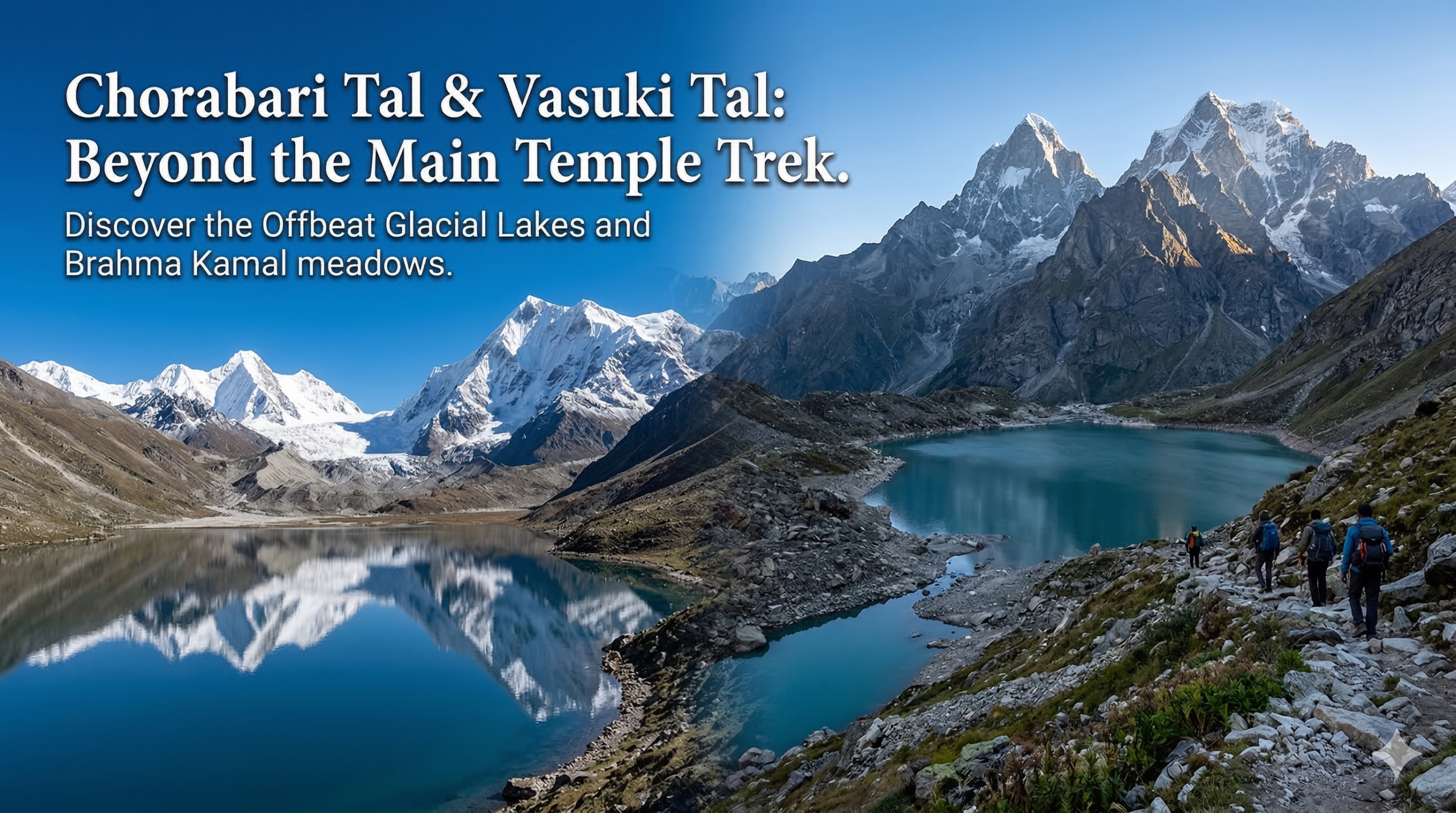
While the Kedarnath Temple is the spiritual heart of the Mandakini valley, the true “Himalayan wilderness” begins where the paved path ends. For those seeking offbeat places near Kedarnath in 2026, the twin glacial lakes of Chorabari Tal (Gandhi Sarovar) and Vasuki Tal offer a transition from pilgrimage to pure adventure.
Whether you are looking for the rare Brahma Kamal sightings or a challenging 8km extension trek through moraines and glaciers, this guide provides the most updated information for your 2026 mountain expedition.
Read Also:- Rudra Cave Meditation: How to Stay in the Famous ‘Modi Cave’ in 2026
Chorabari Tal: The Reflective Gandhi Sarovar
Chorabari Tal, popularly known as Gandhi Sarovar, is a crystal-clear glacial lake perched at an altitude of approximately 3,900 meters (12,795 feet). It is the source of the Mandakini River and sits at the mouth of the Chorabari Bamak Glacier. In 1948, a portion of Mahatma Gandhi’s ashes was immersed here, giving the lake its modern name.
In 2026, the trek to Chorabari Tal remains one of the most accessible yet rewarding “side quests” from the Kedarnath shrine. The trail starts from the iron bridge behind the temple and winds through a 3 km uphill path. Unlike the main trek from Gaurikund, this path is relatively quiet, dominated by the sound of the nearby Madhu Ganga waterfall. On a clear morning, the reflection of the Meru-Sumeru peaks in the still waters of the lake is a sight that rivals any alpine postcard.
However, trekkers should be aware of the geographical sensitivity of this area. The 2013 floods were triggered by the bursting of this lake’s banks, and in recent years (including 2024 and 2025), minor avalanches have been reported in the upper reaches of the Chorabari glacier. While the trail is safe for day visitors in 2026, it is strictly a “morning-only” destination. Clouds and mist often roll in by noon, obscuring the path and the peaks.
Chorabari Tal Quick Facts
| Feature | Details |
| Distance from Kedarnath | 3 km (One Way) |
| Difficulty Level | Easy to Moderate |
| Altitude | 3,900 meters |
| Best Time | 6:00 AM to 10:00 AM |
| Key Attraction | Mirror reflection of Himalayan peaks |
Vasuki Tal: The 8km Extension Trek for Adventure Seekers
If Chorabari Tal is a gentle walk, Vasuki Tal is a true test of Himalayan endurance. Located 8 km from Kedarnath at a staggering altitude of 4,135 meters (13,566 feet), this lake is steeped in mythology. It is believed that Lord Vishnu bathed in these waters during the festival of Raksha Bandhan.
The trek to Vasuki Tal is a continuous ascent. It starts with a steep climb toward Vasuki Top, which offers a panoramic 360-degree view of the Chaukhamba peaks and the Mandakini Valley. From the top, you must descend about 1 km to reach the lake itself. The terrain is rugged, consisting of narrow goat paths and loose moraine (boulders).
For the 2026 season, authorities recommend hiring a local guide for this route. The weather at Vasuki Top can change in minutes, and the trail can become nearly invisible during sudden mists. However, the reward for this “difficult” grade trek is the chance to see high-altitude glacial lakes in their most pristine form, far removed from the thousands of pilgrims at the base.
Vasuki Tal Trek Details
| Feature | Details |
| Total Distance | 16 km (Round trip from Kedarnath) |
| Max Altitude | 4,135 meters |
| Trek Duration | 6 to 8 hours (Round trip) |
| Terrain Type | Rocky, steep, and glaciated |
| Permit | Required (Check at Kedarnath GMVN office) |
Flora of the Gods: Brahma Kamal Sightings
One of the biggest draws for trekking to Vasuki Tal between July and September is the chance to see the Brahma Kamal (Saussurea obvallata). This rare, sacred flower is the state flower of Uttarakhand and is famous for blooming only at altitudes above 4,000 meters.
In 2026, the meadows surrounding Vasuki Tal remain one of the few places where you can see these flowers in their natural habitat. The Brahma Kamal is not a typical “lotus”; it looks like a yellowish-green cabbage-shaped bloom with delicate, translucent petals that protect the internal flowers from the harsh Himalayan cold and UV rays.
Because of its mythological significance—being the flower offered to Lord Shiva—locals often warn against plucking it. In fact, under the Wildlife Protection Act, plucking these rare herbs can lead to heavy fines. Observing them as they sway in the thin mountain air, surrounded by blue poppies and rhododendrons, is a spiritual experience in itself. The peak blooming season is usually late August, but sightings are common throughout the monsoon and early autumn months of 2026.
Expert Review: Is the Trek Worth It in 2026?
“The 2026 season shows a clear trend: pilgrims are becoming trekkers. While the Kedarnath temple is the ‘Why’, Chorabari and Vasuki are the ‘Wow’. Chorabari is perfect for families who can walk an extra 2-3 hours. However, Vasuki Tal is a serious high-altitude endeavor. I advise trekkers to never attempt Vasuki Tal on the same day they reach Kedarnath from Gaurikund. Your body needs at least 24 hours to acclimatize at 3,500m before pushing to 4,100m. The thin air and the steep climb to Vasuki Top can cause Acute Mountain Sickness (AMS) if you rush. If you have the fitness, the solitude of Vasuki Tal is the best ‘digital detox’ the Garhwal Himalayas can offer.” — Senior Himalayan Expedition Leader
Pros and Cons of the Twin Lake Treks
| Pros (Why You Should Go) | Cons (What to Watch Out For) |
| Stunning Views: Better views of Chaukhamba and Meru-Sumeru than the temple. | Thin Air: Significant risk of altitude sickness above 4,000m. |
| Rare Flora: Only place to see blooming Brahma Kamals near Kedarnath. | No Infrastructure: No shops or permanent shelters at the lakes. |
| Spiritual Peace: Zero crowds compared to the main temple complex. | Weather Volatility: High risk of sudden rain, snow, or fog. |
| Pristine Nature: High-altitude glacial lakes with crystal-clear water. | Tough Terrain: Slippery rocks and narrow ridges on the Vasuki trail. |
The 2026 Protocol: What to Do and What Not to Do
Trekking in the sensitive Kedarnath Wildlife Sanctuary requires a responsible mindset. As an 8km extension trek into the high Himalayas, you are entering a zone where help is far away.
What to Do:
- Acclimatize: Spend a full day in Kedarnath before heading to Vasuki Tal.
- Start Early: Leave by 5:00 AM or 6:00 AM. You must aim to be back at Kedarnath by 2:00 PM.
- Hire a Guide: For Vasuki Tal, a local guide is invaluable for navigating the moraines.
- Pack for “Four Seasons”: Even in June, it can rain or hail at Vasuki Top. Carry a poncho and thermals.
- Carry a Medical Kit: Include Diamox (after consulting a doctor) for altitude, and basic O2 cans if you are a first-timer.
What Not to Do:
- Don’t Pluck Flowers: It is illegal and disrespectful to the local ecosystem.
- Don’t Litter: There is no waste management at the lakes. Carry every wrapper back to Kedarnath.
- Don’t Go Alone: Especially to Vasuki Tal. If you twist an ankle, there is no one to call for help.
- Don’t Camp Overnight: Without professional gear and specific permits, camping at these lakes is discouraged due to wildlife (bears/leopards) and freezing temperatures.
- Don’t Ignore Your Body: If you feel a headache or nausea, descend immediately.
Next Step: Would you like me to create a 3-day itinerary that combines the Kedarnath Darshan with both the Chorabari and Vasuki Tal treks?
Read Also:- Digital Survival Kit: Mobile Network & 5G Hotspots in Kedarnath 2026
