
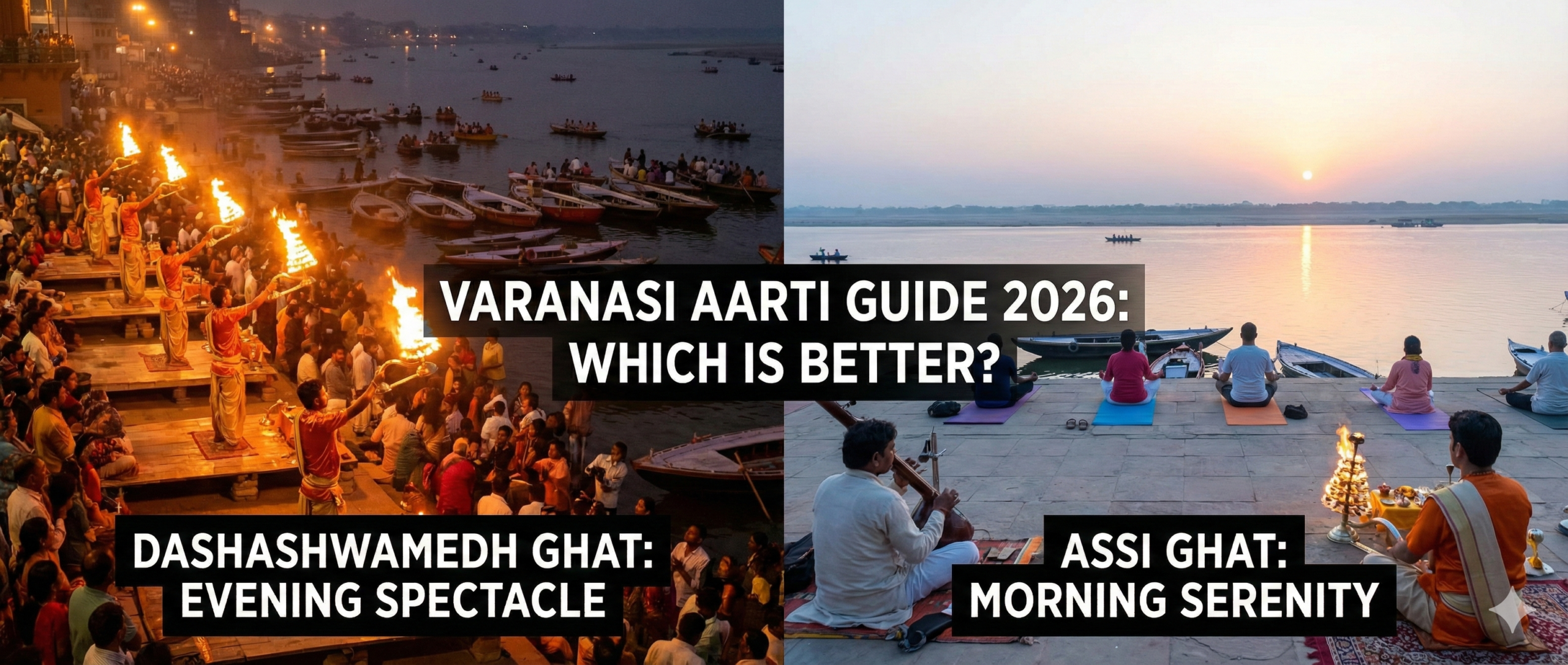
Varanasi is not just a city; it is an experience that stays with you forever. At the heart of this spiritual capital are its Ghats (riverbanks) and the mesmerizing Ganga Aarti. But for a traveler in 2026, a common confusion arises: Where should I watch the Aarti?
Should you choose the world-famous, grand spectacle at Dashashwamedh Ghat, or the peaceful, soulful morning vibes of Assi Ghat?
Both offer completely different experiences. This guide compares them side-by-side to help you decide which one suits your vibe.
Read Also:- The Mystery of Kaal Bhairav: The Kotwal of Kashi
Dashashwamedh Ghat: The Grand Evening Spectacle
“The Cosmic Performance of Fire and Sound”
If Varanasi had a main stage, this would be it. Dashashwamedh Ghat is the oldest and most spectacular ghat in the city. Legend has it that Lord Brahma performed the Dasa Ashvamedha (ten horses) sacrifice here, giving the ghat its name.
In 2026, the evening Aarti here has become a massive, choreographed production that rivals any major cultural event in the world. As the sun sets, the air becomes thick with the scent of sandalwood and camphor. Thousands of pilgrims, tourists, and locals gather on the steps, while hundreds of boats anchor in the river, creating a floating audience.
The Experience:
The ceremony is performed by a group of young priests (Pandits), draped in saffron and gold robes. They move in perfect synchronization. It is not just a prayer; it is a performance. They use huge brass lamps shaped like snakes (Naga lamps), wave peacock feathers, and blow conch shells that vibrate through your chest. The chanting is amplified by loudspeakers, and the rhythmic clanging of bells creates a trance-like atmosphere.
For a first-time visitor, this is sensory overload in the best way possible. It is loud, it is bright, and it feels like the entire universe is focusing its energy on this one spot. If you want to see the “classic” image of India—mystic, crowded, and intense—this is where you need to be.
Key Logistics:
- Best View: You can sit on the steps (free) or hire a boat (approx. ₹300-₹500 per person) to watch from the water.
- Crowd Level: Extremely High. You will be shoulder-to-shoulder with strangers.
- Vibe: Electric, festive, and chaotic.
Assi Ghat: The Spiritual Solitude (Subah-e-Banaras)
“Where the River Meets the Soul”
Located at the southernmost tip of the city, where the river Assi meets the Ganga, Assi Ghat offers a completely different energy. While Dashashwamedh is about the fire of the evening, Assi is about the water of the morning.
The highlight here is the Subah-e-Banaras (Morning of Varanasi) program. This is a government initiative that has turned the morning ritual into a cultural masterpiece. It doesn’t just start with fire; it starts with the sun.
The Experience:
Imagine arriving at the ghat at 4:30 AM. It is dark, and the city is silent. As the first light of dawn touches the horizon, a specialized Aarti begins. Unlike the loud evening affair, this is softer. It is immediately followed by Vedic Chanting by young students in white robes, and then a classical music performance (tabla, flute, or sitar) by maestros.
The most unique part? A free mass Yoga session happens right there on the platform as the sun rises. You are welcome to join in. The crowd here is different—you’ll see students from Banaras Hindu University (BHU), foreigners meditating, and locals taking their morning dip. It feels less like a tourist attraction and more like a community ritual.
There is an evening Aarti here too, but it is smaller and simpler. The real magic of Assi is in the morning.
Key Logistics:
- Best View: Sit on the steps. The boat view is nice, but being on the concrete platform lets you feel the music better.
- Crowd Level: Low to Moderate. You have space to breathe and sit comfortably.
- Vibe: Meditative, intellectual, and calming.
Comparison: The 2026 Snapshot
Here is a quick breakdown to help you compare the two experiences instantly.
| Feature | Dashashwamedh Ghat (Evening) | Assi Ghat (Morning – Subah-e-Banaras) |
| Best Time | Sunset (Winter: 6:00 PM / Summer: 7:00 PM) | Sunrise (Winter: 5:30 AM / Summer: 5:00 AM) |
| Primary Vibe | Grand & Intense. Loud bells, fire, crowds. | Peaceful & Soulful. Classical music, yoga, sunrise. |
| Crowd Density | Very High (Thousands of people). | Moderate (Mostly yoga practitioners & locals). |
| Duration | 45 Minutes. | 2 Hours (Includes Aarti, Music, Yoga). |
| Cost | Free (Steps) / ₹300-₹1500 (Boat). | Free (Steps) / Yoga is free to join. |
| Best For | Photographers, First-timers, Culture Vultures. | Solo travelers, Meditators, Early Risers. |
| Accessibility | Harder (Traffic is banned; long walk to ghat). | Easier (Rickshaws can go closer to the ghat). |
Pros and Cons
Dashashwamedh Ghat (Evening Aarti)
Pros:
- Visual Spectacle: The synchronization of the priests and the massive fire lamps is visually stunning.
- The “Varanasi” Feel: It captures the chaotic energy the city is famous for.
- Boat Option: Watching from a boat offers a magical, panoramic view of the lit-up ghats.
- Market Access: You are right next to the Godowlia market, perfect for shopping and street food after the ceremony.
Cons:
- Overcrowding: It can get claustrophobic. If you are anxious in crowds, this might be difficult.
- Scams: Being the tourist hub, touts selling “VIP seats” or overpriced boat rides are common.
- Noise: The loudspeakers are very loud; it is not a quiet place for meditation.
Assi Ghat (Morning Aarti)
Pros:
- Serenity: It is quiet enough to hear the river flowing and birds chirping.
- Cultural Depth: The addition of classical music and yoga adds immense value beyond just the religious ritual.
- Cleanliness: Assi Ghat is generally cleaner and wider than Dashashwamedh.
- No Touts: You are rarely bothered by sellers or guides here.
Cons:
- Early Wake-up: You need to be up by 4:00 AM to catch the full experience.
- Less “Grand”: If you are expecting huge fire lamps and drama, you might find it too simple.
- Distance: It is far from the main city center (Godowlia), so you need to plan transport.
Expert Review & Verdict (2026)
So, which one should you choose?
If you only have time for ONE:
Go to Dashashwamedh Ghat. It is the iconic image of Varanasi. You simply cannot say you have been to Banaras without witnessing this grand evening prayer. It is intense, yes, but it is unforgettable.
If you want to find yourself:
Go to Assi Ghat. The morning Subah-e-Banaras is life-changing for many. Watching the sun rise over the Ganges while listening to a live flute recital is a therapy you didn’t know you needed.
The “Pro” Itinerary:
Do both! They happen at opposite times of the day.
- Morning: Wake up early for Assi Ghat (5:00 AM). Do the yoga, watch the sunrise.
- Day: Explore the city/temples.
- Evening: Head to Dashashwamedh Ghat (5:30 PM) to grab a seat for the evening show.
Dos and Don’ts
What Should You Do?
- DO arrive early: For Dashashwamedh, arrive at least 45 minutes early (around 5:15 PM in winter) to get a front-row seat on the steps.
- DO dress modestly: Cover your shoulders and knees. This is a religious ceremony.
- DO protect your electronics: If you are on a boat, be careful with your phone. One slip and it belongs to the Ganga!
- DO check the timings: Timings change with the sunset. Ask your hotel reception for the exact time on the day of your visit.
Read Also:- How to Book Sugam Darshan at Kashi Vishwanath: The Ultimate 2026 Guide to Skipping the Line
What Should You NOT Do?
- DON’T pay for “VIP” seats on the steps: The steps are public property and free. Only pay if you are renting a plastic chair or a boat.
- DON’T use flash photography: It distracts the priests and ruins the atmosphere for others.
- DON’T buy flowers/diyas from the first seller: Walk a bit; the prices drop as you get closer to the river.
- DON’T litter: Varanasi is fighting hard to stay clean. Keep your plastic wrappers in your pocket.
