
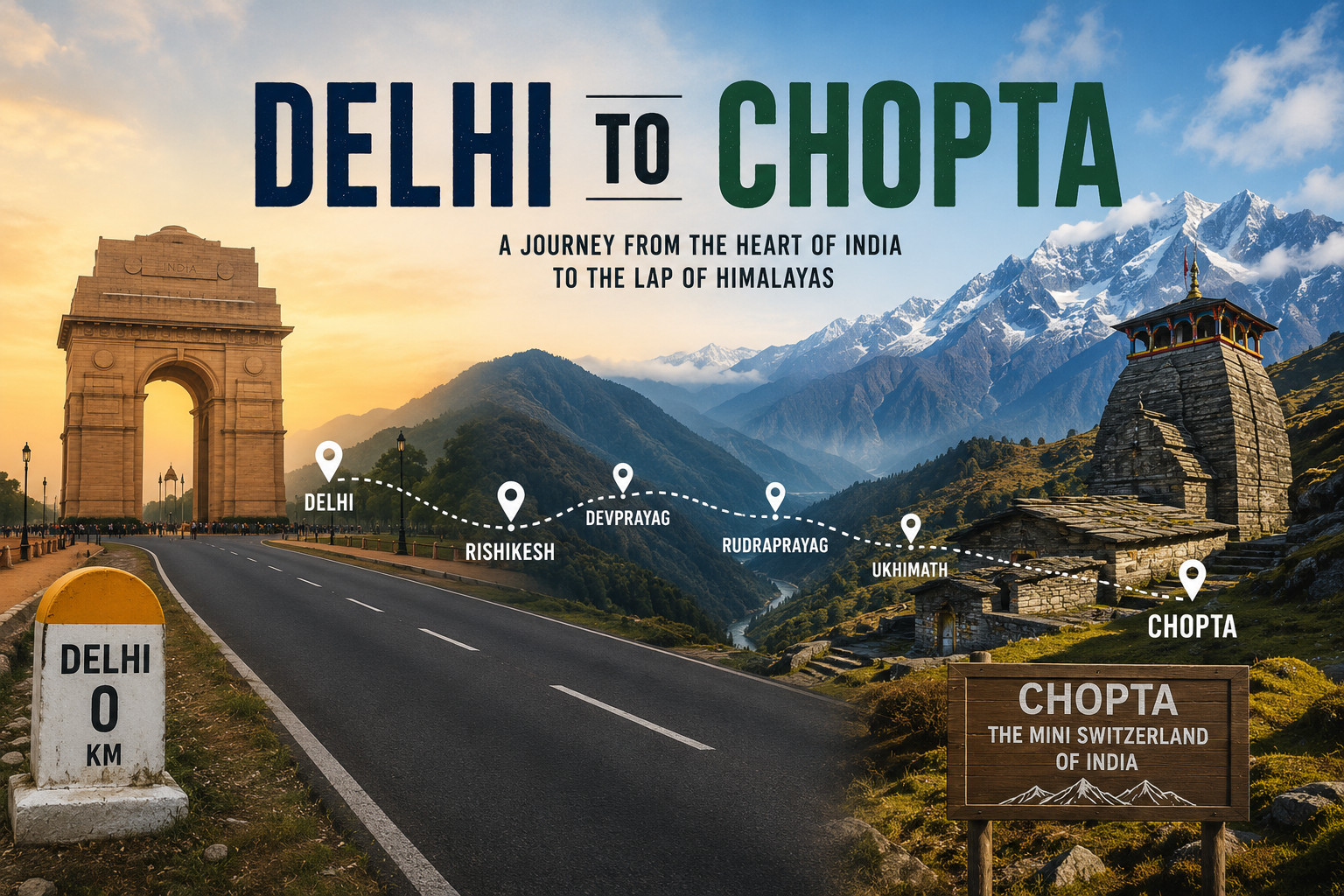
Executing a self-drive expedition from the metropolitan plains of New Delhi to the high-altitude sanctuaries of Northern India demands precise navigation, trusted highway data, and meticulous logistical planning. For international overlanders and domestic motorists utilizing an authoritative trip planning guide to engineer a seamless mountain vacation, a delhi to chopta driving journey represents the pinnacle of trans-Himalayan road tripping.
Passing through sacred river confluences, historical foothills, and ascending into dense, sub-alpine meadows, this road trip links India’s capital with the pristine chopta valley frequently celebrated by global eco-tourists as the mini Switzerland in Uttarakhand.
This publication-grade manual serves as your premier travel guide blog asset, delivering verified odometer distances, altitude points, optimal routing transit channels, and critical safety protocols for a flawless mountain trip.
1. Route Anatomy: Spatial Distances & Altitudinal Milestones
A successful chopta road trip requires an understanding of the geographical transitions between the National Capital Region (NCR) and the Rudraprayag district of Uttarakhand. The drive involves a steady elevation climb over a relatively short geographical window.
Core Transit & Elevation Blueprint
- Total Driving Distance (Delhi to Chopta): Approximately 410 kilometers (254.7 miles) via the primary highway grid.
- Average Safe Transit Time: 11 to 13 hours, depending on real-time hill traffic, seasonal weather variations, and rest stops.
- Delhi Base Altitude: 214 meters (702 feet) above sea level.
- Chopta Hill Station Base Altitude: A soaring Chopta height of 2,680 meters (8,790 feet).
- Tungnath Altitude: Restingly beautifully at 3,680 meters (12,073 feet).
- Chandrashila Peak Height: Reaches an absolute summit height of 4,000 meters (13,123 feet).
When plotting your chopta itinerary from Delhi, the primary and most reliable transit highway infrastructure is the National Highway 58 (NH-58) corridor, moving toward the Ukhimath-Chopta link road.
1.Phase 1: Delhi NCR to Haridwar/Rishikesh:Distance: 200 km | Time: 4.5–5 Hours.
Depart early via the Delhi-Meerut Expressway (NE-3) to bypass morning city bottlenecks. Transition onto NH-58 past Muzaffarnagar and Roorkee, driving through the flat plains of western Uttar Pradesh before arriving at the foothills of Haridwar and Rishikesh.
2.Phase 2: Rishikesh to Rudraprayag via NH-7:Distance: 140 km | Time: 4.5–5 Hours.
Enter the mountain terrain on the All-Weather Highway grid. Follow the sacred Alaknanda River upstream, passing through major mountain settlements and river confluences (Prayags), including Devprayag (where the Alaknanda meets the Bhagirathi) and Srinagar Garhwal, before pulling into Rudraprayag.
3.Phase 3: Rudraprayag to Ukhimath Corridor:Distance: 45 km | Time: 1.5–2 Hours.
At Rudraprayag, clear the river bridge and split from the main Badrinath highway system. Turn onto the Kedarnath highway system, tracking the Mandakini River valley floor northward toward Kund, before climbing the switchbacks up to the regional hub of Ukhimath.
4.Phase 4: Ukhimath to Chopta Meadows Base:Distance: 30 km | Time: 1 Hour.
Navigate the final section of the ukhimath to chopta distance. The road winds through dense, protected woods inside the Kedarnath Wildlife Sanctuary. Watch for sharp bends and sudden mist before reaching the open alpine meadows of Chopta Hill Station.
3. High-Altitude Trekking Extensions from Chopta Base
Once your vehicle is securely parked at the chopta hill station trailhead, the region opens up into world-class backcountry trails that rank among the finest Uttarakhand trekking destinations.
The Chopta Tungnath Chandrashila Trek
The legendary chopta tungnath trek starts right from the main highway parking zone. A wide, stone-paved foot path stretches over a tungnath trek distance of 3.5 kilometers (2.1 miles) to reach the 1,000-year-old stone temple complex.
For high-end adventure seekers looking for a dramatic chandrashila view, the trail pushes an additional 1.5 kilometers (0.9 miles) past the temple steps. Climbing the unpaved gravel switchbacks of the exposed mountain spine leads directly to the top of Chandrashila Peak. Standing at the peak gives you an unmatched view of massive Himalayan giants like Chaukhamba, Nanda Devi, and Trishul.
The Deoria Tal Side-Quest
On your return drive, make time to incorporate the beautiful deoria tal trek. Located a short drive down the valley near Sari Village, the Deoria Tal trek distance is an accessible 2.5 km (1.5 miles) walk. The emerald-green lake functions as a massive mirror, reflecting the multi-peaked Chaukhamba massif on its calm waters. Combining these routes creates the iconic, comprehensive deoriatal chandrashila trek loop.
4. Seasonal Weather Road Mapping & Budget Logistics
Mountain Weather Profiles & Driving Windows
- Chopta in Summer (April to June): Offers ideal driving conditions, clear alpine visibility, and daytime temperatures ranging between 15°C and 24°C (59°F–75°F). This is the absolute peak window for a chopta road trip or a chopta bike trip, as the rhododendron forests are in full crimson bloom.
- Chopta Snowfall Guide (November to March): The valley transforms into a winter wonderland. Heavy winter snow can block sections of the main roads between January and February. During these freezing months, check updates on the road conditions frequently. The western slopes facing Ukhimath are typically cleared first by highway crews.
- Chopta Monsoon Travel (July to September): The hills turn incredibly green, but heavy rains increase the risk of landslides along the river valleys, requiring cautious driving and regular highway alerts.
Estimated Travel Budget Breakdown
Planning an independent chopta budget trip is highly cost-effective compared to standard Western mountain destinations.
| Travel Expense Category | Independent Budget (USD / Day) | Premium / All-Inclusive Packages |
| Fuel & Highway Tolls | $15 – $25 | Covered in standard chopta tour package |
| Accommodations (Homestay/Tents) | $15 – $30 | Included in comprehensive tungnath trek package |
| Mountain Meals & Logistics | $10 – $15 | Full catering included in guided plans |
Frequently Asked Questions (FAQs)
What is the exact driving distance from Delhi to Chopta?
The total road distance from New Delhi to Chopta Hill Station along the primary NH-58 and NH-7 highway corridors is approximately 410 kilometers (254.7 miles). The drive usually takes between 11 and 13 hours of active mountain motoring.
Is a 4×4 vehicle required for a winter road trip to Chopta?
A 4×4 vehicle is not strictly mandatory for most of the year, but high ground clearance is strongly recommended. During heavy winter snowfall events (January to February), the final 10 kilometers of the road from Ukhimath to Chopta can collect thick ice, often requiring tire chains or 4WD capabilities.
Why is Chopta valley frequently called the Mini Switzerland of Uttarakhand?
Chopta earned the nickname mini Switzerland of Uttarakhand due to its expansive, rolling green alpine meadows (bugyals), dense pine and oak forests, clean mountain air, and its striking backdrop of dramatic, snow-capped mountain peaks.
What is the road distance between Chopta and Kedarnath?
For travelers looking to combine multiple destinations, the driving distance between the Chopta foothills and Sonprayag (the vehicle gateway for the Kedarnath trek) is 95 kilometers (59 miles), requiring roughly 4 to 5 hours of mountain driving.
Are there functional EV charging stations along the route to Chopta?
Reliable fast-charging EV stations are widely available up through Rishikesh and Srinagar Garhwal. Beyond Rudraprayag, charging infrastructure becomes limited, so hybrid or internal combustion engine (ICE) vehicles remain the preferred choice for long-distance mountain travel.
Direct Inquiries: dreamtripguides@gmail.com
👉 Also Read – Book Kedarnath Package
