
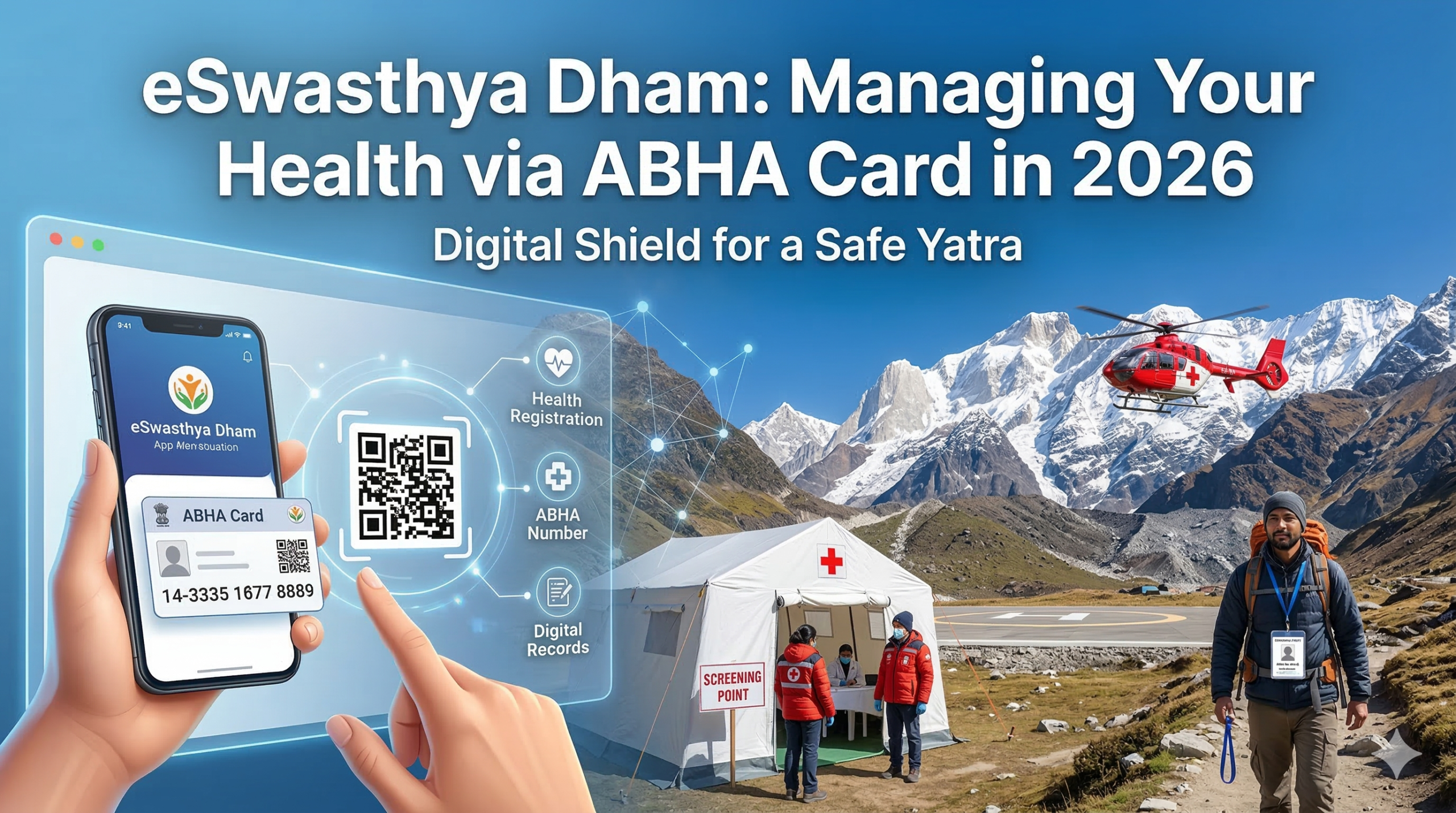
The Char Dham Yatra is one of the most spiritually fulfilling journeys in the world, but it is also one of the most physically demanding. In 2026, the Uttarakhand government has taken a massive leap in pilgrim safety by launching the eSwasthya Dham portal. This digital initiative ensures that your medical history travels with you, even to the remotest peaks of Kedarnath and Yamunotri.
By integrating the ABHA (Ayushman Bharat Health Account) card, the state aims to provide real-time medical tracking and rapid response during emergencies. This guide covers everything you need to know about health registration for Char Dham and how to use your 14-digit ABHA number for a safer pilgrimage.
Read Also:- Night Aarti at Kedarnath: A Guide to the Evening Rituals
eSwasthya Dham: The Digital Shield for Pilgrims
The eSwasthya Dham portal is the cornerstone of Uttarakhand’s “Safe Yatra” mission in 2026. It is a dedicated health management system integrated with the Ayushman Bharat Digital Mission (ABDM). The primary goal is to monitor the health parameters of millions of pilgrims who face extreme cold, low oxygen levels, and steep climbs.
In 2026, the portal serves as a mandatory bridge between your Yatra registration and medical clearance. When you register on the eSwasthya Dham portal, you are essentially creating a digital health locker. If you have pre-existing conditions like diabetes, hypertension, or heart issues, this data is instantly accessible to doctors at any medical check-up center along the route. This eliminates the need to carry bulky paper records and ensures that if an emergency occurs, the medical team knows exactly what medications you are on.
The portal also facilitates the mandatory health screening for pilgrims over the age of 50. In 2026, the government has intensified this check at entry points like Rishikesh and Haridwar. By linking your ABHA number, the results of these screenings are automatically updated to your profile, allowing for a seamless transition from base camp to the high-altitude shrines.
Portal & ABHA Quick Facts
| Feature | Details |
| Portal Name | eSwasthya Dham (Uttarakhand Health Dept) |
| Primary Integration | ABHA (Ayushman Bharat Health Account) |
| Mandatory For | All pilgrims (Highly recommended for 50+) |
| Key Function | Health monitoring, Record storage, Emergency access |
| Helpline | 104 (Health) or 108 (Ambulance) |
ABHA Number for Yatra: Why It’s Your Most Important ID
In 2026, your ABHA number for Yatra is just as vital as your Aadhaar card. This 14-digit unique identifier acts as your digital health identity across India, but its utility in the Himalayas is life-saving. When you arrive at a medical check-up center in Guptkashi or Joshimath, a simple scan of your ABHA QR code allows the doctor to see your verified health history.
The integration with the eSwasthya Dham portal means that any treatment you receive during the Yatra is recorded digitally. If you are treated for altitude sickness at Kedarnath Base Camp, that record is added to your ABHA profile. This is crucial for follow-up care if you are later moved to a lower altitude or a larger hospital in Dehradun.
Furthermore, the ABHA card helps in managing the “Self-Health Declaration” required during the registration process. Instead of manually filling in your details every time, the portal fetches your verified data, making the health registration for Char Dham much faster. For the 2026 season, special “ABHA Desks” have been set up at the Rishikesh ISBT and Haridwar Railway Station to help pilgrims generate their numbers on the spot if they haven’t done so already.
Benefits of ABHA in Char Dham
| Benefit | How it Helps the Pilgrim |
| Paperless Records | No need to carry physical prescriptions or test reports. |
| Instant Access | Doctors can see your blood group and allergies in seconds. |
| Better Triage | In mass emergencies, medical teams can prioritize based on records. |
| Verified Data | Reduces the chance of medical errors or wrong drug interactions. |
Medical Check-up Centers and Screening Points
The 2026 Yatra season features an expanded network of healthcare facilities. The Uttarakhand government has established a three-tier medical system: Screening Points at the base, Medical Relief Posts (MRPs) on the treks, and well-equipped hospitals at the Dhams.
Every pilgrim, especially those with a history of respiratory or cardiac issues, must stop at a medical check-up center before starting the steep treks to Yamunotri or Kedarnath. In 2026, new high-tech screening kiosks have been installed at Sonprayag and Janki Chatti. These kiosks measure blood pressure, oxygen saturation ($SpO_2$), and heart rate in less than two minutes.
If your vitals are not within the safe range for high altitude, the eSwasthya Dham system will flag your registration. You may be advised to rest for 24 hours to acclimatize or, in some cases, discouraged from proceeding further for your own safety. This proactive monitoring has significantly reduced the number of cardiac incidents reported in the early months of the 2026 season.
Major Health Centers 2026
| Location | Type of Facility | Services Available |
| Rishikesh / Haridwar | Primary Screening Hubs | Full check-up, ABHA generation |
| Barkot / Uttarkashi | Community Health Centers | Emergency stabilization, Oxygen |
| Guptkashi / Sonprayag | Specialized Cardiac Units | ECG, Oxygen, Stabilization |
| Kedarnath / Badrinath | High-Altitude MRPs | $SpO_2$ monitoring, First aid, Heli-base |
Emergency Heli-Evacuation: The Last Resort
Despite all precautions, the high-altitude environment can be unpredictable. For severe cases of Acute Mountain Sickness (AMS) or cardiac distress, emergency heli-evacuation is the only viable option. In 2026, the state has streamlined the “Air Ambulance” protocol, linking it directly to the eSwasthya Dham database.
If a doctor at a high-altitude relief post determines that a pilgrim needs immediate evacuation, they trigger an “SOS” through the portal. Because the pilgrim’s ABHA details and location are already in the system, the nearest available medical helicopter is dispatched immediately.
The cost of emergency heli-evacuation in 2026 is often covered by the specialized Yatra Insurance policies that are now linked with the registration process. However, for those without insurance, the government-capped rates are approximately ₹25,000 to ₹40,000 for a rescue flight to the nearest major hospital in AIIMS Rishikesh or Jolly Grant, depending on the distance and complexity.
Expert Review: The Digital Evolution
“The eSwasthya Dham portal is a game-changer for 2026. In previous years, we struggled to treat unconscious pilgrims because we had no idea about their medical history. Now, with the ABHA integration, we have their ‘Golden Hour’ info—allergies, chronic conditions, and emergency contacts—at our fingertips. My advice: Don’t treat the health screening as a hurdle; treat it as your life insurance. If the system flags you at Sonprayag, listen to the doctors. The mountain will always be there, but your life is irreplaceable.” — Dr. S. Negi, High-Altitude Medicine Specialist
Pros, Cons, and The “Do’s & Don’ts”
Managing your health via digital cards has its learning curve. While the system is robust, it requires the pilgrim to be proactive.
Pros and Cons
| Pros (Advantages) | Cons (Challenges) |
| Rapid Treatment: Instant access to medical history. | Connectivity: Some high-altitude spots have slow internet for syncing. |
| Safety First: Mandatory screenings prevent high-risk travel. | Tech Barrier: Elderly pilgrims may find the portal difficult to navigate. |
| Better Coordination: Links local MRPs with major city hospitals. | Privacy Concerns: Some users are wary of sharing health data digitally. |
| Free Service: The ABHA and portal use are completely free. | Wait Times: Screening kiosks can have long queues during peak weeks. |
What to Do:
- Register Early: Create your ABHA card and update your health profile on the eSwasthya Dham portal at least 15 days before travel.
- Keep Offline Copies: Download your ABHA QR code and Yatra health pass as a PDF on your phone for offline use.
- Be Honest: Declare all pre-existing conditions (asthma, heart issues, etc.) in the health declaration. It could save your life.
- Check Vitals Daily: Use the free $SpO_2$ check stations at every 2 km on the Kedarnath and Yamunotri treks.
- Carry a Physical Kit: Even with digital help, always carry your basic prescribed medicines and a copy of your latest ECG if you are a heart patient.
What Not to Do:
- Don’t Skip Screening: Never bypass the mandatory check-ups at the base camps.
- Don’t Ignore Symptoms: If you feel a persistent headache or nausea, don’t just take a pill and climb higher. Report to an MRP.
- Don’t Use Someone Else’s ID: The ABHA and Yatra pass are strictly individual. Mixing records can lead to dangerous medical errors.
- Don’t Rely Solely on Tech: While 2026 has better 5G coverage, always carry one physical printout of your emergency contact numbers.
Read Also:- The Sacred Panchmukhi Doli Journey: From Ukhimath to Kedarnath
Next Step: Would you like me to generate a step-by-step guide on how to create your ABHA card specifically for the 2026 Yatra?
