
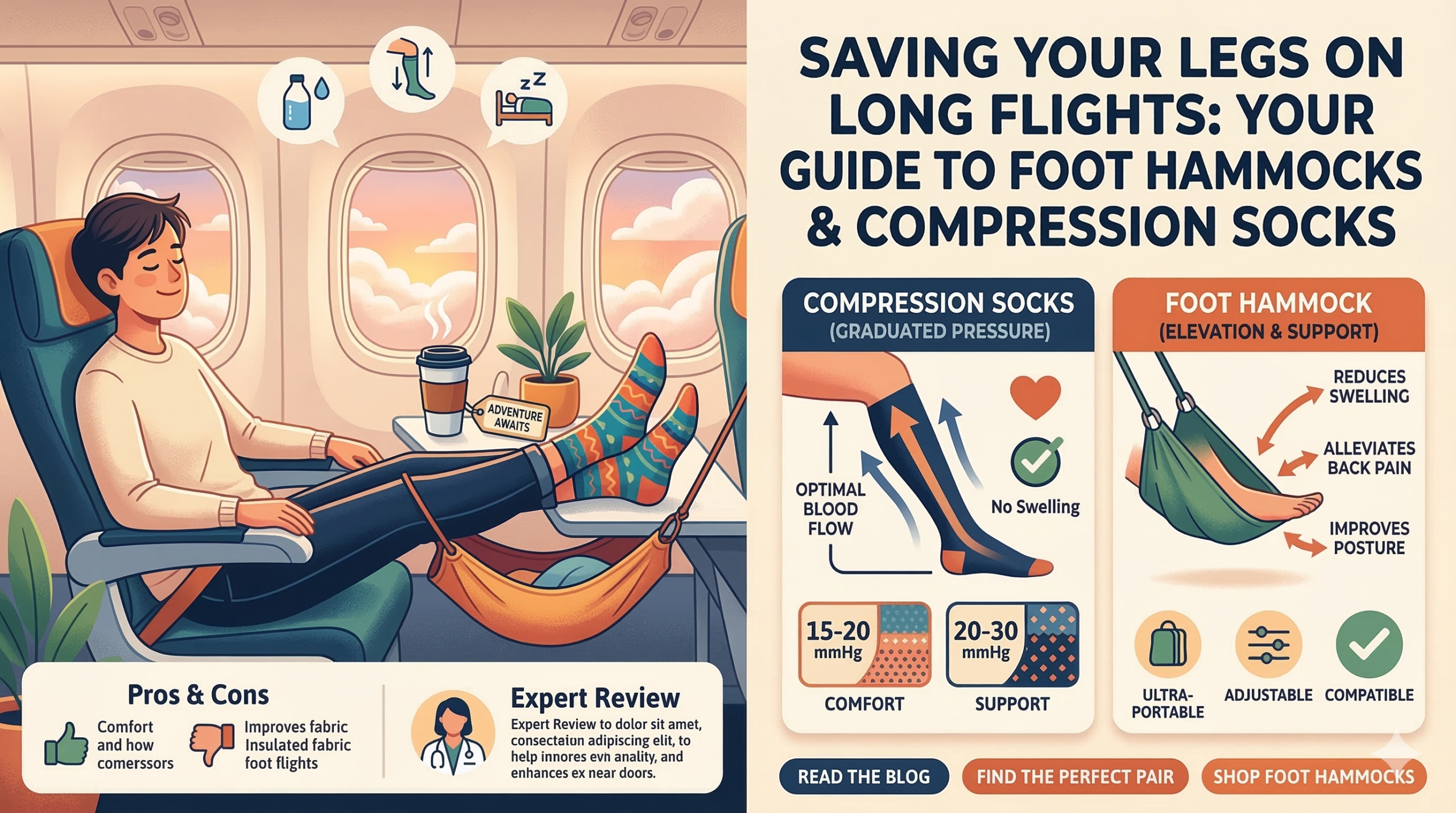
Imagine landing after a long-haul flight, ready to explore a new city, but your legs feel like lead, and your ankles are as swollen as watermelons. It’s a common and uncomfortable reality for many travelers. Hours of immobility, cramped seating, and altitude can seriously mess with your circulation. But there’s good news: you can fight back! This blog post explores two simple yet highly effective tools to keep your legs happy and healthy on long flights: foot hammocks and compression socks. Let’s dive into how these travel essentials can transform your flying experience from agonizing to genuinely relaxing.
Part 1: The Problem – Why Long Flights Are Hard on Your Legs
Let’s break down why your legs feel so terrible after hours of flying. It’s not just in your head (or your feet).
- Prolonged Immobility: This is the big one. When you sit for hours, your calf muscles—which usually help pump blood back up your legs towards your heart—are inactive. Gravity causes blood to pool in your lower legs, leading to swelling (edema). This isn’t just uncomfortable; it increases the risk of Deep Vein Thrombosis (DVT), a dangerous blood clot.
- Cramped Quarters: Economy class seats are famously tight. Limited legroom means you can’t properly extend your legs, further impeding circulation and often putting pressure on certain points, like the back of your thighs.
- Lower Cabin Pressure: The cabin is pressurized to simulate an altitude of about 6,000 to 8,000 feet. This lower pressure, combined with lower oxygen levels, can affect circulation and contribute to swelling.
- Dehydration: The air in airplane cabins is very dry. Dehydration makes your blood slightly thicker, which further impairs circulation and heightens the risk of clots.
The Solution: The key to happier legs is fighting immobility and promoting healthy blood flow. This is where foot hammocks and compression socks come into play.
Part 2: Foot Hammocks – Your Personal Footrest in the Sky
A foot hammock is exactly what it sounds like—a small hammock for your feet. It’s usually made of fabric with straps that you hang over the tray table in front of you. You can then rest your feet (or even your shins, in some cases) in it, giving them much-needed elevation and support.
How They Work: Foot hammocks address the problem of immobility by allowing you to change your foot and leg position easily. By elevating your feet, they take pressure off your lower back and help gravity do its work in moving fluid out of your lower legs. They can also prevent your feet from dangling, which is especially uncomfortable for shorter travelers.
The Pros and Cons of Foot Hammocks
| Pros | Cons |
| Simple Elevation: Provides immediate, adjustable elevation, reducing swelling. | Compatibility Issues: Some newer airplane seats have tray tables with designs that don’t accommodate the straps easily. |
| Relieves Lower Back Pain: Shifting weight and posture can ease back strain. | Potentially Disturbs Other Passengers: If it touches the seat in front, it might vibrate or push on the other passenger. (Always check before installing!) |
| Increased Comfort for Shorter Travelers: Finally, your feet have a solid place to rest, not just dangle! | Bulk in Carry-On: While lightweight, it’s still an extra item in your bag. |
| Promotes Movement: Makes it easier to wiggle your feet and do simple seated stretches. | Requires Set-Up: You need to deploy it after the tray table is accessible (usually after takeoff). |
Expert Review: Travel Writer, Amelia
“I won’t fly long-haul without my foot hammock. It’s the single best upgrade for economy class comfort. It takes all the pressure off my ankles, and I find I’m much less prone to ‘cramp’ in my lower back. Just be mindful when setting it up—ensure the straps don’t obstruct the tray latch and always test that it doesn’t disturb the person in front of you. It’s a small adjustment that makes a massive difference.”
Recommended Foot Hammocks
- [The Original ‘Foot Hammock’]: The brand that started the trend, known for durability and a padded base. (Purchase link to a popular brand on Amazon)
- [Uncharted Ultra-Portable Footrest]: A very compact and lightweight option, perfect for minimalist travelers. (Purchase link to a popular brand on Amazon)
- [High-Heel Optimized Foot Hammock]: Designs specifically crafted to support the unique arch and needs of travelers wearing heeled shoes (or just wanting more arch support). (Purchase link to a relevant product)
Part 3: Compression Socks – Your Graduated Pressure Friend
Compression socks are specialized socks designed to apply gentle pressure to your lower legs. Crucially, this pressure is graduated, meaning it’s tightest at the ankle and gradually loosens as it goes up the leg.
How They Work: This graduated compression works with your muscles to squeeze the veins, helping move blood efficiently back towards your heart. It prevents blood from pooling in the lower legs and significantly reduces the swelling (edema) and that heavy, achy feeling. More importantly, compression socks are a primary medical recommendation for reducing the risk of Deep Vein Thrombosis (DVT) during long periods of immobility, like flying. They are a non-negotiable travel essential for anyone concerned about leg health on flights longer than 4 hours.
Understanding Compression Ratings (mmHg)
The tightness is measured in millimeters of mercury (mmHg). For travel, you generally want one of the following levels:
- 15-20 mmHg (Mild): Great for general comfort, mild swelling, and prevention. This is what most healthy travelers should start with.
- 20-30 mmHg (Moderate): Best for those with known issues like varicose veins, a history of DVT, or who experience significant swelling. Consult a doctor before choosing this level.
The Pros and Cons of Compression Socks
| Pros | Cons |
| Scientifically Proven DVT Prevention: The #1 reason to wear them. They are medical-grade prevention. | Can Be Difficult to Put On: They are tight, which is the point, but can take a bit of effort, especially the higher compression levels. |
| Significantly Reduces Swelling: Keeps ankles from ballooning and prevents ‘heavy legs’ feeling. | Can Be Warm/Uncomfortable: Some materials can trap heat, which is noticeable in warm airplane cabins. |
| Improves Circulation Overall: Benefits your vascular health even beyond just travel. | Finding the Right Fit is Key: Sizing is crucial. Too tight is bad; too loose is useless. |
| Wide Variety of Styles & Materials: No longer just the beige medical socks! Think cool patterns, bamboo, and athletic styles. | Potential Skin Irritation: If made from low-quality materials or not washed properly. |
Expert Review: Dr. Sarah, Vascular Specialist
“Compression socks are essential travel gear. They are the simplest and most effective way to address the two biggest vascular risks on long flights: significant swelling and, more seriously, Deep Vein Thrombosis (DVT). The key is the graduated compression—tight at the ankle, looser up the leg. For healthy adults, a 15-20 mmHg rating is generally sufficient for prevention and comfort. If you have pre-existing conditions, a higher level might be necessary, but this requires a medical consultation. I recommend them to all my patients who fly frequently.”
Recommended Compression Socks
- [CEP Progressive Run Socks 3.0]: A highly-rated athletic sock that provides excellent graduated compression. (Purchase link to a popular brand on Amazon)
- [Vim & Vigr Cotton compression]: Known for stylish patterns and a comfortable, breathable cotton blend (typically 15-20 mmHg). (Purchase link to a relevant product)
- [Sockwell Graduated Compression Socks]: Features a blend of merino wool and bamboo, which is fantastic for moisture-wicking and comfort (often available in both 15-20 and 20-30 mmHg). (Purchase link to a popular brand on Amazon)
Part 4: Maximize Your Effort – Using Both Tools Effectively
You’ve got your tools; now here’s how to use them together for the ultimate stress-free vacation:
- Pre-Flight Preparation: Put your compression socks on before you even head to the airport. It’s easier to don them while standing on a cool, solid surface. Pack your foot hammock in an easily accessible part of your carry-on.
- In-Flight Application: Once the “fasten seatbelt” sign goes off after takeoff and it’s okay to move about, install your foot hammock. Adjust the height so that your knees are bent and your feet are comfortably resting—not dangling and not pushed too high.
- Strategic Alternation: This is the magic combo! Use your foot hammock to change positions frequently. You might put your feet in, then shift to resting just one shin, then switch to crossing your ankles on the tray table bar, then back to the hammock. At the same time, your compression socks are working continuously, providing that critical graduated pressure regardless of your foot position.
- Combine with Movement: The foot hammock and compression socks are powerful, but they don’t replace the need for movement. Make a point to wiggle your toes, roll your ankles, and do seated calf-raises every hour. If possible, stand up and walk a bit every 2-3 hours to fully activate your circulation.
The Golden Rule: Both tools work. Using them in tandem is the most potent defense.
Part 5: Updated Tips and The Comfort Checklist
The world of travel gear is always evolving. Here are some of the most current tips to ensure you’re getting the most out of your leg-saving efforts:
- Material Matters: The latest trend is comfort. Look for compression socks made with natural, breathable fibers like merino wool or bamboo to prevent that overheating, itchy feeling. For foot hammocks, soft, non-abrasive fabrics are best.
- Technology is Your Friend: Check sizing charts very carefully for both socks and hammocks. Many brands now use specific measurements (ankle circumference for socks, leg length for some hammocks) rather than just shoe size.
- Be Seat-Smart: If you’re tall, a foot hammock might be less useful or more difficult to set up. Consider booking an aisle seat for easier movement, and prioritize regular standing over elevation.
Your “Stress-Free Leg Vacation” Checklist:
- [ ] Consult with your doctor about compression level, especially if you have varicose veins, heart issues, or a history of DVT.
- [ ] Choose and purchase your compression socks. Use a sizing chart! Aim for 15-20 mmHg as a baseline.
- [ ] Choose and purchase your foot hammock. Opt for a portable, highly adjustable model.
- [ ] Wear your compression socks to the airport.
- [ ] Pack your foot hammock in your carry-on for easy access.
- [ ] Set up your foot hammock as soon as it’s safe after takeoff.
- [ ] Alternate positions using the hammock frequently.
- [ ] Perform seated exercises every hour.
- [ ] Stand up and move around the cabin every 2-3 hours.
- [ ] Stay hydrated throughout the flight.
Ready for the adventure? By investing in these two simple, inexpensive tools and adopting a proactive approach to movement, you can arrive at your destination with happy, healthy legs, ready to start your stress-free vacation from the very first step.
