
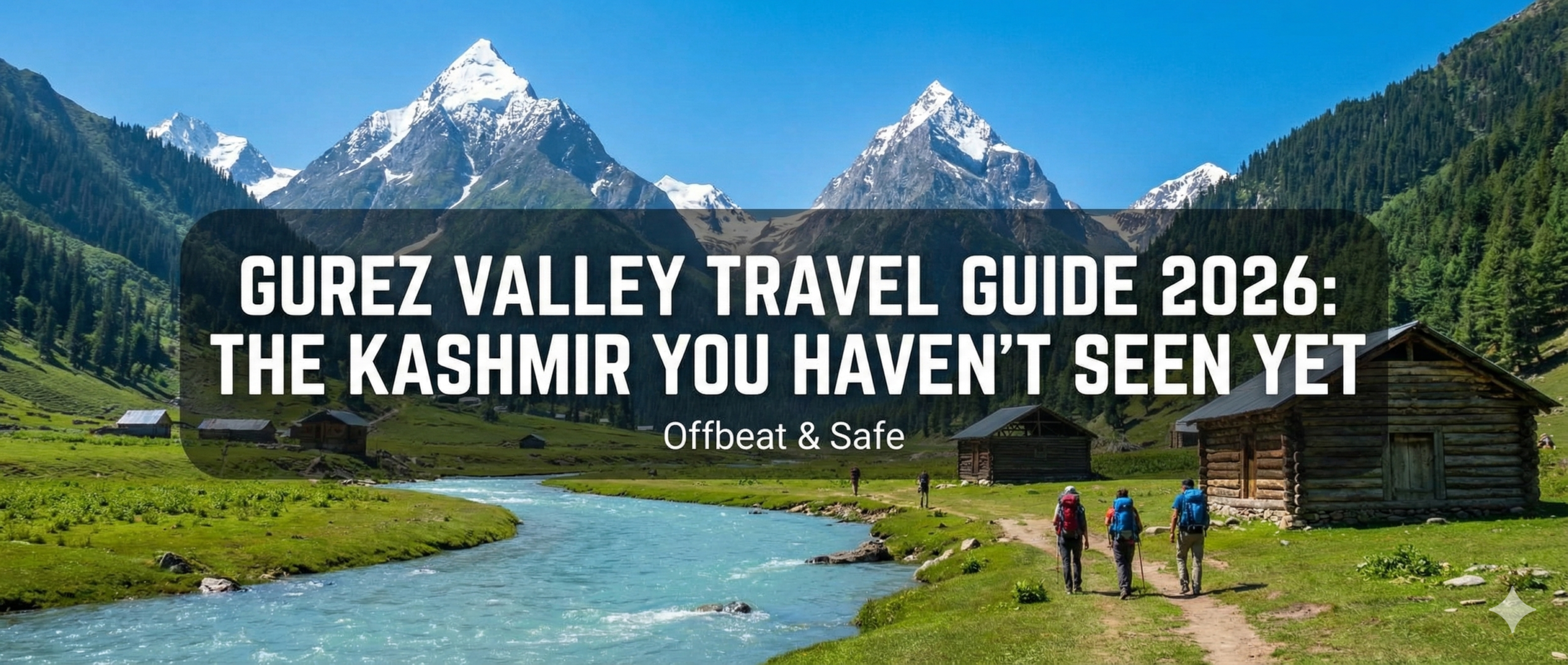
Imagine a place in Kashmir where the phone signal is weak, but the connection to nature is stronger than anywhere else. A place where wooden log huts sit quietly under pyramid-shaped mountains, and a river as clear as glass flows right through your backyard. This is Gurez Valley. While places like Gulmarg and Pahalgam are beautiful, they are often crowded. Gurez is different. It is raw, untouched, and silent.
For years, Gurez was hidden from the world. It was known mostly as a sensitive border area near the Line of Control (LoC). But things have changed. By 2026, Gurez has transformed into the safest and most exciting offbeat destination in India. The roads have improved, new homestays have opened, and the government has made it easier for tourists to visit.
This guide is written for you—the traveler who wants to see the real Kashmir. Whether you are a solo backpacker, a couple looking for peace, or a family wanting a digital detox, Gurez is the answer. In this blog, we will explore everything you need to know: how to get there, where to stay, the new permit rules for 2026, and a perfect itinerary. We will keep the language simple and easy to understand so you can plan your trip without confusion.
Also Read:- Delhi Tourism Top 20 Tourist Places Every Traveler Must See Dream Trip Guide
1. Why Gurez Valley is the “Switzerland of Kashmir”
When people call Gurez the “Switzerland of Kashmir,” they are not exaggerating. The landscape here is dramatically different from the rest of the Kashmir Valley. While Srinagar and Pahalgam have wide, open valleys, Gurez feels like a secret European village tucked away in the Alps. The valley is situated at an altitude of about 8,000 feet and is surrounded by snow-capped peaks that seem to touch the sky.
The most famous landmark here is the Habba Khatoon Peak. Unlike most jagged mountains, this peak is shaped like a perfect pyramid. It towers over the main town of Dawar and changes colors during sunset—from rocky grey to golden orange. The river that flows through the valley is the Kishanganga River. Its water is turquoise blue and ice-cold. You can sit on its banks for hours, just listening to the sound of the water.
What makes Gurez truly special in 2026 is its “time-capsule” vibe. Because it was closed off for so long, modernization hasn’t ruined it yet. The houses are still made of wood and mud (traditional log huts). The fences are made of simple wooden branches, not concrete walls. The local people, who belong to the Dard-Shina tribe, are incredibly warm and welcoming. They don’t see tourists as just customers; they see them as guests. It is very common for a local to invite you into their home for a cup of “Namkeen Chai” (salty tea).
Another reason to visit now is the peace. In popular spots like Sonamarg, you are often surrounded by hundreds of taxis and pony wallas. In Gurez, you might be the only person walking on a meadow. It offers a kind of silence that is hard to find in the modern world. However, this beauty comes with a price—remoteness. You are far away from luxury malls and 5-star hotels. But for nature lovers, this isolation is exactly the point.
The air in Gurez is crisp and pollution-free. At night, the sky is so clear that you can see the Milky Way with your naked eye. Photographers love Gurez because the light here is soft and magical. Whether you are looking at the green fields of summer or the orange hues of autumn, every corner of Gurez looks like a painting. It is not just a destination; it is an experience of slowing down and living simply.
2. The Journey: Razdan Pass and Road Conditions
Getting to Gurez is an adventure in itself. The valley is located about 125 kilometers from Srinagar, but the drive takes about 6 to 7 hours. Why so long? Because you have to cross the mighty Razdan Pass.
Razdan Pass is the gateway to Gurez. Standing at an elevation of nearly 11,672 feet, it is one of the highest motorable passes in Kashmir. The journey starts from Srinagar and takes you through the town of Bandipora. Once you leave Bandipora, the climb begins. As of 2026, the road to Razdan Pass has been widened and improved significantly by the Border Roads Organisation (BRO), but it can still be a bit bumpy in patches.
As you drive up to Razdan Pass, the view is breathtaking. You can see the Wular Lake (one of Asia’s largest freshwater lakes) spreading out below you like a giant mirror. The air gets colder, and you will see patches of snow even in June. The pass is not just a scenic point; it is a holy place. There is a shrine of a saint (Peer Baba) at the top. All drivers stop here to pray for a safe journey. It is a local tradition, and it adds a spiritual touch to the road trip.
However, tourists must be careful. The road is full of hairpin bends (curves). If you have motion sickness, it is best to take medicine before you leave Bandipora. The drive is steep, and there are no shops or petrol pumps after Bandipora until you reach Dawar in Gurez. This means you must fuel up your car in Bandipora.
The descent from Razdan Pass into Gurez Valley is magical. You leave the rocky mountains behind and enter a lush green paradise. The Kishenganga River suddenly appears next to the road, welcoming you to the valley.
Important Note for 2026:
In previous years, the road to Gurez was very rough. In 2026, the road is much better (mostly macadamized), but there are still some rough sections near the top of the pass due to heavy winter snow. You do not strictly need a 4×4 SUV to reach Gurez anymore; a decent hatchback or sedan with good ground clearance can make it if driven carefully. However, an SUV (like an Innova, Scorpio, or Thar) is still highly recommended for comfort.
Also, remember that Razdan Pass closes in winter (usually from December to March/April) due to heavy snow. The valley becomes completely cut off from the rest of the world during these months, accessible only by helicopter for emergencies. So, planning your trip between May and October is crucial.
3. Is Gurez Safe? Permits and Security in 2026
One of the biggest questions tourists ask is: “Is Gurez safe?” The short answer is: Yes, absolutely.
In the past, Gurez was a restricted area because it sits right on the border with Pakistan (the Line of Control or LoC). Tourists were hesitant to visit. However, the situation has changed dramatically in the last few years. A ceasefire agreement has kept the borders calm, and the Indian Army has worked hard to promote tourism in the region.
In 2026, you will see Army check posts along the way, but they are there for your safety, not to scare you. The soldiers are very friendly to tourists. In fact, the Army runs the famous “Log Hut Cafe” in Dawar, which is a favorite spot for visitors to have coffee and sandwiches.
Permit Rules (Updated for 2026):
The permit process has become much simpler and user-friendly.
- For Indian Tourists:
- You generally do not need a complex “Inner Line Permit” anymore for the main town of Dawar.
- However, you must carry a valid government ID proof (Aadhaar Card, Voter ID, or Driving License).
- At the Razdan Pass check post, you will have to step out of your car and register your name and vehicle details in a register. It takes 5 minutes.
- If you plan to visit the deeper parts of Gurez, like the Tulail Valley or villages very close to the border (like Chakwali), you might need permission from the local police station or Army post in Dawar. This is usually granted easily on the spot.
- For Foreign Tourists:
- Good news! As of late 2025/2026, the restrictions for foreigners have been eased. You no longer need special permission from the Home Ministry in Delhi.
- However, foreigners must still register at the Foreigners’ Registration Office (FRO) in Srinagar or Bandipora before heading to Gurez. It is highly recommended to travel with a registered local guide who can handle these formalities for you.
General Safety Tips:
- Don’t photograph military bases: While you can take photos of the scenery, avoid taking pictures of Army bunkers, bridges, or soldiers without asking. It is strictly prohibited.
- Carry physical maps: Internet connectivity is weak (more on that later). Do not rely solely on Google Maps.
- Medical Safety: Gurez has a small hospital in Dawar, but it is for basic treatment. If you have a serious medical condition, carry your own medicines. The nearest major hospital is hours away in Srinagar.
Overall, Gurez feels safer than many busy cities. The crime rate is virtually zero. You can walk around the village of Dawar late at night without any fear. The locals are protective of tourists and will go out of their way to help you if you face any trouble.
4. The Hidden Gem: Tulail Valley
Most tourists reach Gurez, stay in the main town of Dawar, and then go back. They miss the real magic. The real magic lies 40 kilometers further ahead in the Tulail Valley.
If Gurez is offbeat, Tulail is “offbeat-offbeat.” It is a sub-valley of Gurez that stretches along the river towards Drass. The landscape here changes dramatically. The valley becomes narrower, the mountains get steeper, and the greenery turns into rugged, alpine meadows full of wild flowers.
To visit Tulail, you need to drive from Dawar. The drive is one of the most scenic in the world. You pass through tiny wooden villages like Sheikhpura, Badugam, and Purana Tulail. These villages look like they are stuck in time. The houses are built entirely of logs, interlocking without nails. The children here have red cheeks and blue or green eyes, reflecting the unique ancestry of the Dard people.
The end of the road for tourists is usually the village of Chakwali. This is the last Indian village on this side of the border. From here, you can actually see the mountains of Pakistan-Occupied Kashmir (PoK). It is a thrilling feeling to be standing so close to the border in such a peaceful environment.
What to do in Tulail:
- Trout Fishing: The river in Tulail is teeming with Trout fish. If you have a permit (which you can get from the fisheries department in Dawar), you can try angling.
- Camping: Tulail is perfect for camping. There are no hotels here, only a few basic homestays. Many adventure lovers pitch their tents near the river.
- Photography: The wildflowers in Tulail (especially in June and July) are spectacular. You will see colors of purple, yellow, and pink spread across the green grass.
Important Advice for Tulail:
The road to Tulail is not as good as the road to Dawar. It is a dirt track in many places. You definitely need a sturdy car for this leg of the journey. Also, there are no petrol pumps in Tulail. You must ensure you have enough fuel to go there and come back to Dawar.
Tulail is for the traveler who wants silence. There is no phone signal here. No internet. Just you, the mountains, and the sound of the river. It is the perfect place to sit and write a book, meditate, or just disconnect from the stress of modern life. If you skip Tulail, you have only seen 50% of Gurez.
5. Culture, Food, and Accommodation
The People and Culture:
The people of Gurez are Dards. They speak the Shina language, which is different from the Kashmiri language spoken in Srinagar. They have their own unique dress, music, and traditions. The women often wear colorful headscarves and heavy jewelry. The culture is very hospitable.
Interestingly, the people of Gurez were cut off from the rest of Kashmir for centuries due to the harsh winters. This isolation helped them preserve their ancient traditions. They are believed to be the descendants of the original Aryan race.
Food in Gurez:
Don’t expect fancy restaurants or pizzas here. The food is simple, home-cooked, and delicious.
- Local Bread: Try the local tandoori bread, often eaten with tea.
- Vegetables: In summer, the locals grow fresh organic vegetables like spinach and potatoes. The taste is incredibly sweet and fresh.
- Wazwan: You can find Kashmiri Wazwan (meat dishes) in some hotels in Dawar, but it is better to stick to simple meals.
- The Log Hut Cafe: Run by the Army, this is the most “modern” place to eat. They serve coffee, momos, sandwiches, and Maggie. It is a great place to meet other travelers.
Where to Stay (Accommodation):
In 2026, accommodation options have improved, but they are still rustic.
- JKTDC Log Huts: The Jammu and Kashmir Tourism Development Corporation (JKTDC) has beautiful wooden huts in Dawar. They are comfortable and offer the best views of Habba Khatoon peak. You need to book these in advance online or through a travel agent.
- Homestays: This is the best way to experience Gurez. Many locals have converted rooms in their wooden houses into guest rooms. It is cheap, clean, and you get home-cooked food. Plus, the money goes directly to the local community.
- Camping: There are designated camping sites near the river in Dawar. You can rent tents or bring your own.
- Hotels: A few private hotels have come up in Dawar (e.g., Hotel Kaka Palace, Wood Vibes). They offer basic amenities like hot water and western toilets.
What to Pack:
- Warm Clothes: Even in July, nights can be cold (around 10°C). Bring a heavy jacket.
- Cash: This is critical. There is only one ATM in Dawar (J&K Bank), and it often runs out of cash or has link failures. Withdraw enough cash in Bandipora or Srinagar to last the whole trip.
- Power Bank: Electricity can be erratic.
- BSNL Sim Card: Jio and Airtel have started working in Dawar as of 2025/2026, but the signal can be weak. BSNL Postpaid is still the most reliable network.
Also Read:- Places to Visit in Delhi to Uttrakhand (Haridwar, Rishikesh) The Ultimate Dream Trip Guide
Quick Information Table
| Feature | Details |
| Best Time to Visit | June to September (Summer/Autumn). |
| Closed Months | December to March (Razdan Pass blocked by snow). |
| Distance | ~125 km from Srinagar (6-7 hours drive). |
| Road Status 2026 | Good up to Bandipora; Average at Razdan Pass; Good in Dawar. |
| Mobile Network | BSNL (Postpaid) is best. Jio/Airtel work intermittently in Dawar. |
| ATM Availability | Only 1 ATM in Dawar (Unreliable). Carry Cash. |
| Petrol Pump | Last pump is in Bandipora. No fuel in Gurez. |
| Permit (Indian) | Aadhaar Card + Entry at Razdan Pass Checkpost. |
| Permit (Foreign) | Passport + Visa + Registration at FRO Srinagar/Bandipora. |
| Main Attraction | Habba Khatoon Peak, Kishanganga River, Tulail Valley. |
Perfect 5-Day Gurez Valley Itinerary
| Day | Activity Plan | Night Stay |
| Day 1 | Srinagar to Gurez (Dawar). Start early (7 AM). Stop at Wular Lake view point. Cross Razdan Pass. Reach Dawar by evening. | Dawar (Log Hut/Hotel) |
| Day 2 | Explore Dawar. Sunrise view of Habba Khatoon. Visit the Habba Khatoon Spring. Walk around the local market. Evening tea at Log Hut Cafe. | Dawar |
| Day 3 | Trip to Tulail Valley. Drive to Sheikhpura and Chakwali. Picnic by the river. Return to Dawar by evening. | Dawar |
| Day 4 | Relaxation & Local Life. Short trek to Khandiyal Top for a 360-degree view. Visit a local home. Try fishing (if permitted). Bonfire at night. | Dawar |
| Day 5 | Gurez to Srinagar. Drive back via Razdan Pass. Stop for photos at the pass. Reach Srinagar by evening. | Srinagar |
Pros and Cons of Visiting Gurez
| Pros (Why you should go) | Cons (Things to consider) |
| ✅ Uncrowded: No mass tourism like Gulmarg/Manali. | ❌ Roads: The journey is long and tiring (bumpy parts). |
| ✅ Scenery: Unique alpine landscape & wooden architecture. | ❌ No Luxury: No 5-star hotels or fancy dining. |
| ✅ Safety: Very safe with helpful locals and Army presence. | ❌ Connectivity: Internet is weak; digital nomads will struggle. |
| ✅ Cost: Cheaper than other popular Kashmir destinations. | ❌ Cash Only: Online payments (UPI) rarely work. |
| ✅ Culture: Unique opportunity to experience Dard-Shina life. | ❌ Seasonality: Open only for 6 months a year. |
Expert Review (2026 Edition)
Rating: 4.8 / 5 Stars
“Gurez Valley in 2026 remains the crown jewel of offbeat Kashmir. While road connectivity has improved, making it accessible for families, it has thankfully not lost its soul. The charm of Gurez lies in its ‘nothingness’—the ability to sit by a river without hearing a car horn. It is not for the tourist who wants shopping malls and fast food. It is for the traveler who wants to reconnect with nature. The opening of the valley to foreigners and the streamlined permit process are game-changers. My advice? Go now before it becomes the next commercial hub. It is safe, stunning, and absolutely worth the bumpy ride.”
— Travel Expert, Kashmir Region
