
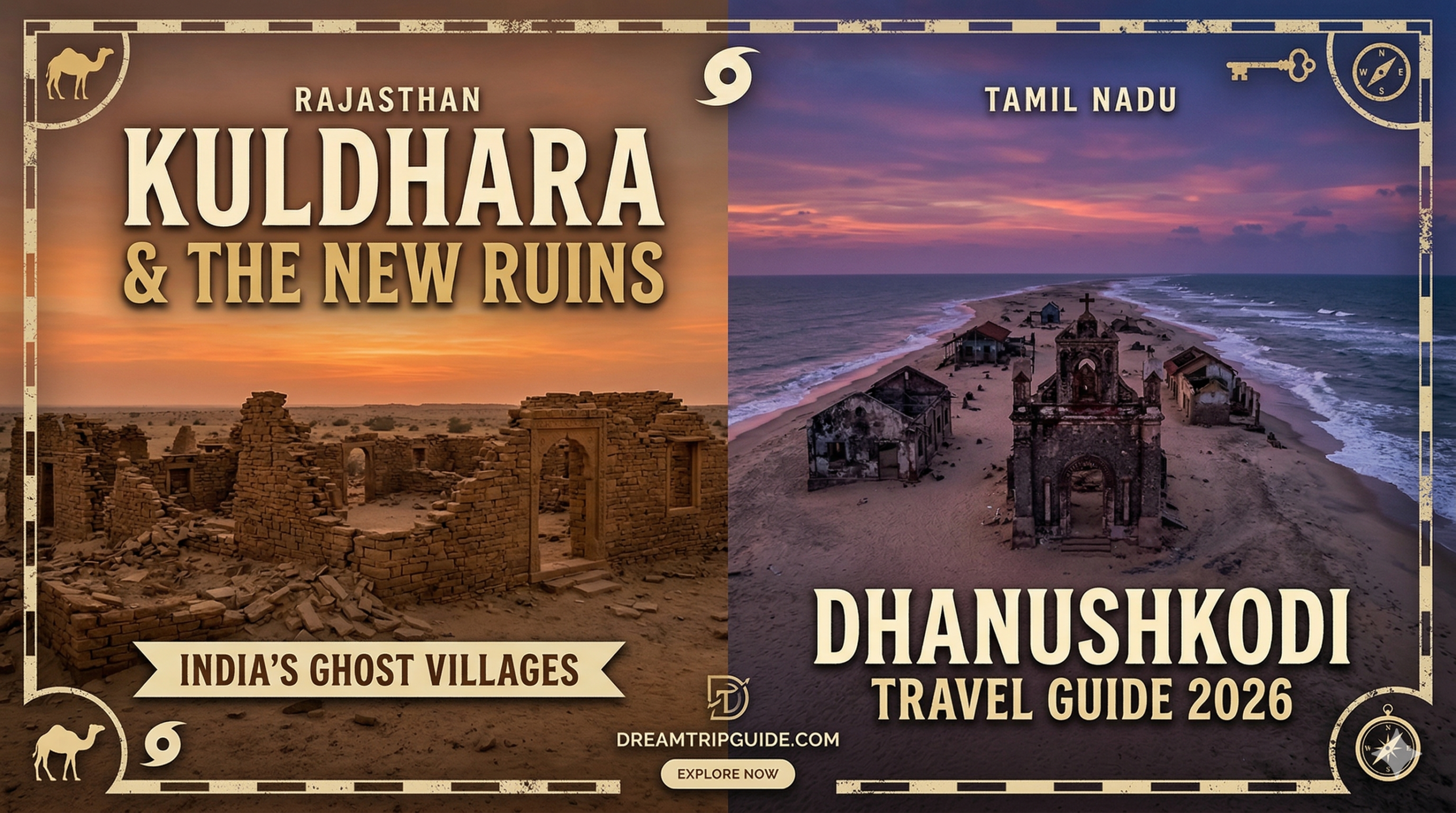
India is a land of vibrant festivals, bustling cities, and ancient traditions. However, tucked away in the shadows of its progress lie places where time has stood still—not by choice, but by desertion. From the golden sands of Rajasthan to the mist-covered peaks of Uttarakhand, “Ghost Villages” are becoming a significant part of India’s travel landscape. This is the realm of dark tourism spots India, where travelers seek the thrill of the unknown and the sorrow of the abandoned.
Whether it is a curse from the 19th century or the modern-day migration crisis in the Himalayas, these ruins tell stories of survival, fear, and ultimate departure. In this guide, we explore the legends of Kuldhara and the rising “New Ruins” across the country.
Read Also:- The Scenic Route: A Review of the Bangalore-Coimbatore Vande Bharat Experience
Kuldhara Village Story: The Night the Lights Went Out
The Kuldhara village story is perhaps the most famous legend in Indian folklore. Located just 18 km from the Golden City of Jaisalmer, this site was once a prosperous home to Paliwal Brahmins. Established in the 13th century, it was a marvel of medieval engineering, featuring sophisticated water harvesting systems in the heart of the Thar Desert.
However, the year 1825 changed everything. Legend says that the powerful and debauched Prime Minister of Jaisalmer, Salim Singh, set his eyes on the beautiful daughter of the village chief. He threatened the villagers with dire consequences and heavy taxes if they did not hand her over. Rather than compromising their honor, the entire population of Kuldhara and 83 surrounding villages vanished in a single night. Before leaving, they supposedly cast a curse: no one shall ever be able to settle in Kuldhara again.
Today, it is managed by the Archaeological Survey of India (ASI). Walking through the roofless stone houses, you can almost hear the echoes of the families that once lived here. It remains one of the top haunted places Rajasthan enthusiasts visit, especially during the golden hour when the shadows grow long and the air turns chilly.
Key Facts: Kuldhara Village
| Feature | Details |
| Location | Jaisalmer, Rajasthan |
| Era of Desertion | Early 19th Century (1825) |
| Best Time to Visit | October to March |
| Entry Fee | ₹50 per person (Approx.) |
| Atmosphere | Eerie, Historical, Desert Ruins |
Dhanushkodi Travel Guide 2026: The Ghost Town of the South
While Kuldhara was lost to a curse, Dhanushkodi was lost to the sea. Once a bustling trade town at the tip of Pamban Island in Tamil Nadu, Dhanushkodi served as a vital link between India and Sri Lanka. It had a railway station, a post office, and a church. On the night of December 22, 1964, a massive cyclone with 280 km/h winds wiped the town off the map, claiming over 1,800 lives.
In this Dhanushkodi travel guide 2026, the town has transformed. While it was once considered a forbidden zone, the government has built a world-class road (NH 87) that leads right to the “Arichal Munai” (Land’s End). You can see the ruins of the railway station and the skeleton of the church standing against the backdrop of the turquoise blue waters where the Bay of Bengal meets the Indian Ocean.
It is a surreal experience. On one side, you see the calm blue sea; on the other, the roaring waves. In 2026, Dhanushkodi is no longer just a ruin; it is a spiritual and photographic pilgrimage. It is a place that reminds us that nature can reclaim anything it wants in a matter of seconds.
Pros and Cons of Visiting Dhanushkodi
- Pros: Incredible photography opportunities, unique “End of the Land” feeling, peaceful environment.
- Cons: Very high humidity, limited food options, strictly no entry after 6:00 PM for safety.
Abandoned Villages Uttarakhand: The “Pauri” Ghost Crisis
The most recent additions to the list of abandoned villages Uttarakhand are not victims of ghosts or cyclones, but of “migration” (Palayan). In districts like Pauri Garhwal and Almora, thousands of villages have been declared “Ghost Villages” (Bhootia Gaon). According to the 2026 migration reports, over 1,500 villages in Uttarakhand have zero permanent residents.
The houses here are beautiful—built with traditional stone and carved wood (Aipan art)—but they are overgrown with weeds. Schools are empty, and the only sound is the wind through the deodar trees. The youth have moved to cities like Delhi or Dehradun for jobs, leaving the elderly behind. Eventually, when the elders pass away, the doors are locked forever.
These “New Ruins” are a different kind of haunt. They represent a socio-economic tragedy. However, they are now attracting travelers interested in “Slow Travel.” Some of these villages are being converted into homestays to bring life back to the hills. Walking through a village like Saur or Lachhiwala gives you a hauntingly beautiful perspective on how modern life is changing our ancestral roots.
Dark Tourism Spots India: Why We Seek the Eerie
The rise of dark tourism spots India is a trend that peaks in 2026. Dark tourism refers to visiting places associated with death, tragedy, or the supernatural. Why do we go? It’s the human curiosity to touch history where it was most painful. It provides a “Memento Mori”—a reminder that life is fleeting.
Apart from Kuldhara and Dhanushkodi, other spots are gaining traction:
- Bhangarh Fort: Often called the most haunted place in Asia.
- Lakhpat: A once-prosperous port in Gujarat that turned into a ghost town after an earthquake changed the course of the Indus River.
- Ross Island: In the Andamans, where the jungle is literally swallowing the old British administrative buildings.
Visiting these places requires a different mindset. You aren’t going for luxury or fun; you are going for an emotional experience. It is about standing in a place that was once full of laughter and realizing that nature always wins.
Expert Review: The Appeal of Ghost Villages
“Ghost villages offer a raw, unfiltered look at history. Unlike museums, there are no glass cases. You are walking through the actual living rooms of the past. In 2026, as our lives become more digital, these tactile, crumbling ruins offer a sense of reality that modern cities simply can’t provide.” — Aakash Verma, Heritage Consultant
Do’s and Don’ts for Exploring Ruins
When visiting haunted places Rajasthan or the ruins of the South, one must follow a strict code of ethics. These aren’t just tourist spots; they are often final resting places or sacred grounds of memory.
What to Do:
- Carry Water: Most ghost towns are in remote areas (like Kuldhara) with no shops.
- Hire a Local Guide: The stories they tell are worth more than any Wikipedia article.
- Respect the Silence: These places have a “vibe.” Avoid loud music or shouting.
- Leave Before Dark: Most of these sites (ASI protected) strictly prohibit entry after sunset for safety and security.
What Not to Do:
- Don’t Take “Souvenirs”: Taking a stone or a piece of wood from Kuldhara or Dhanushkodi is considered disrespectful and, according to locals, brings bad luck.
- Don’t Litter: These are fragile heritage sites. Plastic ruins the “ghostly” aesthetic and the environment.
- Don’t Vandalize: Writing names on ancient stone walls destroys history forever.
Summary of Major Ghost Sites
| Village/Town | State | Reason for Abandonment | Best For |
| Kuldhara | Rajasthan | Curse / Honor | History & Legends |
| Dhanushkodi | Tamil Nadu | 1964 Cyclone | Coastal Beauty & Solitude |
| Pauri Villages | Uttarakhand | Economic Migration | Culture & Slow Travel |
| Lakhpat | Gujarat | Earthquake / River Shift | Photography & Silence |
Exploring India’s ghost villages is a journey into the heart of the country’s “other” side. Whether you believe in the Kuldhara village story or you want to see the modern ruins of the Himalayas, these places offer a silence that you won’t find anywhere else. They remind us that while humans build, time and nature have the final say.
Read Also:- Budget vs. Luxury: Planning Your 2-Day Trip from Bangalore by Vande Bharat
Would you like me to create a customized travel itinerary for a 3-day trip to Kuldhara and Jaisalmer for your blog?
