
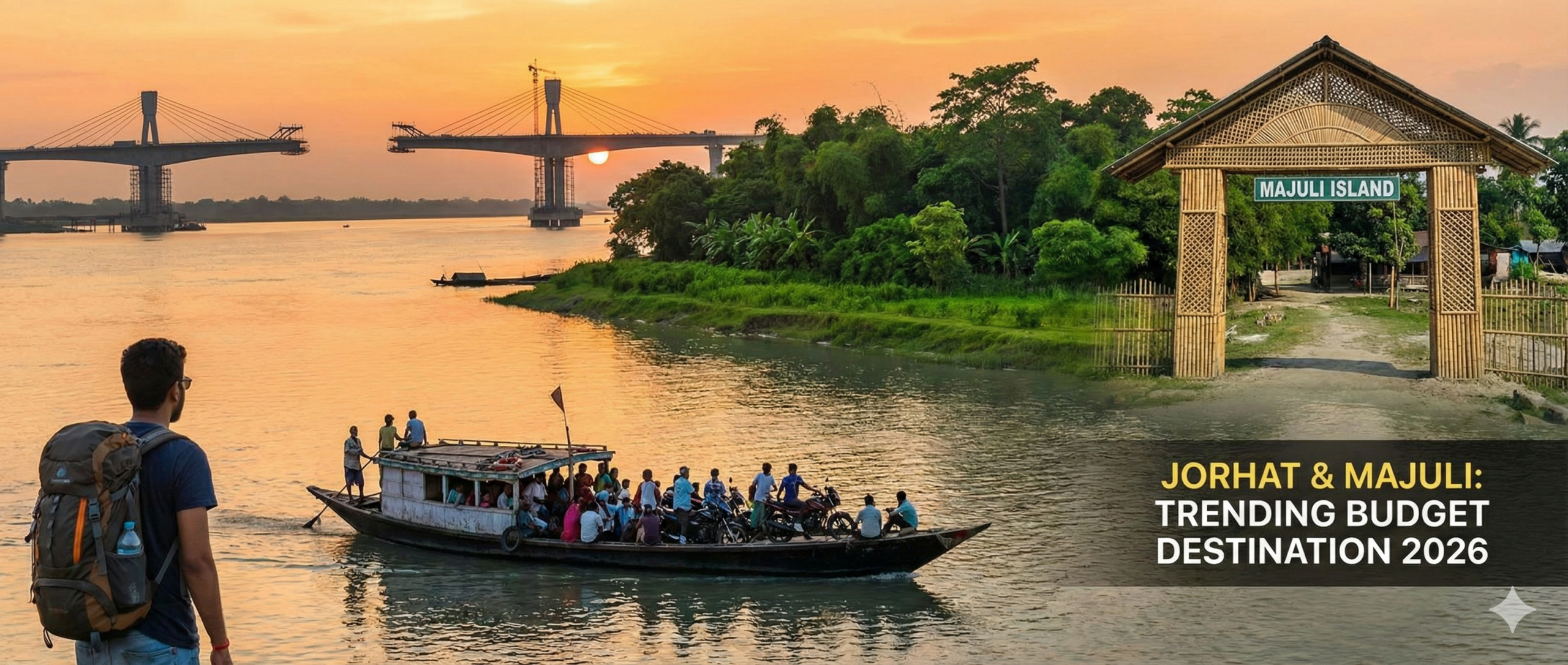
The year 2026 is seeing a massive shift in travel trends. While the world chases expensive European summers or crowded beaches in Southeast Asia, smart travelers are turning their eyes toward Northeast India. Specifically, the twin gems of Assam: Jorhat and Majuli Island.
Why now? Because Majuli is on the brink of a massive transformation. With the highly anticipated Jorhat-Majuli bridge currently under accelerated construction (slated for completion in late 2026 or 2027), this year represents perhaps the final opportunity to experience the island in its most authentic, river-isolated form. It is the perfect blend of raw culture, budget-friendly prices, and eco-tourism that defines travel in 2026.
This guide covers everything you need to know about planning a budget trip to North East India, focusing on the cultural heartland of Jorhat and the world’s largest river island, Majuli.
Read Also:- Rajasthan Tour Packages: Top 5 Royal Places
Why Jorhat & Majuli Are The Top Pick for 2026
The allure of Jorhat and Majuli in 2026 goes beyond just scenic beauty; it is about witnessing a region at a pivotal moment in history. For decades, Majuli has been a world apart, accessible only by the moody waters of the Brahmaputra River. This isolation preserved a Neo-Vaishnavite culture that dates back to the 15th century. However, with the bridge from Jorhat making rapid progress this year, the “island life” is about to change forever. Travelers in 2026 are rushing here to capture the rustic charm of the ferry rides and bamboo bridges before concrete completely takes over.
Financially, it is an unbeatable bargain. Inflation has hit popular tourist spots hard, but Assam remains incredibly affordable. A full-course Assamese thali still costs less than a coffee in Mumbai, and accommodation in bamboo cottages offers a luxury experience for a hostel price.
Moreover, 2026 has been dubbed the year of “Slow Travel.” Jorhat and Majuli demand patience. This isn’t a place for tick-box tourism. It is about sitting by the river, watching the sunset turn the Brahmaputra into liquid gold, and learning mask-making from a monk who has practiced the art for fifty years. The region also fits perfectly into the growing demand for sustainable and eco-friendly tourism. Majuli is carbon-neutral by nature, not by policy. The bicycle is the king of the road here, and single-use plastic is frowned upon by the local tribal communities.
For the budget traveler, Jorhat serves as the perfect logistical hub—a city of tea planters and colonial history—while Majuli offers the spiritual escape. Together, they form a circuit that costs a fraction of a trip to Kerala or Goa but offers double the cultural immersion.
Reaching the River Island: Ferry Logistics & Updates (2026)
Getting to Majuli is an adventure in itself and is often cited by travelers as the highlight of the trip. In 2026, the logistics have improved significantly compared to previous years, but it still requires planning.
The Gateway: Jorhat
Your journey begins in Jorhat. The city is well-connected by air and rail.
- By Air: Jorhat Airport (Rowriah Airport) has daily flights from Kolkata and Guwahati.
- By Train: Mariani Junction is the main railway hub, located about 30 minutes from Jorhat town.
The Ferry Experience: Nimati Ghat
To reach Majuli, you must travel from Jorhat to Nimati Ghat, which is about 15km from the city center. You can take a shared auto-rickshaw (approx. ₹50-₹80) or a private taxi (approx. ₹400-₹500).
In 2026, the ferry system is a mix of traditional soul and modern efficiency. The government has introduced newer RO-PAX vessels, which are safer, faster, and can carry cars and motorcycles easily.
- Government Ferry (IWT): These are the most budget-friendly. The ticket costs roughly ₹20-₹30 per person. The ride takes about 1 to 1.5 hours depending on the water current.
- Private Ferry: These are smaller boats. They are slightly faster but can feel a bit more crowded.
- Timings: The first ferry usually leaves at 7:30 AM and the last one around 3:30 PM. Crucial Update for 2026: During the winter months (November-January), fog can delay morning ferries. Always keep a buffer of 2-3 hours in your itinerary.
The Bridge Status (2026 Update)
You will see massive pillars rising from the Brahmaputra as you cross by boat. This is the Jorhat-Majuli bridge. While construction is bustling, it is not open for traffic yet. Do not plan your trip assuming you can drive straight to the island. The ferry remains your only entry point this year, which keeps the crowd numbers manageable and the vibe authentic.
Once you land on the Majuli side (usually Kamalabari or Afalamukh Ghat), you will be greeted by the vast sandy banks of the island. Shared sumos are available to take you to the main town of Garamur, or you can pre-book a taxi if you are carrying heavy luggage.
Majuli Island: The Cultural & Spiritual Soul
Majuli is not just an island; it is a living museum. It is the seat of Vaishnavite culture in Assam, spearheaded by the 15th-century saint Srimanta Sankardeva. The island is dotted with Satras (monasteries), each with its own unique identity, art form, and religious significance.
The Satras (Monasteries)
- Auniati Satra: This is one of the oldest and largest. It is famous for its collection of ancient artifacts, jewelry, and handicrafts. If you visit during the evening prayer, the sound of cymbals and drums is mesmerizing.
- Samaguri Satra: This is the most “Instagrammable” and culturally fascinating spot. It is the home of the traditional Mask Making art. The monks here create vivid, terrifying, and beautiful masks of mythological characters using bamboo and clay. You can even buy small souvenir masks here.
- Kamalabari Satra: Known for its rigorous discipline and arts, this Satra produces some of the finest classical dancers in the region.
The Mishing Villages
Majuli is also home to the Mishing tribe, an indigenous community known for their stilt houses (Chang Ghars). Walking through a Mishing village is a lesson in sustainable living. The houses are made of bamboo to survive the annual floods, and the people are incredibly hospitable. You might be invited up for a bowl of Apong (local rice beer) and a meal of pork and wild herbs.
Nature & The Molai Forest
You cannot talk about Majuli without mentioning Jadav Payeng, the “Forest Man of India.” He single-handedly planted a forest larger than Central Park on a sandbar. In 2026, the Molai Forest is lush and teeming with wildlife, including rhinos and elephants that swim across from Kaziranga. Visiting this forest is a pilgrimage for eco-tourists.
Festivals to Watch in 2026
If you can, time your trip for November 2026 to catch the Raas Mahotsav. The entire island transforms into an open-air theatre enacting the life of Lord Krishna. Every village, every child, and every elder participates. It is a spectacle of color, devotion, and drama that rivals any major festival in India.
Jorhat: The Tea Capital & Wildlife Gateway
While Majuli steals the spotlight, Jorhat is more than just a transit point. It is the Tea Capital of the World and offers a sophisticated, colonial contrast to the rustic island life.
The Tea Gardens
Jorhat is surrounded by emerald green tea estates. A visit to the Cinnamora Tea Estate (the first tea garden in Assam) is a must. Walking through the narrow lanes between tea bushes, with the aroma of fresh leaves in the air, is therapeutic. Many estates now offer “Tea Tourism” where you can stay in colonial bungalows (albeit at a higher price) or take guided tours of the factories to see how your morning brew is processed.
Hoollongapar Gibbon Sanctuary
Located just 20km from Jorhat, this sanctuary is a hidden gem for wildlife enthusiasts. It is the only sanctuary in India named after a primate, the Hoolock Gibbon. These are the only apes found in India.
- The Experience: Unlike the jeep safaris of Kaziranga, this is a walking forest. You trek through the jungle with a guard (mandatory).
- The Sighting: The Gibbons are arboreal, meaning they live in the tree canopy. Hearing their distinct, loud calls echoing through the forest is spine-chilling. You can also spot the Stump-tailed Macaque and various exotic birds.
- Best Time: Reach early! The gates open at sunrise, and that is when the Gibbons are most active.
Tocklai Tea Research Institute
For the science buffs, this is one of the oldest and largest tea research stations in the world. It’s a fascinating look into the history and future of tea.
The Gymkhana Club
Built in 1876, the Jorhat Gymkhana Club has the third-oldest golf course in the world. Even if you don’t play golf, the architecture and the vibe of the place transport you back to the British Raj era. It’s a great spot for a quiet evening walk or a photo session.
Budget Breakdown & Itinerary (2026 Estimates)
One of the biggest pros of this destination is the cost. You can have a premium experience on a shoestring budget. Below is a detailed breakdown for a standard budget traveler.
Expert Review: 5-Day Budget Itinerary
| Day | Activity | Estimated Cost (Per Person) |
| Day 1 | Arrive in Jorhat. Visit Gymkhana Club & Tea Gardens. Stay in Jorhat. | ₹1,200 (Hotel + Food) |
| Day 2 | Early morning Gibbon Sanctuary Trek. Afternoon Ferry to Majuli. Stay in Bamboo Hut. | ₹1,500 (Entry + Ferry + Stay) |
| Day 3 | Explore Majuli: Rent a Scooty/Cycle. Visit Satras (Samaguri, Auniati). Sunset at River. | ₹1,000 (Bike Rent + Food) |
| Day 4 | Village Walk (Mishing Tribe). Molai Forest boat ride. Local Rice Beer/Cuisine. | ₹800 (Boat + Food) |
| Day 5 | Morning Ferry back to Jorhat. Shopping for Tea/Masks. Departure. | ₹500 (Ferry + Misc) |
| Total | 5 Days / 4 Nights | Approx. ₹5,000 – ₹6,000 |
(Note: This excludes flight/train tickets to Jorhat. Costs are based on twin-sharing accommodation and local transport).
Cost Comparison Table
| Expense Category | Budget Option | Mid-Range/Luxury Option |
| Ferry (One Way) | ₹20 (Govt Ferry) | ₹1,500 (Private Boat Charter) |
| Accommodation | ₹500 – ₹800 (Homestay/Bamboo Hut) | ₹2,500 – ₹4,000 (Resort/Hotel) |
| Food (Per Meal) | ₹150 (Local Thali) | ₹500 (Restaurant) |
| Transport (Majuli) | ₹200 (Cycle Rent/Day) | ₹1,500 (Taxi Hire/Day) |
| Entry Fees | ₹50 (Museums/Satras) | ₹500 (Guided Tours) |
Pros & Cons, Expert Tips, and Dos & Don’ts
To ensure you have a realistic expectation of your trip, here is a brutally honest review of the destination in 2026.
Pros & Cons
| Pros (The Good Stuff) | Cons (The Challenges) |
| Unbeatable Value: Extremely cheap compared to other Indian destinations. | Infrastructure Gaps: Roads in Majuli can be bumpy and dusty. |
| Authenticity: No fake tourist traps; the culture is living and breathing. | Ferry Uncertainty: Fog or engine trouble can delay plans by hours. |
| Safety: Northeast India, and Assam specifically, is very safe for solo and female travelers. | Nightlife: Zero nightlife. Everything shuts down by 8:00 PM. |
| Digital Detox: While 4G is available, the slow pace forces you to disconnect. | ATMs: Limited ATMs on the island; cash runs out frequently. |
Expert Review
“Majuli in 2026 is a fleeting masterpiece. The bridge construction creates a visual contrast between the old world and the new. The best way to enjoy this trip is to lower your gears. Don’t rush. The ferry ride is not a commute; it’s a safari. The food is not fast; it’s organic. If you are looking for parties, go to Goa. If you are looking for peace, come to Majuli.”
Dos and Don’ts
DO:
- Carry Cash: Digital payments (UPI) work in some places, but cash is King in rural areas and for ferry tickets.
- Respect the Satras: Dress modestly (cover shoulders and knees) when entering monasteries.
- Rent a Cycle: It is the best way to see the island. The terrain is flat and green.
- Book Ferry Tickets Online: In 2026, the IWT often allows e-ticketing to skip the queue at Nimati Ghat.
DON’T:
- Don’t litter: Majuli is an eco-sensitive zone. Carry your plastic waste back to Jorhat if possible.
- Don’t ignore the clock: Ferries stop before sunset. If you miss the last boat (usually 3:30 PM), you are stuck on whichever side you are on.
- Don’t expect 5-star service: Service here is warm and friendly, but slow. Patience is key.
- Don’t disturb the monks: Ask for permission before taking photos inside the prayer halls.
Conclusion
Jorhat and Majuli offer a travel experience that is rare in 2026: a genuine connection with nature and culture without the commercial veneer. Whether you are a backpacker on a tight budget or a culture vulture looking for the next big story, this Assamese duo welcomes you with open arms. Pack your bags, catch that ferry, and witness the magic of the Brahmaputra before the bridge changes it forever.
Happy Travels!
Read Also:- Guide to South India Temple Tours: Itineraries & Tips
