
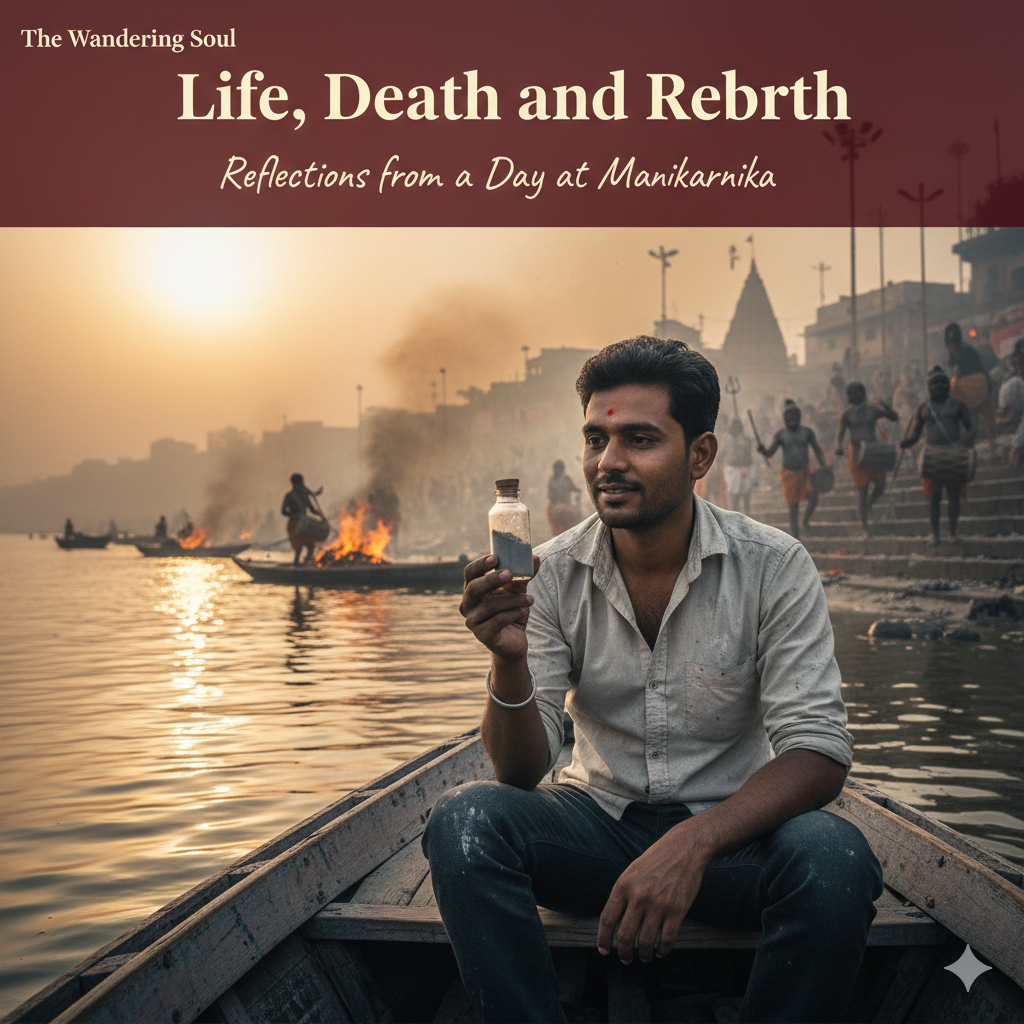
Sitting on the edge of a weathered wooden boat, the Ganges flowing beneath me like liquid silk, I watched a thin veil of gray ash settle on my sleeves. In any other part of the world, this would be cause for alarm. But here, at the Manikarnika Ghat in Varanasi, it was a blessing.
This wasn’t just any day; it was the day of Masaan Holi. While the rest of India prepares for colors and sweets, the “City of Death” celebrates with the remains of the departed. Witnessing this ritual is more than a travel experience—it is a confrontation with the one thing we spend our whole lives running away from: our own mortality.
Read Also:- Beyond Gulal: The Legend of Lord Shiva and the Ghosts of Manikarnika
1. The Smolder of Eternal Fires: A Morning at the Mahashamshan
The day begins not with the smell of incense, but with the heavy, sweet scent of sandalwood and burning wood. Manikarnika is known as the Mahashamshan (the Great Cremation Ground). Legend says the funeral pyres here have not been extinguished for thousands of years. As I walked through the “Gully” (narrow lanes) toward the ghat, I saw a contrast that only Varanasi can provide. A vendor was selling colorful bangles just ten feet away from a family carrying a shrouded body on a bamboo bier, chanting “Ram Naam Satya Hai” (The name of Ram is the only Truth).
In the Western world, we hide death behind hospital curtains and polished mahogany. In Kashi, death is a neighbor. It is loud, it is visible, and during Masaan Holi, it is even celebrated. Standing there, I realized that the fear of death often stems from its mystery. But when you see it happen twenty times an hour, it stops being a mystery and starts being a fact. The realization isn’t depressing; it’s actually quite freeing. If this is where we all end up—turned into a handful of gray dust—then the trivial worries about office politics or social media likes suddenly seem absurd.
By noon, the atmosphere shifted. The mourning families were still there, but a different energy began to pulse through the air. The Ganas (devotees of Shiva) and Naga Sadhus began to gather. They don’t see the ash as a remnant of a person, but as the final, purest form of the physical body. To them, playing Holi with this ash is a way of saying, “I am not this body; I am the soul.”
2. The Chaos of the Ash: When Mortality Becomes a Celebration
As the clock struck one, the silence of the cremation ground was shattered by the thunderous roar of Damrus (small drums) and the blowing of conch shells. This is the moment Masaan Holi truly begins. Hundreds of men, their bodies smeared in white ash, began to dance. They threw handfuls of Bhasma (sacred ash) into the air, creating a thick, silver fog that blurred the line between the sky and the river.
At first, my instinct was to pull back. It felt sacrilegious to “play” in a place of mourning. But as I watched the faces of the Sadhus, I saw a joy that was almost terrifyingly pure. They were laughing. They were celebrating Lord Shiva’s visit to the cremation ground to play with his “Ganas”—the outcasts, the spirits, and the forgotten.
This is the core of the Kashi philosophy: Advaita (Non-duality). If God is in everything, then God is in the ash as much as He is in the flower. Witnessing this changed my perspective on “endings.” We spend so much energy trying to preserve things—relationships, youth, wealth—but Masaan Holi teaches you the beauty of the “burnt.” There is a strange, wild peace in accepting that everything must break, burn, and disappear to make room for something new. I found myself no longer looking at the ash as “death,” but as a precursor to “rebirth.”
3. The River’s Silence: Reflections on Transience
As the sun began to dip, casting a golden-orange glow over the smoke-filled horizon, I took a boat out into the middle of the Ganga. From the water, the chaos of Manikarnika looked like a small, flickering star on the map of the world. The sounds of the drums became a distant hum, replaced by the rhythmic splashing of the oars.
I looked back at the ghat. One pyre was being lit, another was being swept into the river, and in the middle, the Holi celebration continued. This is the cycle of life in a single frame. The river doesn’t judge; it just carries everything away—the ashes of the rich, the poor, the saint, and the sinner.
In that moment of silence, I felt a profound sense of transience. We are all just visitors here. My “problems” back home felt like pebbles thrown into an ocean. The ego, which usually demands so much attention, felt small. Varanasi has a way of stripping you of your titles and leaving you with just your breath. I realized that the “Death” celebrated at Manikarnika isn’t the end of life; it’s the end of the illusion that we are in control. The rebirth doesn’t happen after we die; it happens the moment we stop being afraid of the inevitable.
4. Planning the Reflection: Quick Reference Guide
If you are planning to visit for this specific reflective experience, here is a breakdown of the logistical and spiritual “reality check.”
The Reality Table
| Aspect | What to Expect | My Personal Take |
| Crowd Intensity | 10/10 – Extremely packed. | Stay on a boat if you are claustrophobic. |
| Spiritual Impact | Life-altering for the open-minded. | It will make you question your life choices. |
| Visual Experience | Cinematic, raw, and gritty. | Wear sunglasses; the ash gets everywhere. |
| Noise Level | Constant drums, chanting, and bells. | It’s a “meditative chaos.” |
Pros and Cons of Witnessing Masaan Holi
Pros:
- Ultimate Perspective: You will never view life (or death) the same way again.
- Authenticity: This isn’t a performance for tourists; it is a raw, ancient tradition.
- Photographic Value: The contrast of white ash and orange fire is a visual masterpiece.
Cons:
- Sensory Overload: The smell of smoke and the sight of bodies can be traumatic for some.
- Physical Toll: The heat from the pyres combined with the crowd is exhausting.
- Ethical Dilemma: Balancing your curiosity with respect for the grieving families is a constant internal struggle.
5. Expert Review & Final Wisdom
Expert Opinion: “Varanasi is a city that requires you to surrender,” says local cultural historian Rahul Singh. “If you go to Masaan Holi with a camera and a ‘tourist’ mindset, you will see a mess. If you go with a ‘seeker’s’ mindset, you will see a miracle.”
I agree. This isn’t a trip for “fun.” It’s a trip for evolution. Masaan Holi is the ultimate “Utility” post for the soul. It teaches you that the only way to truly live is to accept that you will, one day, be the ash in someone else’s celebration.
Do’s and Don’ts for the Reflective Traveler
- Do sit in silence for at least an hour at a nearby ghat (like Scindia) before entering Manikarnika.
- Do dress in old clothes that you don’t mind getting stained by ash and smoke.
- Don’t take close-up photos of mourning families or bodies. It is deeply disrespectful.
- Don’t try to “rush” the experience. Let the city speak to you at its own pace.
- Do talk to a local priest or a boatman about the history—their stories are often better than any guidebook.
Read Also:- The Paradox of Kashi: Celebrating Life at the Great Cremation Ground
