
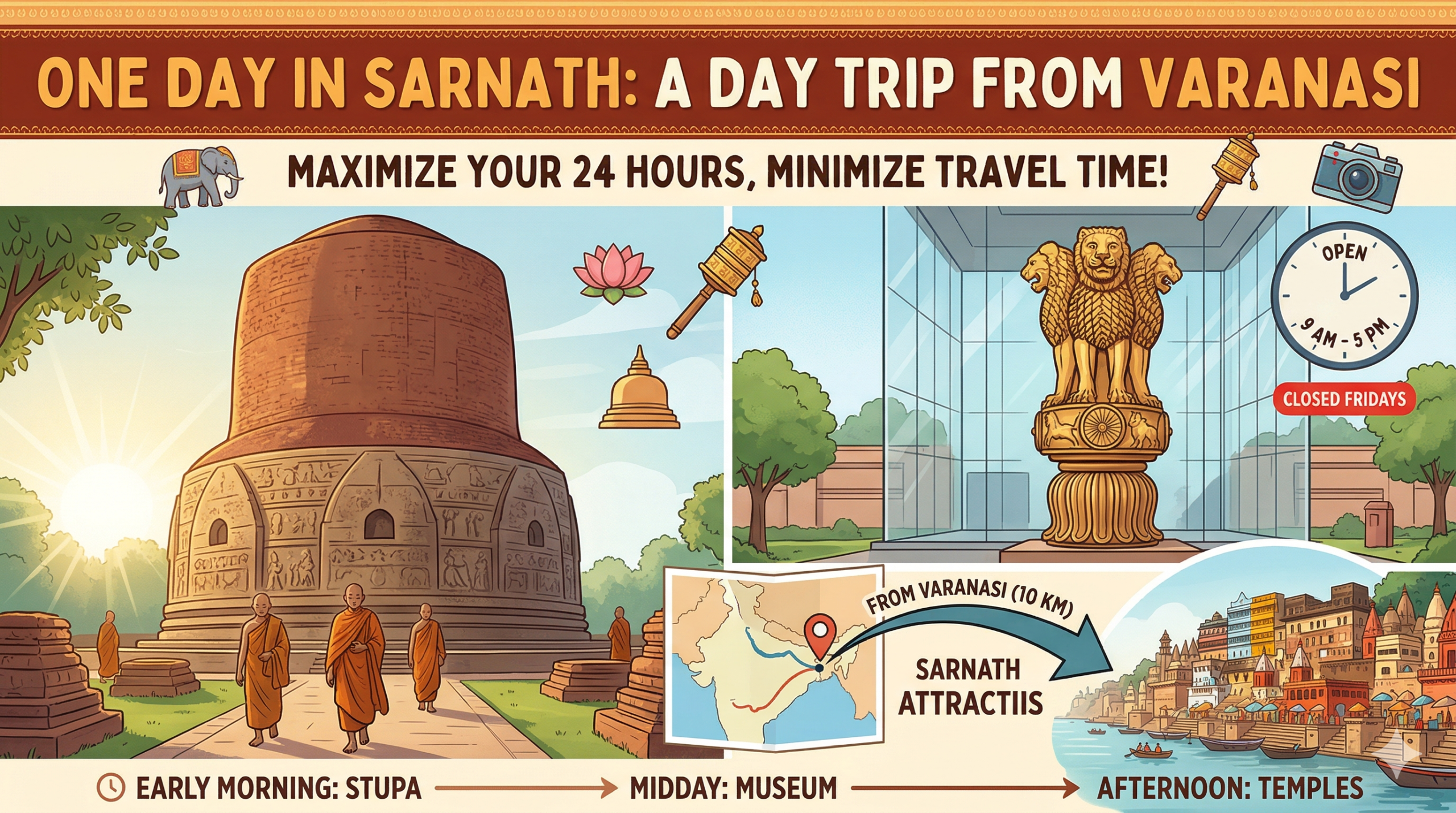
Varanasi is a city of high energy, ringing bells, and eternal fires. But just 10 kilometers ($6.2\text{ miles}$) away lies its silent, peaceful sibling: Sarnath. While Varanasi is the city of Lord Shiva, Sarnath is where Gautama Buddha gave his first sermon after attaining enlightenment. It is one of the four most important Buddhist pilgrimage sites in the world, and in 2026, it remains a “must-visit” for anyone seeking a break from the chaotic charm of the Kashi ghats.
A day trip to Sarnath is more than just a sightseeing tour; it is a walk through 2,500 years of history. From the towering Dhamek Stupa to the exquisite Ashoka Pillar ruins, the site radiates a sense of calm that is hard to find elsewhere. Whether you are a history buff, a spiritual seeker, or a traveler looking for great photography spots, Sarnath offers a perfectly paced escape. This guide will help you navigate your day trip with ease, covering everything from the iconic ruins to the latest museum timings and hidden garden cafes.
Also Read:- Varanasi’s Summer Evenings: Why the Ganga Aarti Feels Different in the Pre-Monsoon Heat
1. Morning Majesty: Exploring the Dhamek Stupa and Ruins
The best way to start your Sarnath day trip is early in the morning, ideally by 8:30 AM. The centerpiece of the archaeological park is the Dhamek Stupa. Standing at a massive 43.6 meters ($143\text{ feet}$) high, this solid cylindrical structure marks the exact spot where the Buddha is believed to have preached his first sermon to his five disciples. The intricate floral carvings on the stone base date back to the Gupta period and are a marvel of ancient Indian craftsmanship.
Surrounding the stupa are the ruins of the Dharmarajika Stupa and various ancient monasteries (viharas). Walking through these red-brick foundations gives you a sense of how vast the Buddhist university here once was. You will also see the glass-enclosed Ashoka Pillar, though its famous Lion Capital is now housed in the nearby museum. In April and May, the morning breeze makes it the perfect time to circumambulate the stupa—a traditional practice of walking clockwise around the structure to soak in its spiritual energy.
Sarnath Archaeological Park Quick-Facts
| Feature | Details (Updated 2026) |
| Opening Hours | Sunrise to Sunset (Approx. 6:00 AM – 6:30 PM) |
| Entry Fee | ₹25 (Indians), ₹300 (Foreigners) |
| Best Time to Visit | 7:00 AM to 10:00 AM (to avoid heat and crowds) |
| Main Attraction | Dhamek Stupa, Ashoka Pillar Ruins, Monasteries |
| Pro Tip | Hire a certified guide at the gate to understand the complex history. |
2. The Sarnath Museum: A Treasure Trove of Art
After exploring the ruins, head directly to the Sarnath Archaeological Museum. This is India’s oldest site museum, and it houses some of the most spectacular Buddhist art in existence. The star of the show is the Lion Capital of Ashoka, the 3rd-century BC sculpture that serves as the National Emblem of India. Seeing the original polished sandstone in person is a profound experience—it looks so smooth it almost resembles metal.
The museum also houses the famous Teaching Buddha statue, considered one of the finest examples of Gupta-period art, depicting Buddha in the Dharmachakra Pravartana Mudra. In 2026, the museum has introduced enhanced digital kiosks that explain the symbolism of each artifact. Because the museum is air-conditioned, it serves as an excellent midday retreat when the sun over the plains begins to peak. Note that the museum has strict security; cameras and large bags are usually not allowed inside, so utilize the locker facilities at the entrance.
Sarnath Museum Timings & Rules
| Detail | Information |
| Timings | 9:00 AM to 5:00 PM |
| Closed On | Fridays (Plan your trip accordingly!) |
| Mobile/Camera | Generally prohibited inside galleries (Locker available) |
| Highlight | Lion Capital of Ashoka, Standing Bodhisattvas |
| Time Required | 1.5 to 2 Hours |
3. Spiritual Serenity: The Mulagandha Kuti Vihar and Temples
Just a short walk from the archaeological park is the Mulagandha Kuti Vihar, a stunning modern Buddhist temple built in 1931. Unlike the ancient ruins, this is a living place of worship. The interior is decorated with breathtaking frescoes painted by the Japanese artist Kosetsu Nosu, depicting scenes from the life of Buddha. Every evening around 6:00 PM, you can hear the monks chanting the Dhammacakkappavattana Sutta, which adds a hypnotic, spiritual layer to your visit.
Adjacent to the temple is the Deer Park, where the Buddha originally preached. It is still home to several deer today, maintained in a fenced, grassy enclosure. Nearby, you will find various international temples built by different Buddhist communities—the Thai Temple (featuring an 80-foot standing Buddha), the Tibetan Temple, and the Japanese Temple. Each offers a unique architectural style and a glimpse into how different cultures interpret Buddhist teachings. Exploring these temples on a battery-operated rickshaw is a fun and “cool” way to get around in the summer heat.
International Temples Comparison
| Temple | Style | Key Highlight |
| Thai Temple | Thai Architecture | Giant 80-ft Standing Buddha statue |
| Tibetan Temple | Himalayan/Vajrayana | Vibrant prayer wheels and Thangka paintings |
| Japanese Temple | Zen/Minimalist | Serene wooden interiors and calm atmosphere |
| Chinese Temple | Traditional Chinese | Ornate red and gold decorations |
4. Pros, Cons, and Expert Review
A day trip to Sarnath is generally smooth, but like any major tourist hub, it has its nuances.
Pros of the Sarnath Trip:
- Proximity: It is very close to Varanasi, making it an easy 30-minute drive.
- Vibe Shift: It offers a complete contrast to the “chaos” of Varanasi—much more space and greenery.
- Education: It is an incredible place for kids and adults alike to learn about Indian history and Ashokan edicts.
- Modern Amenities: Sarnath has wider roads and better-managed traffic compared to the interior of Kashi.
Cons to Consider:
- Friday Closure: The Museum is closed on Fridays, which can ruin a trip if not planned.
- Aggressive Guides: Some unofficial guides can be persistent; it’s best to fix a price beforehand or use an audio guide app.
- The Summer Heat: Being an open-air site, the afternoon sun in April/May can be brutal without proper shade.
Expert Review
“Sarnath is often treated as an ‘add-on’ to Varanasi, but it deserves its own dedicated day. For 2026 travelers, I recommend starting with the ruins, hitting the museum by 11:30 AM to beat the heat, and lunching at one of the local garden cafes. Don’t skip the Chaukhandi Stupa on your way out—it’s the first monument you see when entering Sarnath and offers a great panoramic view.” — A. Dwivedi, Cultural Historian
5. Sarnath Survival Guide: Do’s and Don’ts
To make the most of your 24 hours in this sacred town, follow these practical tips:
What To Do
- Hire an E-Rickshaw: They are eco-friendly, cheap, and can navigate the narrow lanes between temples easily.
- Dress Respectfully: While there isn’t a strict dress code for the ruins, the active temples require shoulders and knees to be covered.
- Carry a Physical ID: You might need it for museum entry or high-security checks.
- Check the Chanting Schedule: If you can stay until evening, the chanting at Mulagandha Kuti Vihar is a soulful experience.
- Visit the Garden of Spiritual Wisdom: A newer attraction in Sarnath that uses sculptures to explain Buddhist concepts—great for a quiet walk.
What Not To Do
- Don’t Forget Sun Protection: Sarnath involves a lot of walking in open parks. Carry an umbrella and high SPF sunscreen.
- Don’t Wear Shoes Inside Temples: Standard practice across India—look for the designated shoe racks outside.
- Don’t Buy “Antiques” from Hawkers: Most “ancient coins” or “stones” sold on the street are modern fakes.
- Don’t Rush the Museum: The Lion Capital is the heart of Indian identity; give yourself time to sit and look at the detail.
- Don’t Loudly Disturb Meditators: You will see many pilgrims meditating under trees; please maintain a low volume.
Also Read:- Varanasi, Prayagraj, and Ayodhya: The Ultimate UP Pilgrimage Route
Summary Table: Your Sarnath Itinerary
| Time | Location | Purpose |
| 8:30 AM | Archaeological Park | Exploring Dhamek Stupa and Ruins |
| 11:00 AM | Sarnath Museum | Viewing the Lion Capital (National Emblem) |
| 1:00 PM | Local Cafe | Lunch (Try the local Thali or Tibetan Momos) |
| 2:30 PM | Thai & Tibetan Temples | Cultural exploration and photography |
| 4:00 PM | Chaukhandi Stupa | Visiting the meeting point of Buddha and disciples |
| 5:30 PM | Mulagandha Kuti Vihar | Evening prayers and chanting |
