
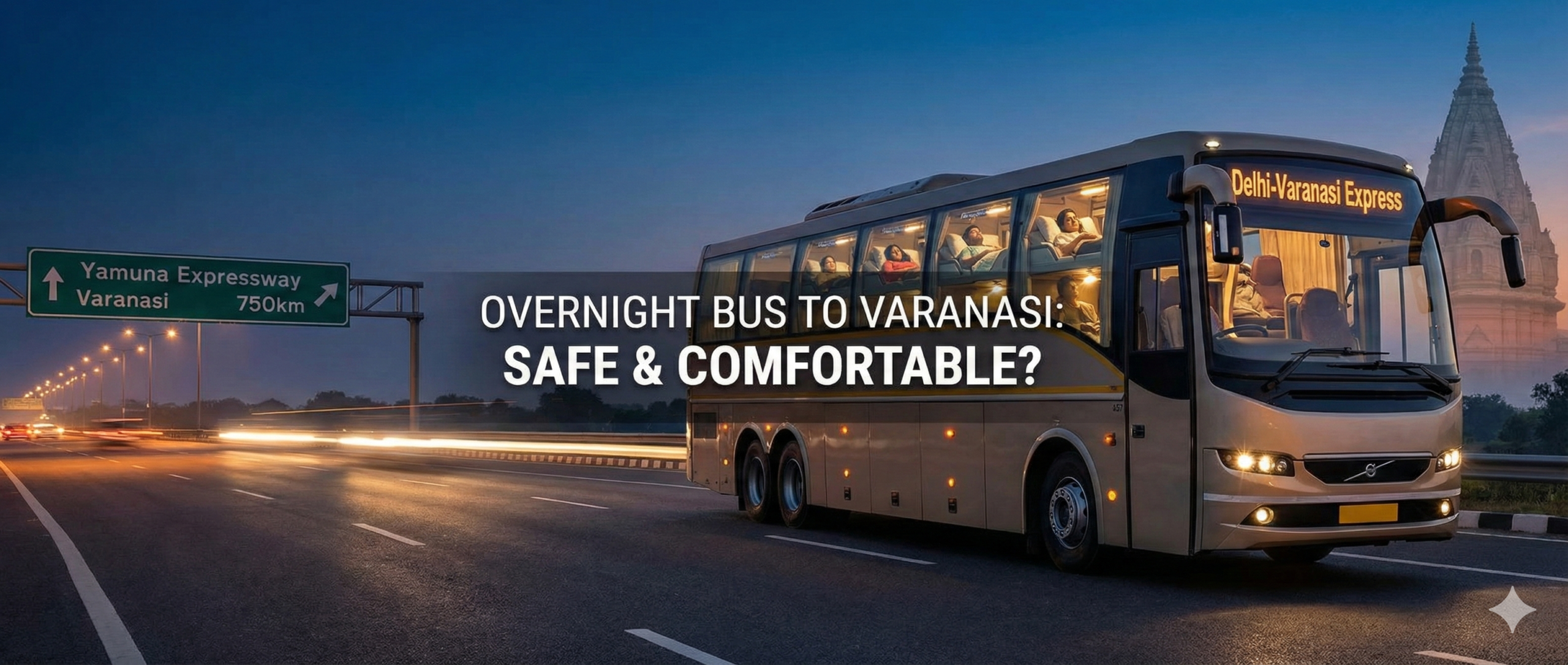
The journey from the chaotic capital of New Delhi to the spiritual heart of India, Varanasi (Kashi), is a rite of passage for many travelers. While the Vande Bharat Express train and flights are popular, the overnight sleeper bus has emerged as a surprisingly viable contender in 2026.
Thanks to the massive upgrades in Uttar Pradesh’s highway infrastructure—specifically the seamless connectivity of the Yamuna Expressway, Agra-Lucknow Expressway, and the Purvanchal Expressway—road travel has transformed. But the big questions remain: Is it safe? Can you actually sleep? And which bus should you book?
This guide covers every inch of the 800+ kilometer journey, helping you decide if the bus is the right choice for your Kashi pilgrimage.
Read Also:- Driving to Kashi? Tips for Parking and Traffic in Varanasi
1. The 2026 Road Revolution: Why Take the Bus?
Five years ago, a bus ride to Varanasi was an endurance test. It involved bumpy state highways, traffic jams in Kanpur, and a dusty, exhausting 16-hour ordeal. In 2026, the narrative has flipped.
The Expressway Effect
The primary reason to consider the bus today is the infrastructure. The route now largely bypasses the congested city centers. Buses glide from Delhi to the Yamuna Expressway, switch to the Agra-Lucknow Expressway, and often utilize parts of the Purvanchal links or upgraded National Highways to reach Varanasi.
- Smoother Ride: The suspension-destroying potholes are largely gone on the main route. Modern Volvo and Scania buses with air suspension make the ride feel more like a train journey.
- Reduced Time: What used to be 15-16 hours is now consistently clocked in 10 to 12 hours. If you board a bus in Delhi at 8:00 PM, you can realistically be at the Varanasi ghats for a morning chai.
The Rise of “Smart Buses”
Private operators like IntrCity SmartBus, Zingbus, and NueGo (electric options) have standardized the experience. These aren’t just vehicles; they are rolling hostels. In 2026, you can expect:
- Live Tracking: Share your exact location with family via an app.
- Onboard Washrooms: A game-changer for women travelers and families, reducing the reliance on potentially unhygienic roadside dhabas.
- Dedicated Lounges: Many premium operators now have air-conditioned waiting lounges in Delhi (like near RK Ashram or Kashmere Gate), so you don’t have to wait on a dusty roadside.
However, despite these upgrades, bus travel is physically different from trains. You are confined to a berth, and motion sickness can be an issue for some. It requires a specific mindset: you are trading the freedom to walk around (train) for the convenience of last-minute booking (bus).
2. Choosing Your Chariot: Government vs. Private
Not all buses are created equal. Your experience will depend entirely on the operator you choose. In 2026, the market is split between the reliable government service (UPSRTC) and tech-savvy private aggregators.
UPSRTC (The Government Option)
The Uttar Pradesh State Road Transport Corporation has upgraded its fleet significantly. Their Janrath (AC Seater) and Shatabdi/Scania (AC Sleeper/Seater) buses are known for one thing: Punctuality.
- Reliability: They rarely cancel trips last minute, unlike private operators who might consolidate buses if bookings are low.
- Safety: Drivers are vetted government employees who generally adhere to speed limits strictly.
- The Downsides: The interiors can be utilitarian. You might not get fresh blankets, charging points might be broken, and they strictly stop at government-approved dhabas which are hit-or-miss for food quality.
Private Operators (The “Luxury” Option)
Brands like IntrCity, Zingbus, Safar Express, and Gola Bus Service dominate this route.
- Luxury Factor: They compete on amenities. We are talking high-thread-count blankets, water bottles, and sometimes even snacks included in the ticket.
- The “Captain”: Many smart buses now have a “Bus Captain” (like a flight attendant) to manage passengers, ensuring no unauthorized people board and helping with luggage.
- The Risk: Private buses can sometimes delay departure to fill seats or take “shortcut” routes to save tolls, though this is becoming less common with GPS tracking.
Bus Comparison Table (2026 Data)
| Feature | UPSRTC (Govt) | IntrCity SmartBus | Zingbus / NueGo | Local Private Operators |
| Price Range | ₹800 – ₹1,500 | ₹1,200 – ₹2,500 | ₹1,000 – ₹2,200 | ₹700 – ₹1,200 |
| Punctuality | Very High | High | High | Medium/Low |
| Hygiene | Average | Excellent | Excellent | Low |
| Washroom | No (Stops only) | Yes (In-bus) | No (Freq. stops) | No |
| Safety (Women) | Good | Best (CCTV + Captain) | Very Good | Mixed |
| Blankets | Sometimes | Always (Fresh) | Always (Fresh) | Shared/Old |
| Tracking | Basic | App-based Live | App-based Live | None |
3. The “Sleeper” Experience: Comfort & Seat Selection
If you have never taken a sleeper bus in India, visualize a moving bunk bed. The layout is usually 2+1, meaning one side of the aisle has double berths (for two people) and the other has single berths.
The Single Berth Strategy
If you are a solo traveler, the Single Upper Berth is the holy grail.
- Privacy: You have your own curtain (or sliding door in premium buses). It is your personal capsule.
- View: You can watch the countryside roll by in the morning light.
- Disturbance: You are away from the aisle traffic.
The Double Berth Warning
If you are traveling alone, never book a “Shared Double Berth” unless you are comfortable sleeping shoulder-to-shoulder with a stranger. While apps allow you to see the gender of the neighbor, it is still an uncomfortable proximity for 12 hours. Double berths are strictly for couples or friends.
Lower vs. Upper Deck
- Lower Deck (Sleeper): Less sway and movement. Better for seniors or those prone to motion sickness. However, you are closer to the engine noise and the road level.
- Upper Deck (Sleeper): More swaying on turns (though less on expressways). Better privacy. AC vents can sometimes be too direct (freezing cold), so bring a hoodie.
Amenities Watch: In 2026, most AC sleeper buses provide a sealed water bottle, a clean blanket, a pillow, and a reading light. Charging ports (USB) are standard, but voltage can fluctuate—don’t leave your expensive iPhone plugged in unattended; use a power bank instead.
4. Safety First: Is it Safe for Women & Solo Travelers?
This is the most common concern. The route traverses through vast stretches of rural Uttar Pradesh at night.
Onboard Safety
- CCTV: Modern private buses are equipped with CCTV cameras in the aisle.
- Tracking: Apps allow you to share your live ride status with family. If the bus stops for an unusually long time, the central command center of brands like IntrCity often calls the driver to check.
- The “Pick-up” Point: Safety starts where you board. Avoid boarding from obscure roadside spots at night. Stick to major hubs like Kashmere Gate ISBT, Anand Vihar, or the operator’s official lounge.
Luggage Safety
Theft of luggage from the storage underbelly is rare but possible.
- Tags: Ensure the conductor puts a tag on your bag and gives you the receipt.
- Valuables: Never put laptops, cameras, or cash in the hold luggage. Keep your backpack inside your sleeper berth. In a single berth, you can easily keep a daypack at your feet or hug it while sleeping.
The “Bio-Break” Safety
This is the weak link. Buses often stop at midnight at roadside dhabas for dinner/tea.
- Lighting: Some dhabas are poorly lit.
- Advice: If you are a solo female traveler, try to use the washroom only at major, well-lit plazas. If the bus stops at a dark, isolated spot, it is better to wait or wake the conductor to ask for a better stop. This is why booking a bus with an onboard washroom is highly recommended for women.
5. Expert Review: The Verdict
(Expert insight on the 2026 bus landscape)
The Travel Editor’s Take:
“In 2026, I actually prefer the bus over the train for the Delhi-Varanasi leg, if tickets for the Vande Bharat are sold out. Why? Because the trains are often waitlisted weeks in advance. The bus offers predictability. You can book a ticket 4 hours before departure and be guaranteed a seat.
However, there is a catch. The ride quality depends 80% on the bus suspension and 20% on the driver. I highly recommend spending the extra ₹300-₹500 for a ‘Multi-Axle Volvo’ or a ‘Scania’. Do not cheap out with a standard non-AC or older AC bus; the fatigue isn’t worth the savings.
My pick: Go for IntrCity or Zingbus. Their lounges in Delhi remove the stress of finding the bus in the chaos of the roadside, and their washroom hygiene is generally superior.”
6. Pros and Cons of Overnight Bus
| Pros | Cons |
| Availability: Easy to get tickets last minute (unlike trains). | Motion Sickness: Even on smooth roads, the swaying can cause nausea. |
| Time Efficient: You sleep through the journey and save a hotel night. | Restroom Access: Unless you book a premium bus, you are at the mercy of dhaba stops. |
| Boarding Points: Multiple pickup points in Delhi (Noida, Gurgaon, Kashmiri Gate). | Legroom: Tall travelers (6ft+) might find the sleeper berths slightly cramped. |
| Connectivity: Drops you relatively close to the main city/cantonment in Varanasi. | Delays: Fog in winter (Dec-Feb) can cause massive delays on highways. |
| Privacy: Single sleeper berths offer great personal space. | Jerks: Speed breakers and city entry points can be bumpy and wake you up. |
7. What To Do and What Not To Do
✅ What To Do:
- Book the “Single” Berth: Even if it costs more, the privacy is worth it.
- Carry Snacks: Bus stops can be at odd hours (e.g., dinner at 11:30 PM). Pack dry fruits, biscuits, or a sandwich.
- Wear Slip-on Shoes: You will need to take your shoes off to climb into the berth. Laces are a hassle in the dark aisle.
- Bring Earplugs/Eye Mask: Drivers often play music, or fellow passengers might talk loudly on phones.
- Check the Drop-off Point: Varanasi traffic is notorious. Ensure your drop-off is near the Cantt Railway Station or Lehartara. Avoid buses that drop you on the highway bypass (10km away), or you will spend a fortune on autos.
❌ What Not To Do:
- Don’t Travel During Fog (Dec-Jan): If the forecast says “Dense Fog,” take the train. Buses can be delayed by 5-6 hours or become unsafe due to low visibility.
- Don’t Drink too much water: Unless your bus has a toilet, bladder control is key. Stops are usually 4-5 hours apart.
- Don’t Pick the Last Row: The seats/berths at the very back of the bus feel every bump and are right on top of the noisy engine. Middle rows are the “sweet spot” for stability.
- Don’t Trust “AC” blindly in Summers: In May/June, ACs can struggle during the day. Night travel is fine, but ensure the bus has good reviews for cooling.
Read Also:- Traveling on the Shiv Ganga Express: The Cult Favorite Train
Conclusion: Is it Worth It?
Taking an overnight sleeper bus from Delhi to Varanasi in 2026 is safe, viable, and moderately comfortable, provided you choose a premium operator. It is no longer the “budget backpacker’s struggle” but a legitimate mode of transport for families and solo travelers alike.
If you enjoy the gentle hum of the road and the convenience of waking up in a new city without the hassle of railway station queues, the bus is a fantastic option. Just remember: Book a Volvo/Scania, grab a single berth, and avoid the winter fog.
Journey well to the City of Lights!
