
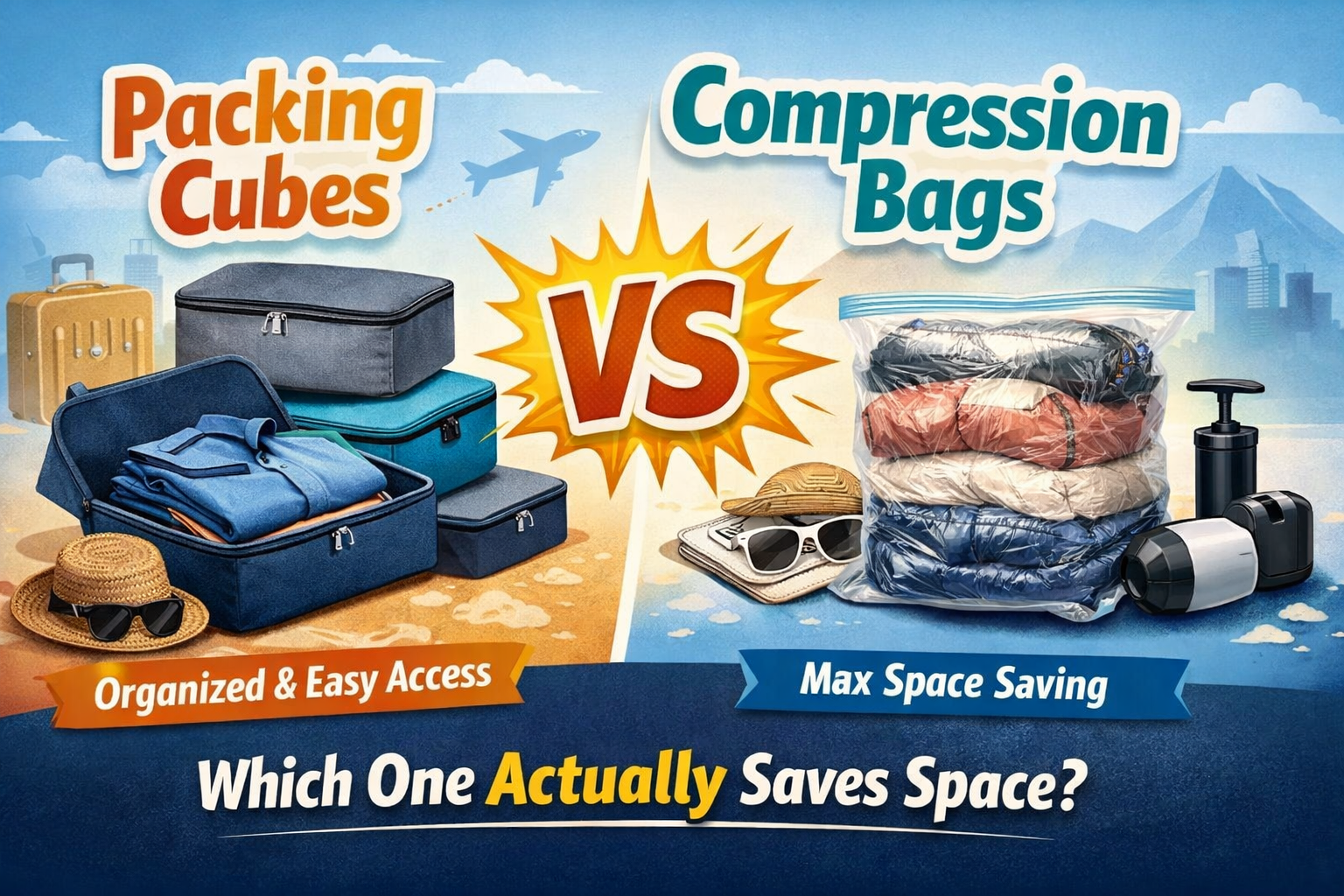
The eternal struggle of every traveler: trying to fit 10 days of clothes into a 5-day suitcase. We have all been there—sitting on our luggage, praying the zipper doesn’t burst.
In the quest for the perfectly packed bag, two challengers have emerged as the ultimate organizational tools: Packing Cubes and Compression Bags.
At first glance, they seem similar. They both put your clothes into smaller containers. But are they the same? Do they both save space? And more importantly, which one should you spend your money on in 2026?
In this ultimate guide, we will break down the differences, test their space-saving claims, and give you a definitive answer on which tool is right for your travel style. We’ll keep it simple, practical, and update you on the newest features available this year.
Also Read:- 10 Flight Essentials That Make Economy Feel Like First Class
1. What Are Packing Cubes? (Organization, Not Magic)
Think of packing cubes as drawers for your suitcase. They are rectangular or square fabric containers with a zipper opening around three sides. They come in various sizes—from tiny ones for socks to large ones for sweaters.
The Primary Goal: Organization.
The main job of a standard packing cube is to group similar items together. Instead of a chaotic pile of clothes in your suitcase, you have neat, stackable bricks. You have a “T-shirt cube,” a “pants cube,” and an “underwear cube.”
How they work:
You fold or roll your clothes and stack them neatly inside the cube. Then you zip it shut. That’s it. They don’t inherently squash your clothes down much more than you could do by hand. They just keep them contained in that squashed state.
Why people love them:
- Tetris for your bag: They fit perfectly into the corners of a rectangular suitcase, utilizing every inch of space.
- Easy access: Need a fresh pair of socks? You don’t have to dig through your whole bag. Just grab the small cube.
- Living out of a suitcase: When you arrive at your hotel, you can take the cubes out and place them directly into the hotel drawer. Unpacking takes 10 seconds.
The 2026 Update:
In 2026, the best packing cubes are made of ultra-lightweight, durable materials like ripstop nylon. They often feature a mesh window so you can see what’s inside without opening it. Brands have also started adding antimicrobial coatings to keep smelly clothes from stinking up the rest of your bag.
Does it save space?
Yes, but only a little. By organizing your clothes tightly, you eliminate the “dead air” pockets between messy clothing piles. However, a standard packing cube will not make a fluffy sweater magically smaller. It just neatly packages the sweater.
Best For:
The organized traveler who hates chaos, moves hotels frequently, and wants easy access to their gear.
2. What Are Compression Bags? (The Space Shrinkers)
If packing cubes are drawers, compression bags are hydraulic presses. Their primary goal is not organization; it is volume reduction. They are designed to physically remove the air from your clothes, making them as flat as a pancake.
There are two main types you’ll see in 2026:
Type A: Plastic Vacuum Bags (Roll-Up Style)
These look like giant, tough Ziploc bags. You put your clothes in, seal the top, and then roll the bag from one end to the other. At the bottom of the bag, there is a one-way valve that forces the air out as you roll. You don’t need a vacuum cleaner.
- Effect: They turn a puffy pile of clothes into a hard, flat sheet. They are incredibly effective at shrinking bulky items like fleece jackets, ski gear, or dirty laundry.
Type B: Compression Packing Cubes (Zipper Style)
This is a hybrid. It looks like a regular fabric packing cube, but it has two zippers.
- You fill the cube with clothes and close the main zipper, just like a normal cube.
- Then, you use a second “compression zipper” that runs around the outside edge. As you zip this second one, it squashes the top and bottom of the bag together, forcing air out through the fabric seams.
- Effect: It compresses your clothes by about 30-40%. It’s not as flat as the plastic vacuum bags, but it’s much more durable and easier to access.
The 2026 Update:
The plastic vacuum bags haven’t changed much, but the zipper-style compression cubes have gotten much better. The zippers are stronger (less likely to snag or break), and the fabrics are lighter but tougher.
Does it save space?
Yes, significantly. This is the clear winner for raw space-saving. By removing air, you can fit 2-3 times more clothes into the same space, especially bulky items.
Best For:
The over-packer, long-term travelers, backpackers with limited space, or anyone traveling with bulky winter clothing.
3. The Showdown: Testing Space-Saving Claims
Let’s put them to the test. Imagine we have 5 large cotton t-shirts, 2 pairs of jeans, and 1 thick hoodie.
Scenario 1: No Organizers (Loose Packing)
You fold the jeans and hoodie and place them in the bottom. You roll the t-shirts and shove them into the gaps.
- Result: The suitcase looks full. The clothes will shift and unroll during transit. Finding a specific t-shirt means messing up the whole pile.
- Space Used: 100%
Scenario 2: Standard Packing Cubes
You neatly roll the 5 t-shirts and fit them perfectly into a medium cube. You fold the jeans and hoodie into a large cube. You place both bricks into the suitcase.
- Result: The clothes are organized. You can see exactly where everything is. The cubes fit together nicely, leaving a clean, flat surface on top for your shoes or toiletry bag.
- Space Used: approx. 85-90%. You saved a little space by removing air pockets, but the clothes themselves are the same size.
Scenario 3: Compression Bags (Zipper Style)
You stuff the t-shirts into a medium compression cube. It looks overly full. You struggle to zip the main zipper. Then, you carefully zip the second compression zipper. The bag shrinks down visibly, becoming a dense, hard brick. You do the same for the jeans and hoodie.
- Result: The two bricks are significantly thinner than the standard cubes. You now have a substantial amount of extra space in your suitcase—enough for an extra pair of shoes or souvenirs.
- Space Used: approx. 60-70%.
Scenario 4: Compression Bags (Plastic Vacuum Style)
You put everything into a large plastic bag. You seal it and roll it aggressively on the floor. All the air hisses out. You are left with a rock-hard, flat slab of clothes.
- Result: Maximum space saving. The clothes take up half the room they did originally. However, your clothes are now a solid block. If you need one t-shirt, you have to break the seal, let the air back in, rustle through the bag, and then re-roll the whole thing. It’s a hassle.
- Space Used: approx. 50%.
Conclusion of the Test:
Compression bags are the undisputed kings of saving space. But space isn’t the only factor. Convenience matters too.
4. The Hidden Problem: Weight vs. Volume
This is the most important chapter of this guide, and the one most travelers ignore.
Compression bags save volume, but they do not save weight.
If you have a 50 lb (23 kg) checked bag limit, and you use compression bags to fit twice as many clothes in, your bag will now weigh 100 lbs. You will be hit with massive overweight baggage fees at the airport.
Compression bags are a trap for over-packers. They enable you to pack more than you can carry.
The Physics of Packing:
- A cotton t-shirt weighs about 150 grams, whether it’s fluffy with air or compressed into a pancake.
- 10 t-shirts weigh 1.5 kg. Compressing them doesn’t make them lighter.
When to use compression safely:
Compression is best used for items that are bulky but light.
- Good candidates: Down jackets, pillows, fleece sweaters, ski bibs. These items are mostly air, so compressing them saves tons of space without adding much weight.
- Bad candidates: Jeans, heavy cotton hoodies, dense wool. Compressing these saves some space, but they are already heavy dense fabrics, so you risk hitting weight limits fast.
The 2026 Traveler’s Rule:
If you are traveling with only a carry-on (where weight limits are rarely checked, only size), compression bags are your best friend. You can stuff a week’s worth of clothes into a small backpack.
If you are checking a bag, use compression with extreme caution. Always weigh your bag with a portable luggage scale before heading to the airport.
Standard packing cubes don’t have this problem. Since they don’t encourage you to overstuff, you are less likely to exceed weight limits inadvertently. They help you manage what you have, rather than enabling you to bring more.
5. Comparison Table: The 2026 Cheat Sheet
Here is a quick view of the key differences to help you decide.
| Feature | Standard Packing Cubes | Zipper Compression Cubes | Plastic Vacuum Bags |
| Primary Goal | Organization & Access | Space Saving & Organization | Maximum Space Saving |
| Space Saved | Low (10-15%) | Medium (30-40%) | High (50%+) |
| Durability | High (Nylon fabric) | Medium (Zippers take stress) | Low (Plastic tears easily) |
| Ease of Access | Excellent (Like a drawer) | Good (Unzip compression first) | Poor (Must reseal & reroll) |
| Wrinkles | Minimal (Clothes stay folded) | Moderate (Clothes get squished) | High (Clothes get crushed) |
| Best For… | Organization freaks, hotel hopping, business travel | Carry-on only travelers, backpackers, general use | Moving house, storing winter clothes, dirty laundry |
| Weight Risk | Low risk of overpacking | Medium risk | High risk of overweight bags |
6. Pros and Cons
Standard Packing Cubes
Pros:
- ✅ Superior Organization: Keeps similar items together.
- ✅ Easy Unpacking: Move cubes directly from bag to hotel drawer.
- ✅ Less Wrinkling: Clothes aren’t crushed under extreme pressure.
- ✅ Durable: Quality nylon cubes last for years.
Cons:
- ❌ Minimal Space Savings: Doesn’t make bulky items much smaller.
- ❌ Cost: A good set can be pricey ($40-$60).
Compression Bags (Zipper & Plastic)
Pros:
- ✅ Massive Space Savings: Fits significantly more into your luggage.
- ✅ Tames Bulky Gear: Perfect for winter coats and pillows.
- ✅ Laundry Managment: Plastic bags are great for sealing away smelly dirty clothes.
Cons:
- ❌ Wrinkle City: Your clothes will come out looking like a crumpled paper ball.
- ❌ Weight Trap: Easy to exceed airline weight limits.
- ❌ Durability Issues: Compression zippers break; plastic bags get punctures.
- ❌ Hassle to Access: Grabbing one item is a multi-step process.
7. Expert Review (2026 Edition)
The Final Verdict for the 2026 Traveler
“As someone who lives on the road, I’ve tried every packing gadget ever invented. Here is my honest take for 2026:
The Plastic Vacuum Bags are a gimmick for regular travel. They are loud, they rip, and they make your clothes impossibly wrinkled. Save them for storing your winter duvets at home.
The real battle is between Standard Cubes and Zipper Compression Cubes.
If you are a carry-on-only traveler, get the Zipper Compression Cubes. The ability to squeeze that extra hoodie into your personal item bin is priceless. The slight increase in wrinkles is worth the freedom of no checked bags.
If you check a bag, stick with Standard Packing Cubes. You have the space. What you need is organization so you don’t lose your mind living out of a large suitcase. They are easier to use, last longer, and won’t tempt you to pack 70 lbs of gear.”
— Professional Travel Blogger & Gear Tester
