
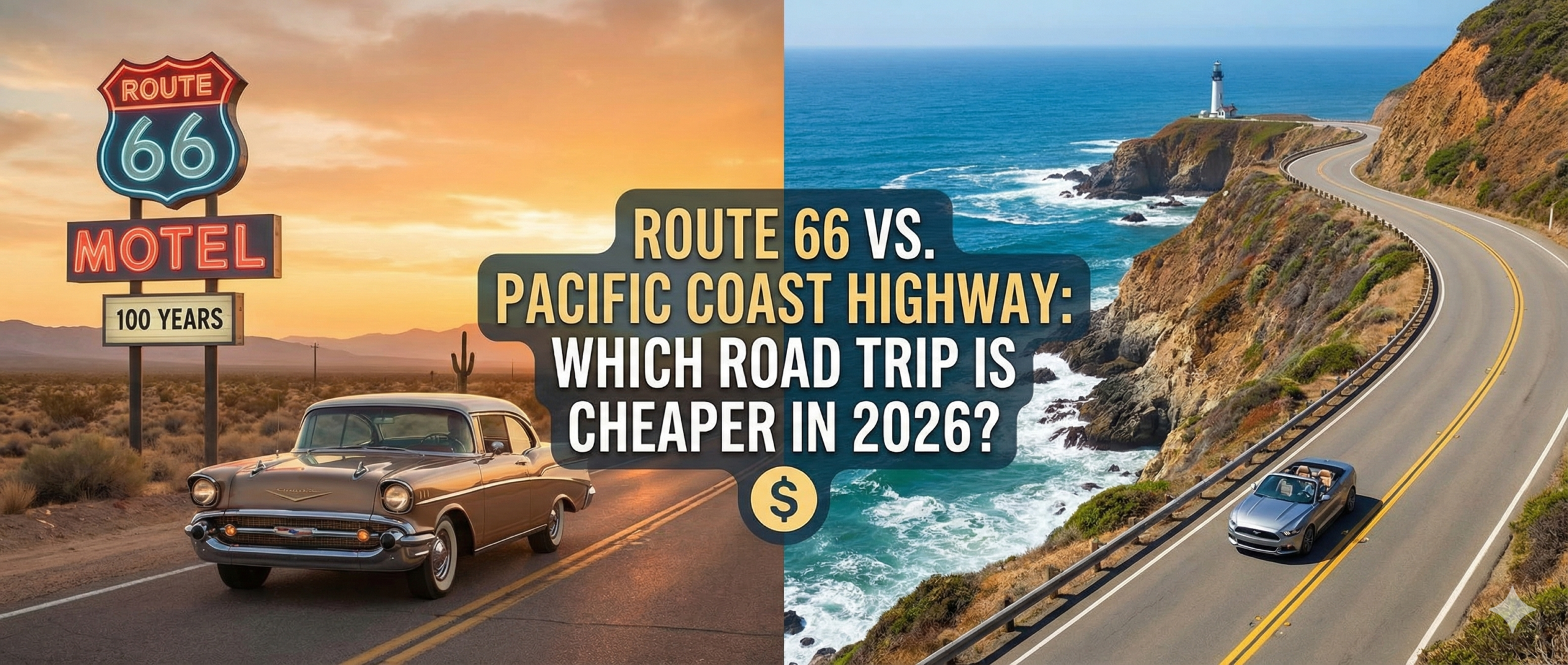
The year 2026 is shaping up to be a historic year for American road trips. Gas prices are stabilizing, travel demand is booming, and the legendary Route 66 is celebrating its 100th Anniversary.
If you are planning the ultimate driving vacation, you are likely torn between the two heavyweights: Route 66 (The Mother Road) and The Pacific Coast Highway (Highway 1).
One is a journey through history, dust, and neon lights across the heart of America. The other is a stunning, wind-in-your-hair drive along the edge of the world’s largest ocean. But when it comes to your wallet, which one wins?
Is the shorter, scenic PCH cheaper? Or does the budget-friendly Midwest make Route 66 the bargain choice? In this guide, we break down the costs, the vibe, and the “hidden” expenses for 2026 to help you decide.
Also Read:- Is Boise, Idaho Worth Visiting? A Luxury Guide for Foreigners
1. The Route Breakdown: Miles and Time
Before we talk about money, we need to talk about scale. These two road trips are completely different beasts. Understanding the distance is the first step in calculating your budget.
Route 66: The Cross-Country Giant
Route 66 is not just a drive; it is an expedition. It stretches approximately 2,448 miles from Chicago, Illinois, to Santa Monica, California. It crosses eight states (Illinois, Missouri, Kansas, Oklahoma, Texas, New Mexico, Arizona, and California) and three time zones.
- Recommended Time: To do it right, you need at least 14 to 16 days. Driving it faster than that means you are just staring at the highway and missing the quirky roadside attractions that make it famous.
- The Vibe: It is about nostalgia. You will see old gas stations, giant statues of fiberglass men, vintage motels, and vast changing landscapes—from cornfields to deserts.
Pacific Coast Highway (PCH): The Coastal Sprint
The PCH (California Highway 1) is much shorter. While you can extend it all the way up to Washington, the classic “PCH Road Trip” usually runs from San Francisco to San Diego (or Los Angeles). This stretch is roughly 600 to 650 miles.
- Recommended Time: You can drive it in 2 days, but you should take 5 to 7 days. This allows you to stop at beaches, hike in Big Sur, and enjoy the towns.
- The Vibe: It is about luxury and nature. Think crashing waves, expensive wine, convertible cars, and golden sunsets. It is sleek, romantic, and incredibly photogenic.
The Cost Implication:
Right off the bat, you can see the difference. Route 66 requires you to pay for 14 nights of hotels and 2 weeks of food. The PCH only requires about 6 nights. However, daily costs on the PCH are much higher.
2026 Special Note:
Because 2026 is the Centennial (100th Year) of Route 66, expect it to be busier than usual. Towns along the route are planning festivals, car shows, and parties. This makes it a “once-in-a-lifetime” year to go, but it might also mean you need to book motels earlier than usual.
2. Fuel Costs in 2026: California vs. The Heartland
Gas is usually the first thing people budget for, and in 2026, the price difference between these two routes is drastic.
The “California Premium” on PCH
The Pacific Coast Highway is located entirely in California (and potentially Oregon/Washington if you go north). The West Coast has the highest fuel prices in the United States due to strict environmental regulations and local taxes.
- 2026 Forecast: In 2026, gas prices in California are projected to hover between $4.10 and $4.70 per gallon. In tourist hotspots like Big Sur or remote coastal towns, it can easily surge past $5.50.
- Terrain Factor: The PCH is winding and hilly. You will be braking and accelerating constantly around curves, which burns more fuel than steady highway driving.
The “Midwest Discount” on Route 66
Route 66 spends most of its time in the Midwest and South (Missouri, Oklahoma, Texas). These states historically have the cheapest gas in the country.
- 2026 Forecast: You can expect to pay around $2.80 to $3.40 per gallon for the majority of the trip.
- The Catch: While the price per gallon is much lower, you are driving 4x the distance.
- Route 66 Math: 2,500 miles / 25 mpg = 100 gallons x $3.20 (avg) = $320.
- PCH Math: 650 miles / 25 mpg = 26 gallons x $4.50 (avg) = $117.
Winner: The Pacific Coast Highway is cheaper for total fuel cost simply because it is shorter. However, Route 66 offers much better value per mile.
EV (Electric Vehicle) Considerations for 2026:
- PCH: California has the best charging infrastructure in the US. You will have no trouble finding fast chargers at hotels and scenic stops.
- Route 66: Charging stations are becoming common, but there are still “dead zones” in the deserts of New Mexico and Arizona. If you drive a Tesla, you are fine. If you drive a non-Tesla EV, you need to plan carefully.
3. Accommodation: Motels vs. Seaside Resorts
This is where the budget gap really widens. The type of place you sleep in on Route 66 is fundamentally different from the PCH.
Route 66: The Kingdom of the $80 Motel
Route 66 is famous for its vintage “Motor Courts” and mom-and-pop motels. In 2026, many of these have been renovated to be retro-cool but remain affordable.
- Average Cost: You can easily find clean, safe motels for $70 – $110 per night. Even the “famous” historic hotels (like the Blue Swallow Motel in Tucumcari) rarely charge more than $130.
- Availability: Outside of major cities (Chicago/LA), you can often just drive up and get a room, though booking ahead is smarter for the 2026 Centennial.
PCH: The Land of the $300 View
Real estate on the California coast is some of the most expensive in the world. Hotels know you are there for the view, and they charge for it.
- Average Cost: A basic hotel in standard towns (like Monterey or San Luis Obispo) will run $180 – $250 per night.
- The Big Sur Problem: If you want to stay in Big Sur or near the water in Santa Barbara, prices often start at $400 – $800 per night.
- Budget Hacks: To save money on the PCH, you often have to stay 20 minutes inland (away from the ocean), which kills the vibe a little.
Camping:
- Route 66: KOA campgrounds and RV parks are everywhere and cheap ($30-$50).
- PCH: State Park campgrounds (like Pfeiffer Big Sur) are stunning but cost $35-$60 and—crucially—must be booked 6 months in advance. You cannot just “show up” and camp on the PCH in 2026.
Verdict:
Route 66 is far cheaper per night.
- 14 Nights on Route 66 @ $100/night = $1,400.
- 7 Nights on PCH @ $250/night = $1,750.Even though Route 66 is twice as long, the total lodging cost is often lower than a week on the California coast.
4. Food & Car Rental: Burgers vs. Seafood
Food Expenses
- Route 66: The diet here is “Diner Americana.” Pancakes, burgers, fried chicken, and milkshakes.
- Cost: You can get a hearty sit-down meal for $15-$20.
- Daily Budget: $50 per person is plenty.
- PCH: The food is a highlight. Fresh oysters in Tomales Bay, wine tasting in Paso Robles, seafood pasta in Santa Barbara.
- Cost: A nice dinner will easily run $40-$80 per person. Even a clam chowder bowl for lunch is $18.
- Daily Budget: Plan for $100+ per person if you want to enjoy the local specialties.
Car Rental: The One-Way Fee Trap
This is the hidden killer for Route 66 budgets.
- Route 66: Almost everyone drives one-way (Chicago to LA). Rental car companies charge a massive “One-Way Drop-off Fee” for returning a car to a different state. In 2026, this fee can range from $500 to $1,000 on top of the rental price.
- PCH: You can easily do a “loop” (Start and end in LA or SF) to avoid this fee. Even if you drive one-way (SF to LA), the drop-off fee within California is usually much smaller or sometimes waived.
Attractions
- Route 66: Most attractions are cheap or free. The Cadillac Ranch is free. The roadside giants are free. Small museums charge $5-$10.
- PCH: Hearst Castle tours ($30+), Monterey Bay Aquarium ($60+), and State Park parking fees ($10 per stop) add up quickly.
5. Comparison Table: The 2026 Budget Breakdown
Here is a realistic cost estimate for a couple (2 people) sharing one room and one car.
| Expense Category | Route 66 (14 Days) | Pacific Coast Hwy (7 Days) |
| Duration | 14 Days / 13 Nights | 7 Days / 6 Nights |
| Distance | ~2,500 Miles | ~650 Miles |
| Avg. Gas Price (2026) | $3.20 / gallon | $4.50 / gallon |
| Total Fuel Cost | ~$320 | ~$120 |
| Accommodation | $1,400 (Avg $108/night) | $1,500 (Avg $250/night) |
| Food & Drink | $1,400 ($100/day for two) | $1,400 ($200/day for two) |
| Car Rental (Standard) | $1,800 (Includes 1-way fee) | $600 (Loop or in-state) |
| Attractions | $200 (Museums/Parks) | $400 (Tours/Aquariums) |
| TOTAL TRIP COST | ~$5,120 | ~$4,020 |
| Cost Per Day | $365 | $574 |
Note: These prices are estimates for 2026. You can do both trips cheaper by camping or eating only fast food, but this reflects a “comfortable” vacation standard.
6. Pros and Cons
Route 66
Pros:
- ✅ Historic Significance: It is the 100th Anniversary in 2026! The energy will be unmatched.
- ✅ Cheaper Daily Rate: Your money goes much further in Oklahoma than in California.
- ✅ Variety: You see forests, plains, deserts, and mountains.
- ✅ Friendly Locals: Small-town America loves chatting with road trippers.
Cons:
- ❌ Time Commitment: You need 2 weeks minimum.
- ❌ Long Driving Days: Some stretches (especially in Texas/Kansas) can be boring and flat.
- ❌ The “One-Way” Fee: Rental cars are expensive if you don’t drive your own vehicle.
Pacific Coast Highway
Pros:
- ✅ Scenery: It is arguably the most beautiful coastline in the world. Every mile is a photo op.
- ✅ Short & Sweet: You can do it in a week without rushing.
- ✅ Weather: Cool ocean breezes beat the blistering desert heat (unless you go in winter).
- ✅ Luxury: Better hotels, better food, better wine.
Cons:
- ❌ Expensive: Hotels and food are shockingly pricey.
- ❌ Crowds: 2026 will see heavy tourist traffic, especially in summer.
- ❌ Fog: “June Gloom” can hide the views for days at a time.
- ❌ Road Closures: Landslides often close parts of Highway 1 (Big Sur) during rainy seasons. Always check conditions.
Also Read:- 7 Days in The Pacific Northwest: Seattle to Portland Road Trip Without a Car
7. Expert Review (2026 Outlook)
“The Verdict for the 2026 Traveler”
*”If you have the time, Route 66 is the winner for 2026, hands down. Why? Because you can drive the PCH any year. But 2026 is the Centennial of Route 66. The festivals, the restored neon signs, and the communal spirit of travelers from all over the world will make it a once-in-a-lifetime event. Yes, the total price tag is higher (~$5,000), but you are getting a 14-day vacation versus a 7-day one.
However, if you are strictly budget-conscious and short on time, the PCH is ‘cheaper’ simply because it ends sooner. But be warned: a ‘budget’ trip on the PCH is hard to do. You will likely end up overspending on $18 sandwiches and $300 hotels because the cheap options just don’t exist there.
My advice? If you have $4,000, do the PCH in luxury. If you have $5,000, do Route 66 for the history.”*
— Senior Travel Consultant, USA Road Trips
Conclusion
So, which road trip is cheaper?
- Strictly by Total Dollar Amount: The Pacific Coast Highway is cheaper. A 1-week trip will cost you about $1,000 less than the full Route 66 experience.
- By Value (Bang for your Buck): Route 66 is the winner. The daily cost is drastically lower ($365/day vs $574/day), and in 2026, you are paying for a piece of history.
If you have two weeks off and want an adventure that feels like a movie, drive Route 66. If you have one week and want to feel like a movie star, drive the Pacific Coast Highway.
Drive safe and enjoy the journey!
Next Step for You:
Would you like me to create a custom day-by-day itinerary for the Route 66 Centennial (Chicago to LA), or should I help you find a list of “hidden gem” affordable hotels on the Pacific Coast Highway to help lower that budget?
