
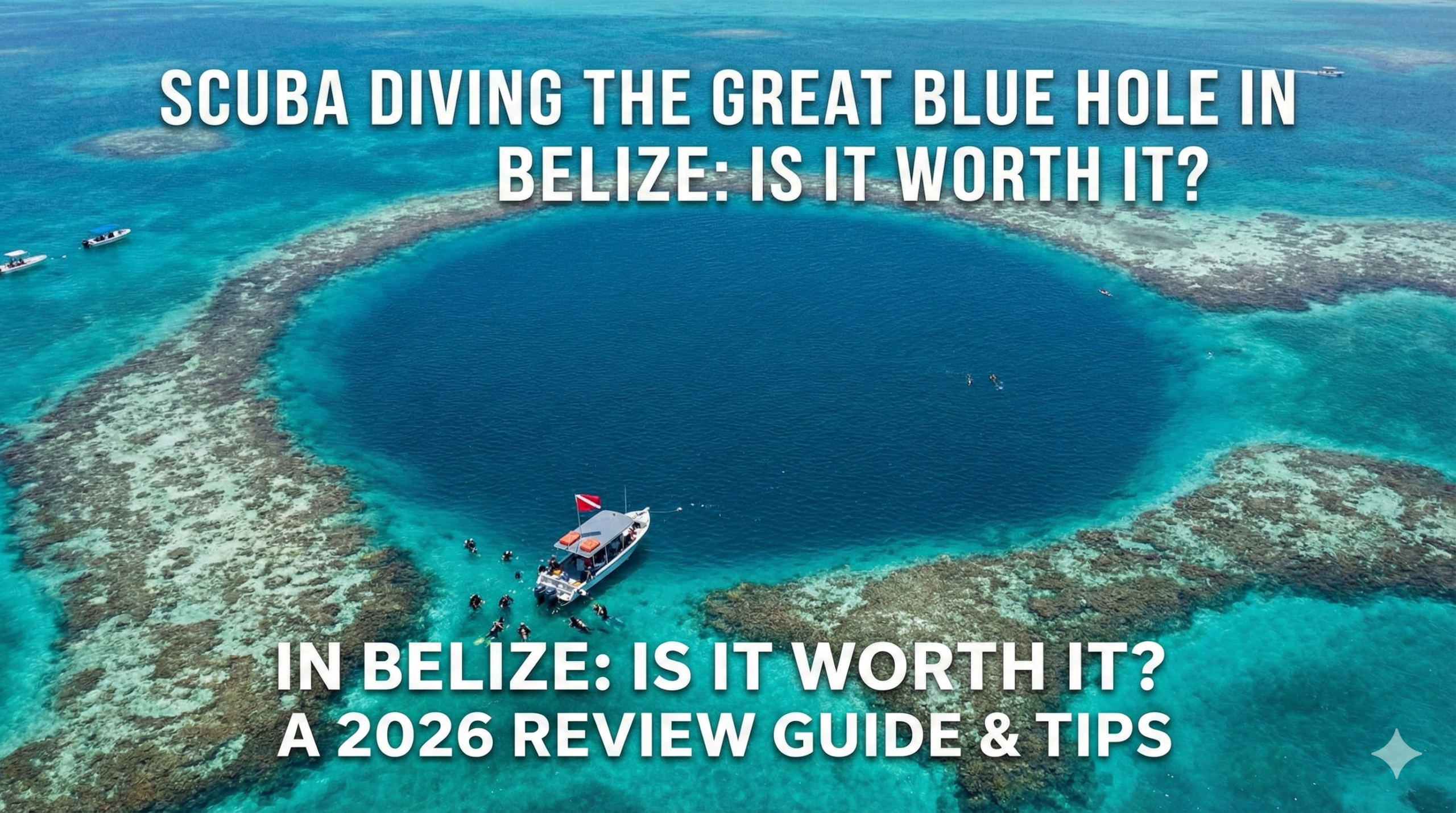
If you are a diver, you have seen the photo. A perfect circle of deep indigo blue surrounded by vibrant turquoise waters. The Great Blue Hole in Belize is one of the most recognizable natural landmarks on Earth. It was made famous by Jacques Cousteau in 1971, who declared it one of the top ten scuba diving sites in the world.
But fame brings expectations. For many divers visiting Ambergris Caye or Caye Caulker, the Blue Hole is the ultimate “bucket list” item. However, it is also one of the most debated dive sites in the community. Some call it a spiritual experience; others call it a “boring deep hole” that is overpriced and overhyped.
So, is it worth the time, the money, and the effort in 2026?
In this guide, we break down everything you need to know: the costs, the conditions, the sharks, and the honest truth about what lies at 130 feet deep. Whether you are a seasoned pro or an Open Water newbie, this guide will help you decide if you should take the plunge.
Read Also:- Savannah vs. Charleston: Which Southern City is Best for Couples?
1. The Journey & The Cost: What to Expect in 2026
The first thing you need to know about the Great Blue Hole is that it is not close to the shore. It is located in the center of Lighthouse Reef Atoll, roughly 43 miles (70 km) off the coast of Belize City and Ambergris Caye.
The Boat Ride: A Reality Check
This is not a quick 10-minute boat ride.
- Departure: Boats typically leave very early, often between 5:30 AM and 6:00 AM.
- Duration: It takes about 2.5 to 3 hours each way to reach the Blue Hole from San Pedro (Ambergris Caye) or Caye Caulker.
- The Conditions: This is open ocean travel. While the boats are large dive vessels, the crossing can be rough. If the wind is up, the ride can be bumpy and wet. If you are prone to seasickness, medication is non-negotiable.
2026 Pricing Breakdown
As of early 2026, prices have adjusted slightly due to fuel costs and park fees. Most reputable dive shops offer a “3-Tank Dive” package for a full day.
| Item | Estimated Cost (USD) | Notes |
| Diver Rate (3-Tank Trip) | $300 – $350 | Includes boat, tanks, weights, lunch. |
| Snorkeler Rate | $200 – $250 | Snorkelers stay on the surface. |
| Marine Park Fee | $40 | Usually paid in CASH upon check-in. |
| Gear Rental (Full Set) | $30 – $50 | If you don’t bring your own BCD/Regs. |
| Nitrox Upgrade | $10 – $15 per tank | Recommended for the shallow dives (not the deep one). |
| Total Estimated Cost | $400+ per person | After tips and taxes. |
Is it expensive? Yes. Compared to local reef diving which costs about $50-$60 per tank, this is a premium expedition. You are paying for the fuel and the distance.
The Schedule
A typical day looks like this:
- 05:30 AM: Check-in at dive shop.
- 06:00 AM: Depart (Coffee and light breakfast usually on board).
- 08:30 AM: Arrive at Great Blue Hole. Dive #1.
- 10:30 AM: Dive #2 at Half Moon Caye Wall.
- 12:00 PM: Lunch on Half Moon Caye Island (Bird Sanctuary).
- 01:30 PM: Dive #3 at “The Aquarium” or “Long Caye Wall”.
- 04:30 PM: Return to dock.
2. The Dive Profile: Into the Abyss
The Great Blue Hole dive is unlike any other Caribbean dive. It is not about colorful coral or small fish; it is about geology, depth, and atmosphere.
The Descent
The Blue Hole is a giant sinkhole. The dive begins on a sandy rim at about 30 feet. Once the group is ready, you descend over the ledge into the darkness.
- Visibility: Often decent (60-100ft), but the water inside the hole is darker and less clear than the open ocean.
- Temperature: It can feel cooler at depth. A thermocline is common.
The Main Attraction: Stalactites at 130 Feet
The goal of this dive is to reach the ancient geological formations. Between 110 feet and 130 feet (40 meters), you will see massive limestone stalactites hanging from the overhangs.
- Ancient History: These were formed thousands of years ago when the Blue Hole was a dry cave above sea level.
- Size: They are gigantic—some are 20 to 40 feet long and thick like tree trunks.
- Swimming Through: Divers usually follow the Dive Master in a single file line, weaving through these massive stone columns. It feels like swimming through a gothic cathedral underwater.
The Sharks
This is the other big draw. The Blue Hole is resident to several shark species that like the deep, darker waters.
- Caribbean Reef Sharks: Almost guaranteed. They often circle below the divers.
- Bull Sharks: Frequently seen patrolling the deep.
- Hammerheads: Occasionally seen in the deeper darkness, though less common.
The Bottom Time
This is a short dive. Because of the depth (130 feet) and the limits of recreational diving (No Decompression Limit), you only spend about 8 minutes at the maximum depth.
- Total dive time is usually 25 to 30 minutes.
- The ascent is slow, with a long safety stop to off-gas nitrogen.
Warning: At 130 feet, Nitrogen Narcosis is real. You may feel “intoxicated” or dizzy. It is crucial to monitor your depth gauge and stay close to your buddy.
3. The “Other” Dives: Why They Save the Trip
Here is the secret that veteran divers know: The Blue Hole is not actually the best dive of the day.
While the Blue Hole gets the fame, the other two dives included in the package—usually at Half Moon Caye Wall and The Aquarium (Long Caye)—are consistently rated as some of the best dives in the entire Caribbean.
Dive 2: Half Moon Caye Wall
After the deep, dark Blue Hole, this dive is an explosion of light and color.
- The Wall: You start on a sandy patch and swim out to a sheer drop-off that plunges thousands of feet down.
- The Wildlife: Expect to see Spotted Eagle Rays flying off the wall, friendly Grouper, and turtles.
- The Clarity: Visibility here is often spectacular, sometimes exceeding 100 feet.
The Surface Interval: Half Moon Caye Island
Between Dive 2 and 3, the boat docks at Half Moon Caye, a protected National Monument.
- Lunch: You eat a picnic lunch on a pristine tropical beach.
- Booby Bird Sanctuary: You can walk a short trail to an observation tower to see the nesting colony of Red-Footed Boobies and Frigatebirds. It is a Jurassic Park-like experience that many divers say is a highlight of the trip.
Dive 3: The Aquarium (Long Caye)
The name says it all. This site is dense with marine life.
- Coral Health: The coral formations here are massive—huge barrel sponges, purple sea fans, and healthy brain coral.
- Fish Density: Schools of Creole Wrasse, Parrotfish, and Angelfish are everywhere. It is a stark, colorful contrast to the gloomy majesty of the Blue Hole.
The Verdict: Many divers come back saying, “I went for the Blue Hole, but I fell in love with The Aquarium.”
4. Prerequisites: Who Can Dive It?
Diving to 130 feet (40m) is the absolute limit of recreational scuba diving. As such, dive shops in Belize have strict rules for safety.
Certification Requirements
- Advanced Open Water (AOW): Most reputable shops require you to be AOW certified. This is because Open Water limits are typically 60ft (18m).
- Open Water with Experience: Some shops may allow Open Water divers if they have a Deep Dive Adventure log or significant experience (25+ dives), but they will often restrict you to a shallower depth or require a private Dive Master.
The “Checkout Dive” Rule
If you have not dived in over a year, or if you are a new diver, many shops will require you to do a local reef dive with them the day before the Blue Hole trip.
- Why? They need to see your buoyancy skills. The Blue Hole is a bottomless pit; if you can’t control your buoyancy, you could sink too fast or shoot up too quickly, both of which are dangerous.
Snorkelers
Can you snorkel the Blue Hole? Yes.
- The rim of the hole is only about 15-20 feet deep and has coral.
- Snorkelers can see the drop-off into the dark blue, which is eerie and cool.
- However, snorkelers will obviously not see the stalactites or the sharks deep down.
5. Pros and Cons: A Quick Summary
To help you make a quick decision, here is a breakdown of the good and the bad.
| PROS (Why you should go) | CONS (Why you might skip it) |
| ✅ Bucket List Status: It is a UNESCO World Heritage site and a world wonder. | ❌ Price: $400+ USD is a lot for one day of diving. |
| ✅ Geology: Swimming through ancient stalactites is a unique, cathedral-like experience. | ❌ Boring Marine Life: Inside the hole, there is very little coral or colorful fish. |
| ✅ Sharks: High chance of seeing Bull Sharks and Reef Sharks. | ❌ Long Commute: 2.5 to 3 hours each way on a potentially rough boat ride. |
| ✅ The Other Dives: Half Moon Caye and The Aquarium are world-class wall dives. | ❌ Short Dive: You only spend 8-10 minutes at the bottom deep section. |
| ✅ The Island Lunch: Half Moon Caye is stunningly beautiful. | ❌ Early Morning: 5:30 AM starts are painful on vacation. |
6. Expert Review & Verdict
What the Pros Say:
“The Great Blue Hole is a ‘check-the-box’ dive. You do it once to say you’ve done it, and you do it for the geological grandeur. It is moody, dark, and eerie. If you are expecting a kaleidoscope of colors inside the hole, you will be disappointed. However, the trip is redeemed by the spectacular wall dives that follow at Lighthouse Reef. Those two dives alone are worth the boat ride.”
Is It Worth It?
- YES, IF: You are an experienced diver who appreciates geology, sharks, and deep dives. If you want to see a UNESCO site and don’t mind a long day, it is an unforgettable adventure.
- NO, IF: You are a new diver with poor air consumption, you get seasick easily, or you only care about colorful fish and coral. If you are on a tight budget, you can have amazing dives on the local barrier reef for half the price.
7. What To Do and What Not To Do
✅ What To Do
- DO take seasickness medication: Even if you think you have “sea legs,” take it the night before and the morning of. The crossing is open ocean.
- DO bring warm clothes: A windbreaker or hoodie is essential for the boat ride back when you are wet and the wind is blowing.
- DO equalize early and often: The descent into the hole is fast to maximize bottom time. Clear your ears constantly.
- DO watch your gauges: It is easy to lose track of depth in the blue void. Check your air and depth every minute.
- DO bring a GoPro with a Red Filter: If you are filming, you need a red filter or good lights, as the color absorption at 130ft is significant.
❌ What Not To Do
- DON’T party the night before: You are diving to 130 feet. Dehydration and a hangover increase the risk of Decompression Sickness (The Bends). Get a good night’s sleep.
- DON’T touch the stalactites: They are ancient geological formations. Touching them can damage them.
- DON’T skip the safety stop: This is a deep dive. Your computer will likely mandate a safety stop. Hang at 15ft and be patient.
- DON’T fly the next day: Because of the nitrogen load from the deep dive and the multiple dives, give yourself at least 24 hours before flying home.
Read Also:- New Orleans Safety Guide for Solo Female Travelers
Conclusion
Diving the Great Blue Hole in Belize is more of an expedition than a typical fun dive. It demands respect, preparation, and a bit of endurance. While the hole itself is a dark, silent chamber of ancient rock, the surrounding Lighthouse Reef offers some of the most vibrant life in the Caribbean.
In 2026, the Blue Hole remains a rite of passage for divers. It may not be the most colorful dive you ever do, but the feeling of hovering suspended in that deep blue abyss among giant stalactites is a memory that stays with you forever.
Ready to book? Look for reputable operators like Amigos Del Mar, Belize Pro Dive Center, or Frenchie’s Diving.
Safe diving and enjoy the depths!
