
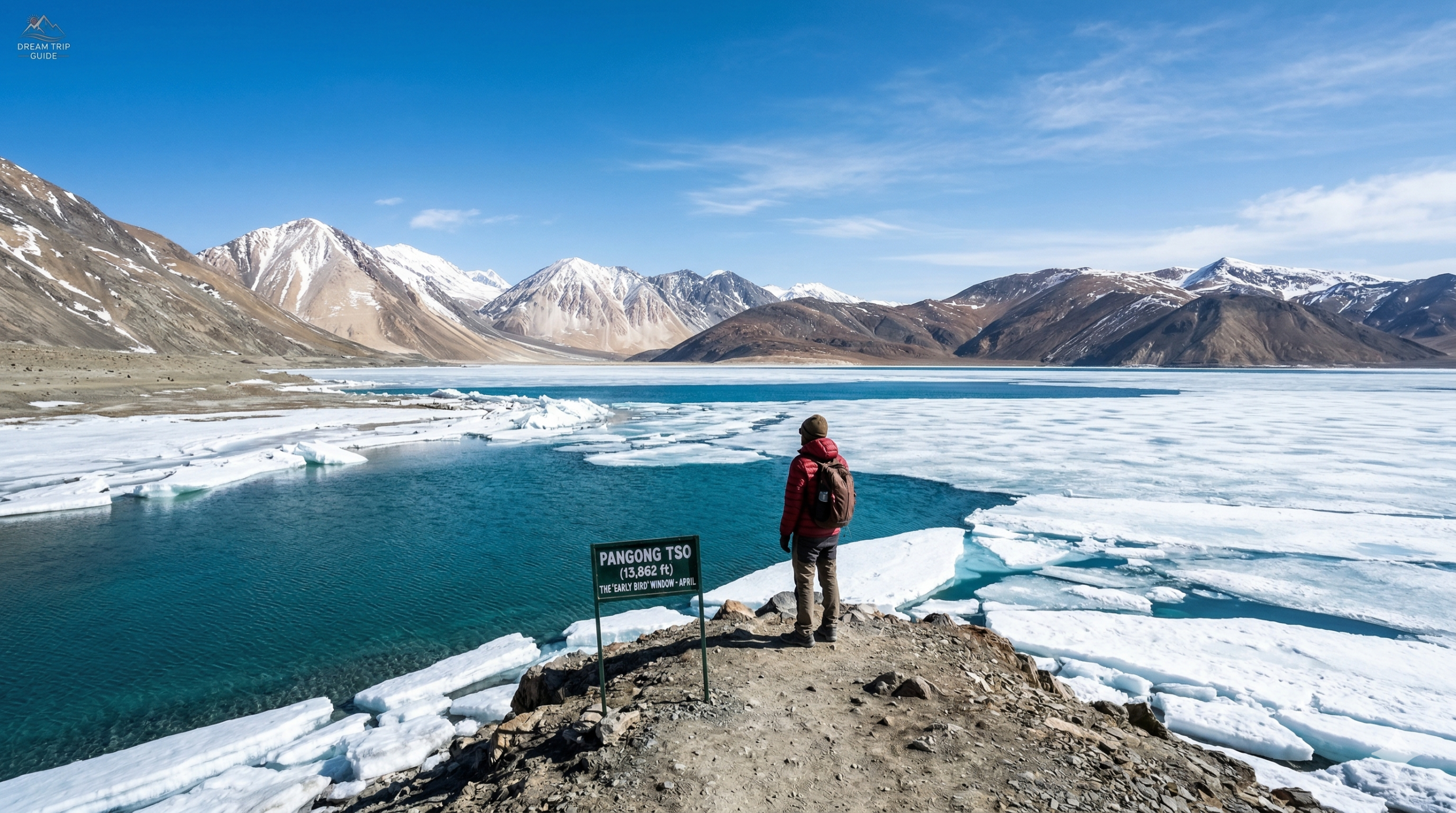
April in Ladakh is a season of transition. It is the moment the “Land of High Passes” wakes up from its deep winter slumber. While the rest of India starts to swelter in the pre-summer heat, Ladakh remains a crisp, snowy wonderland transitioning into spring.
The Crowd-Free Advantage
The biggest pull for April is the silence. In June or July, the Pangong Lake looks like a busy mela. In April, you might be the only person standing on the shores of the partially frozen lake. This “crowd-free” status isn’t just about peace; it’s about accessibility. You get the best rooms at lower prices, the taxi drivers are more relaxed and willing to share stories, and your photos won’t have 50 strangers in the background.
The Visual Contrast
In April, you see the “Two Faces of Ladakh.” The high peaks and passes like Khardung La and Chang La are still buried under 10–15 feet of snow, giving you a hardcore winter feel. However, down in the valleys of Leh and Nubra, the snow has melted, and the first signs of green start to appear. It is the only month where you can experience a frozen lake and a blooming orchard in the same 48 hours.
Expert Review: > “April is for the ‘soul traveler.’ If you seek the raw, unfiltered version of the Himalayas and don’t mind wearing three layers of woolens, this month offers a spiritual connection with the mountains that the busy summer months simply cannot provide.” — Tashi Namgyal, Senior Mountain Guide.
Read Also:- India’s Ghost Villages: Kuldhara & The New Ruins
2. Weather and Road Status: What’s Open in 2026?
Understanding the geography in April is vital. Ladakh is “landlocked” during this time, meaning the famous road trips from Manali or Srinagar are either closed or highly unpredictable.
The Flight Route
For an April expedition, flying into Leh (Kushok Bakula Rimpochee Airport) is your primary option. The aerial view of the Zanskar range in April is worth the ticket price alone—it looks like a white ocean of peaks.
Highway Updates for 2026:
- Srinagar-Leh Highway: Usually opens by early to mid-April. However, Zoji La pass remains extremely “mercurial” (unpredictable). Expect temporary closures due to late-season snow.
- Manali-Leh Highway: STRICTLY CLOSED. Do not plan a road trip from Manali in April. The BRO (Border Roads Organization) usually clears the massive snow at Baralacha La only by late May or early June.
Internal Roads
The good news? Internal roads from Leh to Nubra Valley, Pangong Tso, and Tso Moriri are kept open by the Indian Army and BRO year-round. While a heavy spell of snow might shut Khardung La for a few hours, it is usually cleared quickly.
Quick Info Table: Ladakh in April at a Glance
| Feature | Details for April 2026 |
| Average Temperature | Day: 6°C to 15°C | Night: -2°C to -5°C |
| Road Access (Manali) | Closed (Opens late May/June) |
| Road Access (Srinagar) | Partially Open (Check Zoji La status) |
| Best Way to Reach | Flight from Delhi/Mumbai/Chandigarh |
| Crowd Level | Very Low (10-20% of peak season) |
| Permits Needed | ILP (Indians) / PAP (Foreigners) |
| Must-See Event | Apricot Blossom Festival (April 8–16) |
3. The Apricot Blossom Festival: Ladakh’s Version of Sakura
While Japan has Cherry Blossoms, Ladakh has the Apricot Blossom Festival (Chuli Mendok). In 2026, this is scheduled between April 8th and April 16th.
Where to witness it?
The festival is spread across lower-altitude villages where spring arrives early.
- Garkone & Darchiks (Aryan Valley): Home to the unique Brokpa community. The pink and white flowers against their traditional floral headgears make for incredible photography.
- Turtuk & Tyakshi: Located near the LOC, these villages turn into a fairy-tale land of white blossoms.
- Sham Valley: Villages like Saspol and Alchi see a beautiful bloom along the Indus River.
Cultural Immersion
This isn’t just about flowers. The local administration organizes folk dances, traditional music, and stalls selling apricot-based products (oil, dried fruit, jams). It’s a rare chance to see Ladakhi culture without the “tourist filter.”
4. Accommodation and Survival: Living in the Cold
In April, you cannot just “wing it” like you might in June. Many luxury camps near Pangong Lake don’t open until mid-May because the pipes are still frozen.
Where to Stay?
- In Leh: Most guesthouses and “A-category” hotels are open. Ensure you book a place with central heating or at least electric blankets.
- In Nubra/Pangong: Luxury tents are mostly unavailable. You will be staying in Homestays. This is actually a “pro”—you get to sit around a traditional Ladakhi Bukhari (wood-fired heater) and eat home-cooked Thukpa.
Water and Hygiene
Be prepared: running water in toilets can be a challenge if the temperature drops at night. Many homestays will provide “dry toilets” or buckets of hot water. It’s part of the adventure!
5. Health, Safety, and the “AMS” Factor
Since you are flying directly to 11,500 feet, Acute Mountain Sickness (AMS) is a very real risk. In April, the cold air is thinner and drier, which can exacerbate symptoms.
The Do’s and Don’ts for April
| What to DO (The Checklist) | What NOT to DO (The Warnings) |
| Rest for 48 Hours: Your first two days in Leh should be spent doing nothing but sleeping and light walking. | Don’t Fly and Drive: Never land in Leh and immediately head to Khardung La (17,582 ft). It can be fatal. |
| Hydrate Like a Pro: Drink 4 liters of water daily. The dry Himalayan air dehydrates you faster than you realize. | Avoid Alcohol/Smoking: For at least the first 3 days. They thin your blood and hinder oxygen absorption. |
| Layer Up: Use the “3-Layer Rule”: Inner thermals, a fleece/sweater, and a windproof down jacket. | Don’t Forget Sunscreen: The April sun at high altitude is brutal. You can get a sunstroke and frostbite simultaneously. |
| Carry Cash: Most ATMs in Leh might be out of cash or frozen. Digital payments (UPI) are unreliable in remote valleys. | Don’t Ignore Headaches: If a headache doesn’t go away with rest and water, descend to a lower altitude immediately. |
6. The “Pros and Cons” of an April Expedition
Pros
- The “Frozen” Pangong Experience: You can see the lake in its transition phase—vibrant blue water clashing with chunks of white ice.
- Extreme Budget Savings: Flight tickets and hotel rates are significantly lower than in the June-July peak.
- Photography Heaven: No “tourist photobombs.” You get clean, vast, cinematic shots of the landscape.
- Local Connection: Since it’s not busy, locals have time to talk, share butter tea, and explain their traditions.
Cons
- The Bone-Chilling Cold: Nights are brutal. If you aren’t a fan of temperatures below zero, this isn’t for you.
- Limited Food Options: Many “tourist cafes” in Leh remain closed. You’ll mostly be eating at your hotel or local dhabas.
- No Manali-Leh Road Trip: You miss out on the legendary drive through Gata Loops and Sarchu.
7. Planning Your 7-Day “Early Bird” Itinerary
If you are visiting for a week in April 2026, here is the most balanced flow to ensure safety and sightseeing:
- Day 1 & 2: Arrive in Leh. Strict Rest. Visit Leh Market/Shanti Stupa only on the evening of Day 2.
- Day 3: Leh Local Sightseeing (Hall of Fame, Sangam Point, Magnetic Hill).
- Day 4: Leh to Nubra Valley via Khardung La. Stay in a homestay in Hunder.
- Day 5: Hunder to Turtuk (Apricot Blossom spotting) and back to Hunder.
- Day 6: Hunder to Pangong Tso via Shyok River road. Marvel at the ice.
- Day 7: Pangong to Leh via Chang La. Farewell dinner in Leh.
- Day 8: Flight back.
Read Also:- Budget vs. Luxury: Planning Your 2-Day Trip from Bangalore by Vande Bharat
Next Step: Since you’re running Dream Trip Guide, would you like me to create a customized packing list graphic or a ready-to-post Instagram caption for this blog post to help you promote it?
