
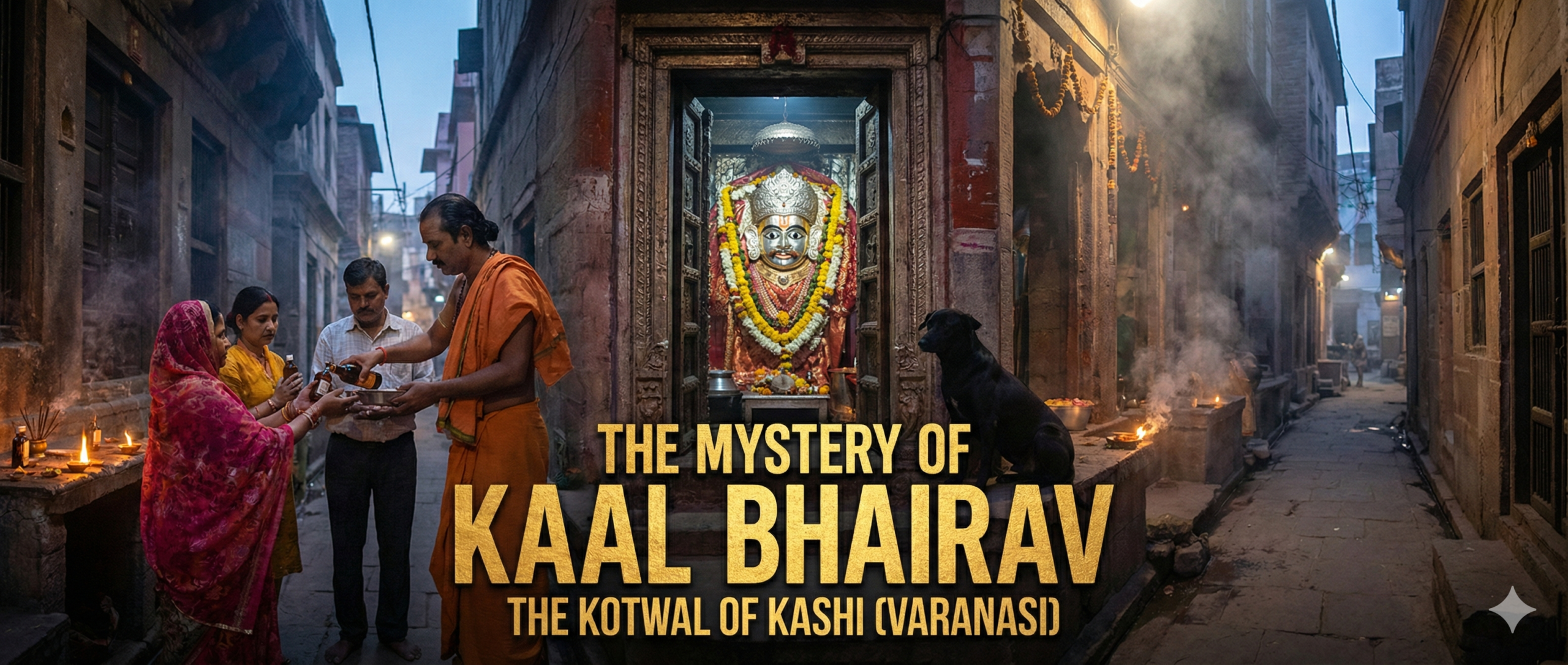
When you step into Varanasi (Kashi), you are entering the city of Lord Shiva. But there is an unwritten rule in this ancient city: You cannot meet the King (Shiva) without the permission of his Chief of Police.
That Chief of Police is Kaal Bhairav.
Hidden in the narrow, labyrinthine lanes of Varanasi, far away from the polished corridors of the new Vishwanath Corridor, lies a temple that challenges every conventional idea of Hinduism. Here, there are no sweet ladoos offered to the deity. Here, the God drinks alcohol. Here, the protector is fierce, terrifying, and yet, overwhelmingly kind to his devotees.
He is the “Kotwal of Kashi” (The Sheriff of Varanasi). Legend says that without his permission, no one can stay in Kashi, and without his blessing, the pilgrimage to Vishwanath is incomplete.
In this detailed guide, we decode the mystery of Kaal Bhairav, the unique alcohol rituals, and how to navigate this intense spiritual experience in 2026.
Read Also:- How to Book Sugam Darshan at Kashi Vishwanath: The Ultimate 2026 Guide to Skipping the Line
1. Who is Kaal Bhairav? The Legend of the Fierce Avatar
To understand the temple, you must understand the deity. “Kaal” means both Time and Death. “Bhairav” implies The One Who Removes Fear. He is the terrifying form of Lord Shiva—a deity who controls time and conquers death.
The origin story of Kaal Bhairav is dramatic. According to the Shiva Purana, the gods Brahma and Vishnu were arguing about who was supreme. In his arrogance, Lord Brahma insulted Lord Shiva. Angered by this disrespect, Shiva created a fierce being from his third eye—Kaal Bhairav.
In a fit of rage, Kaal Bhairav severed one of Brahma’s five heads (the head that spoke arrogantly). However, this act made him guilty of Brahmahatya (the sin of killing a Brahmin). As penance, the severed head of Brahma stuck to Bhairav’s hand. He roamed the universe as a beggar, trying to get rid of the sin.
It was only when he entered Kashi (Varanasi) that the skull finally fell from his hand at a place now called Kapal Mochan Teerth. Lord Shiva then decreed that Kaal Bhairav would stay in Kashi forever as its guardian. He was tasked to be the Kotwal—the administrator who keeps the city’s karmic records.
Why is he called the Kotwal?
In a spiritual sense, Kaal Bhairav manages the “law and order” of Kashi. It is believed that even Yama (the God of Death) cannot enter Varanasi without Kaal Bhairav’s permission. If you live in Kashi, you don’t fear death, because the Kotwal protects your soul.
2. The Mystery of the Alcohol Offering
The most startling aspect of the Kaal Bhairav Temple for first-time visitors is the offering. In most Hindu temples, alcohol is strictly prohibited. In this temple, it is the primary Prasad.
As you walk through the lane leading to the temple, you won’t see shops selling flowers or sweets alone; you will see government-authorized shops and vendors selling small bottles of liquor—whisky, rum, vodka, and country liquor (desi daru).
The Ritual
- Buying the Offering: Devotees buy a bottle of liquor and a garland of marigold flowers.
- The Pouring: When you reach the sanctum (Garbha Griha), you hand the bottle to the priest.
- The Miracle: The priest opens the bottle and pours a portion of it into a saucer or directly towards the silver mask of the deity. The liquid disappears. Where does it go? Does the stone idol absorb it? Is there a drainage system?
- The Mystery: For centuries, skeptics and scientists have tried to find an outlet or a drain near the mouth of the idol, but none has been found. The idol simply “drinks” the offering.
- The Prasad: The priest returns the remaining half-filled bottle to you. This is your prasad. Devotees sip this outside the temple or take it home.
Why Alcohol?
Kaal Bhairav is a Tantric deity. In Tantra, the substances that are usually taboo (like alcohol and meat) are used in rituals to transcend social conditioning and duality. Offering alcohol symbolizes surrendering your intoxication (ego, arrogance, and ignorance) to the Divine.
3. The Power of the “Kaal Bhairav Dhaga” (Black Thread)
If you look at the wrists of people in Varanasi, you will notice a thick, black thread with several knots. This is the Kaal Bhairav Dhaga (Thread).
This is not just an accessory; it is considered a spiritual shield.
Significance of the Thread
- Protection: It is believed to protect the wearer from the “Evil Eye” (Buri Nazar), black magic, and negative energies.
- Fearlessness: Since Bhairav is the remover of fear, children who have nightmares or adults suffering from anxiety are often advised to wear this thread.
- The Making: These threads are prepared by the temple priests. They are placed near the idol, chanted over with mantras, and then sold at the temple exit.
The “Jhadu” (Broom) Ritual
Another unique sight at this temple is the “Jhadu” ritual. You will see people sitting in a row while a priest lightly hits their back and head with a peacock feather broom. This is a form of spiritual cleansing (Jhara). It is believed to dust off illness, bad luck, and negative vibes that may have attached themselves to the devotee.
4. Temple Facts & Practical Guide (2026 Updated)
Unlike the Kashi Vishwanath Temple, which has been renovated with a massive corridor, the Kaal Bhairav temple retains its old-world, rustic charm. It is located in the Visheshwarganj area, a dense network of narrow lanes.
Temple Information Table
| Feature | Details |
| Location | K-32/22, Bharonath, Vishweshwarganj, Varanasi |
| Best Transport | Cycle Rickshaw or Walking (Cars cannot reach the gate) |
| Primary Deity | Kaal Bhairav (The Silver-faced Idol) |
| Vehicle (Vahan) | The Dog (Shvan) |
| Key Offering | Alcohol (Liquor), Mustard Oil, Black Sesame Seeds |
| Entry Fee | Free (General Entry) |
| Avg. Wait Time | 30 Mins (Weekdays) to 2 Hours (Sundays/Ashtami) |
| Photography | Strictly Prohibited inside the sanctum |
Timings (Subject to Change)
| Ritual | Time |
| Temple Opening | 5:00 AM |
| Morning Aarti | 5:30 AM – 6:30 AM |
| Mid-Day Break | 1:30 PM – 3:30 PM (Temple Closed) |
| Evening Aarti | 7:30 PM – 8:30 PM |
| Temple Closing | 10:00 PM |
Pro Tip for 2026: Sunday is the day of Kaal Bhairav. The crowds on Sundays are massive. If you want a peaceful darshan, go on a Tuesday or Wednesday morning around 7:00 AM.
5. Expert Review: The Vibe & Experience
Based on inputs from spiritual travelers and local guides in Varanasi.
Review by: Rajesh Kumar, Heritage Guide
“Visiting Kaal Bhairav is very different from Kashi Vishwanath. Vishwanath ji feels peaceful and royal. Kaal Bhairav feels raw, intense, and energetic. The lane leading to the temple smells of incense, mustard oil, and yes, liquor. When you look into the silver eyes of the deity, you feel a sense of immediate submission. It is said that while Vishwanath gives you Moksha (liberation), Bhairav gives you the ‘stick’ to correct your life before you get there.”
The Atmosphere
The temple is small. The sanctum is visible from the courtyard. The idol of Kaal Bhairav is garlanded with flowers, and only the face is visible (the rest is covered in cloth and flowers). He has a mustache, large eyes, and carries a trident. A dog (his vehicle) usually sits calmly near the idol or within the temple complex.
Expert Rating: ⭐⭐⭐⭐⭐ (5/5) for Cultural Uniqueness.
6. Pros and Cons of Visiting
While it is a must-visit, it is not the most comfortable experience for everyone.
Pros (The Good Stuff)
- Unique Culture: Nowhere else will you see a god being offered whiskey. It is a cultural shock and a marvel.
- Powerful Vibes: Devotees report feeling a sudden shift in energy—a feeling of being protected or cleansed.
- Historical Authenticity: The area (Kotwalpuri) feels like the “real” old Kashi, untouched by modern renovations.
- The Black Thread: A great souvenir that holds spiritual meaning.
Cons (The Challenges)
- Cleanliness: The narrow lanes can be dirty, with stray dogs and mud. It is not sanitized like the new Corridor.
- Aggressive Sellers: Flower and liquor sellers can be very pushy. They might try to force you to buy expensive baskets.
- Crowd Management: On busy days, there is a lot of pushing. It is not recommended for claustrophobic people.
- Monkey Menace: There are many monkeys in the area. Keep your glasses and food hidden.
7. What Should You Do & What Not To Do
To ensure you don’t offend the deity or the locals, follow these “Kotwal Rules.”
Do This ✅
- Respect the Dogs: The dog is Kaal Bhairav’s divine vehicle. You will see many stray dogs in and around the temple. Never kick, shoo away, or be rude to a dog here. Feeding them biscuits is considered a good deed.
- Buy Alcohol Outside: If you wish to offer alcohol, buy it from the licensed shops outside the lane. Do not carry an open bottle from your hotel.
- Mustard Oil: Apart from alcohol, offering Mustard Oil is highly auspicious, especially for removing Saturn (Shani) related doshas.
- Leave Ego Outside: This is the court of the supreme judge. Enter with humility.
- Ask Permission: Before leaving Varanasi, it is customary to visit Kaal Bhairav again to “check out” of the city, asking for safe passage home.
Do Not Do This ❌
- No Photos Inside: The guards are very strict. Do not try to sneak a selfie with the idol. It is considered disrespectful and you will be fined/scolded.
- Don’t Judge: You might see people who look intoxicated or “mad” (Aghoris). Do not stare or judge them. This is their space.
- Don’t Wear Leather: Like most temples, leather belts and wallets are often restricted or frowned upon.
- Don’t Scam Yourself: Priests might ask for large sums of money for a “special puja” to remove black magic. Be polite, offer what you can (₹10 – ₹100), and move on. You are not obligated to pay thousands.
Read Also:- The Complete Guide to Kashi Vishwanath Corridor (2026): Entry, Lockers, & Darshan
8. Conclusion: The Final Verdict
The Kaal Bhairav Temple is the fierce soul of Varanasi. While Kashi Vishwanath is the heart, Bhairav is the shield. A trip to Varanasi is spiritually incomplete without bowing your head to the Kotwal.
It is a place that reminds you that divinity isn’t just about purity and light; it is also about embracing the dark, the fierce, and the time that eventually consumes us all.
If you are brave enough to look beyond the chaos, the grime, and the unconventional rituals, you might just find the most powerful blessing of your life here.
Jai Bhairav Baba!
