
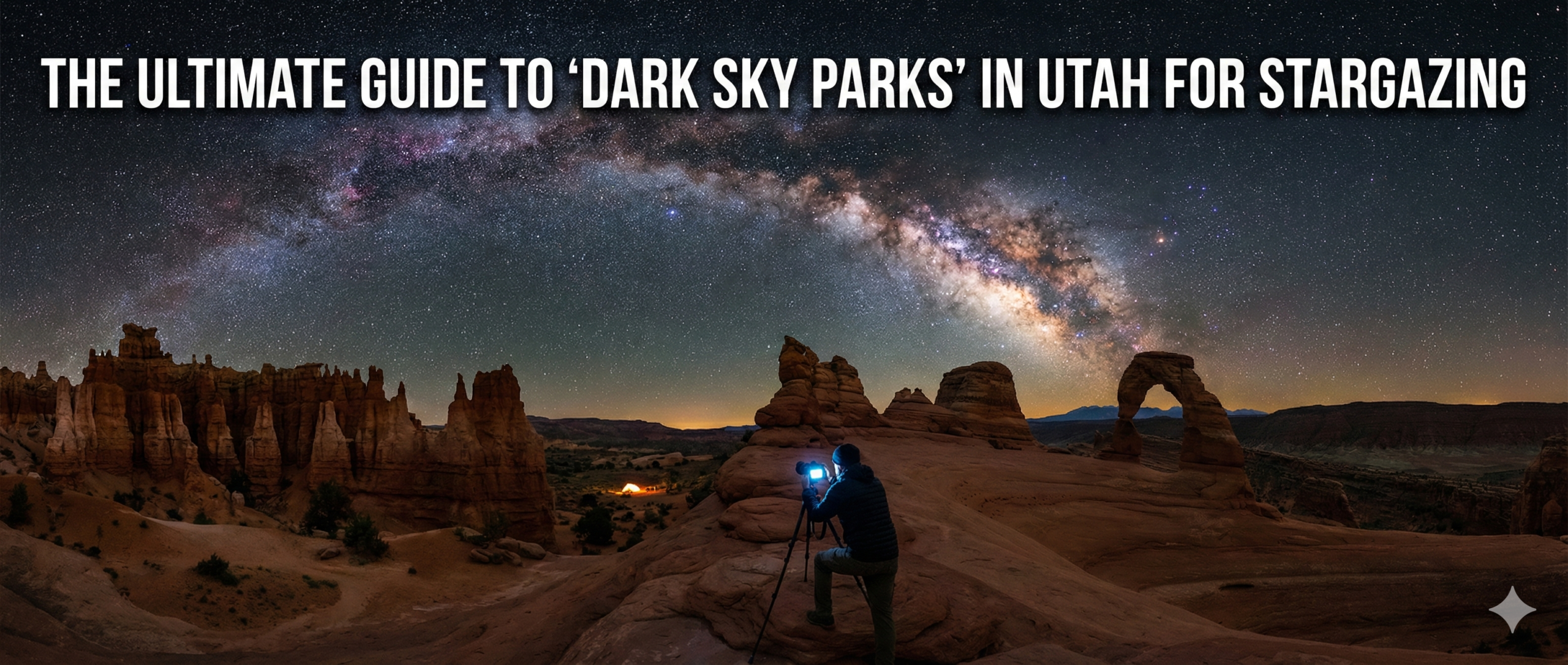
Utah is not just famous for its red rocks; it is famous for its darkness. In a world drowning in artificial light, Utah has become the world’s capital for Dark Sky Parks.
With over 24 certified International Dark Sky Places, the state offers a rare luxury: the ability to see the Milky Way cast a shadow on the ground. Whether you are a professional astrophotographer or a family looking to show your kids the universe for the first time, this guide covers the best dark sky parks Utah has to offer.
We will break down where to go, how to escape the crowds, and specifically compare the titans of rock and sky.
Read Also:- How to Visit “Yellowstone” (The TV Show) Filming Locations in Montana
1. Bryce Canyon: The “Dark Ranger” Headquarters
Bryce Canyon National Park is often called the “last grand sanctuary of natural darkness.” While many parks are dark, Bryce is special because of its elevation. At 8,000 to 9,000 feet, the air is thinner and cleaner, meaning there is less atmospheric distortion between you and the stars.
Stargazing in Bryce Canyon Guide
The park takes astronomy as seriously as geology. They have a dedicated team of “Dark Rangers” who host some of the best astronomy programs in the National Park Service.
The Experience:
Imagine standing on the edge of a massive amphitheater. Below you are thousands of “hoodoos” (stone spires) that look like a silent army in the moonlight. Above you, the Milky Way stretches from horizon to horizon.
Best Spots:
- Sunset Point & Sunrise Point: These are the most accessible. They offer wide views but can have some people.
- Inspiration Point: This is arguably the best spot. It has three levels of viewing platforms, allowing you to find a quiet corner away from others.
- Yovimpa Point: Located at the far southern end of the park. It is darker because it is shielded from the tiny bit of light pollution coming from the town of Bryce Canyon City.
Quick Information Guide
| Feature | Details |
| Darkness Level | Gold Tier (Exceptional) |
| Best Time | New Moon phases; June (Astronomy Festival) |
| Accessibility | Paved overlooks; very wheelchair friendly |
| Ranger Programs | Telescope tours (Thu-Sat in summer); Full Moon Hikes |
| Crowds | High during the day, Moderate at night |
Pros and Cons
- Pros:
- High Altitude: 8,000+ ft means crystal clear air.
- Educational: The ranger programs are world-class with large telescopes provided.
- Foreground: The hoodoos make for dramatic silhouette photos.
- Cons:
- Cold: Even in July, temperatures can drop to 40°F (4°C) at night.
- Crowds: The main amphitheater can get busy during the annual Astronomy Festival (June).
Expert Review:
“If you can only visit one park for stars, make it Bryce. The ‘Full Moon Hikes’ are a lottery system, so sign up at the visitor center the moment they open. If you miss the hike, drive to Farview Point. It’s an underrated spot where you can see stars reflected in the hoods of your car—it’s that dark.”
2. Goblin Valley State Park: The Alien Planet
If Bryce Canyon is a cathedral, Goblin Valley is a playground on Mars. This state park is one of the weirdest and most wonderful places to be after the sun goes down.
Goblin Valley State Park at Night
Located in the remote San Rafael Swell, Goblin Valley is far from any major city. The light pollution here is near zero. The park is famous for its thousands of mushroom-shaped rock formations called “goblins.”
The Experience:
Unlike National Parks where you usually stay on the trail, Goblin Valley (in the main valley) allows you to wander freely among the rocks. At night, this creates a fun, spooky, labyrinth-like experience. You can play hide-and-seek with the constellations.
Camping:
Goblin Valley has a fantastic campground with Yurts (circular tents) available for rent. Staying overnight here allows you to step out of your tent at 3:00 AM and witness a sky so thick with stars it looks like white dust.
Quick Information Guide
| Feature | Details |
| Darkness Level | Bortle Class 1 (The darkest possible scale) |
| Best Time | Spring and Fall (Summer is too hot during the day) |
| Accessibility | Open roaming; ground is uneven dirt/sand |
| Camping | 25 spots + 2 Yurts (Book 4-6 months in advance) |
| Vibe | Spooky, fun, quiet, secluded |
Pros and Cons
- Pros:
- Freedom: You can walk among the formations, not just look from a ledge.
- Darkness: It is significantly darker than Arches or Zion.
- Photography: The weird shapes create the most unique astrophotography compositions in Utah.
- Cons:
- Remoteness: It is a long drive from anywhere (1.5 hours from Moab).
- Services: No restaurants or gas stations nearby. You must bring all food/water.
Expert Review:
“Goblin Valley offers the best ‘bang for your buck’ stargazing. It’s less regulated than the National Parks. Bring a red-light headlamp and just wander into the valley. It feels like you are walking on the surface of an alien planet. It’s superb for kids because it engages their imagination.”
3. The Showdown: Arches vs. Canyonlands
Moab is home to two National Parks, and travelers often ask: Arches vs Canyonlands for stargazing—which is better?
Both are International Dark Sky Parks, but they offer very different experiences.
Arches National Park
Arches is famous for its geologic windows.
- The Vibe: Accessible and iconic. You can drive up to majestic spots like Balanced Rock or The Windows.
- Light Pollution: It is very close to the town of Moab (5 miles). While the sky is dark, you will see a “light dome” on the southern horizon from the town lights.
- Best Spot: Panorama Point (designated stargazing area) or the Garden of Eden.
Canyonlands National Park (Island in the Sky)
Canyonlands is vast, wild, and high up on a mesa.
- The Vibe: Deep solitude. You are looking into a massive black void of canyons.
- Light Pollution: It is about 30-40 minutes further from Moab than Arches. This extra distance makes a huge difference. The skies here are ink-black.
- Best Spot: Grand View Point (at the very end of the road) or Mesa Arch (classic photo spot).
Comparison Table
| Feature | Arches National Park | Canyonlands (Island in the Sky) |
| Darkness Quality | Excellent (some horizon glow) | Superior (True deep dark) |
| Accessibility | Easy paved roads | Easy paved roads |
| Crowds (Night) | Moderate (Photographers everywhere) | Very Low (Ghost town at night) |
| Key Photo Op | Delicate Arch (Requires hiking in dark) | Mesa Arch (Short walk) |
| Entry Rules | Timed Entry Reservation required (Day) | usually Open Entry (Check current rules) |
Pros and Cons
- Arches Pros: Iconic photos; very easy to navigate; close to hotels.
- Arches Cons: Car headlights from other tourists can ruin your night vision; light pollution from Moab.
- Canyonlands Pros: Darker skies; utter silence; high elevation (6,000 ft).
- Canyonlands Cons: Further drive (45 mins from Moab); big drop-offs require safety caution in the dark.
Expert Review:
“If you want the photo for Instagram (Milky Way behind an Arch), go to Arches. If you want the spiritual experience of staring into the infinite void with zero noise, go to Canyonlands. Grand View Point at 2 AM is a religious experience.”
4. Capturing the Cosmos: Utah Astrophotography Locations
For those bringing a DSLR or Mirrorless camera, Utah is a paradise. You don’t need a telescope; a wide-angle lens (14mm-24mm) and a tripod are enough.
Utah Astrophotography Locations & Tips
1. Delicate Arch (Arches NP):
- The Shot: The arch frames the Milky Way core perfectly in late summer.
- The Challenge: It involves a 1.5-mile hike in the dark on slickrock. It is also crowded with other photographers who might accidentally shine lights in your shot.
- Tip: Use “Light Painting” (briefly shining a low light on the arch) to illuminate the red rock against the black sky.
2. Thor’s Hammer (Bryce Canyon):
- The Shot: Shooting down into the amphitheater from Sunset Point. The Hammer stands tall with the galactic core rising behind it.
- The Challenge: It can be windy on the rim, which shakes the tripod.
3. Mesa Arch (Canyonlands):
- The Shot: Traditionally a sunrise spot, but at night, the underside of the arch glows if you light paint it, framing the stars and the canyon below.
- The Challenge: You must arrive extremely early or late to avoid the sunrise crowd.
4. Dead Horse Point State Park:
- The Hidden Gem: This state park is right next to Canyonlands. The overlook of the Colorado River Gooseneck is spectacular.
- Why here: They have less restrictive parking rules than the National Parks and fewer crowds.
Quick Settings Guide (Start Here)
- Lens: Wide Angle (14mm – 24mm)
- Aperture: f/2.8 (or as low as your lens goes)
- ISO: 1600 – 3200
- Shutter Speed: 15 – 20 seconds (Any longer and stars will trail)
- Focus: Manual Focus (Set to “Infinity”)
Expert Review:
“Don’t ignore the ‘lesser’ parks. Kodachrome Basin State Park has a massive stone spire called ‘The Chimney’ that is perfect for star trails, and you will likely be the only photographer there.”
5. Other Hidden Dark Sky Gems
If you want to escape the “Mighty 5” National Parks entirely, Utah has certified State Parks that are just as dark but half as expensive/crowded.
- Natural Bridges National Monument: This was the first International Dark Sky Park in the world (certified in 2007). It is incredibly remote. The Owachomo Bridge is easy to walk to and magnificent under the stars.
- Antelope Island State Park: Located near Salt Lake City. If you are in the city and can’t drive 4 hours south, go here. It is surprisingly dark despite being near the metro area because it sits in the Great Salt Lake.
- Kodachrome Basin: Just 30 minutes from Bryce. It is quiet, intimate, and has great camping.
What to Do and What Not to Do
Stargazing requires a different set of etiquette and safety rules than hiking.
✅ What to Do (Dos)
- Do Check the Moon Phase: This is critical. Go during a New Moon. If the moon is Full, its light will wash out the Milky Way, and you will only see the brightest stars.
- Do Use Red Lights: White light (from phone flashlights) kills your night vision instantly. It takes 20 minutes for human eyes to adjust to the dark. Use a headlamp with a “Red Light” mode.
- Do Bring Layers: Deserts are freezing at night. Even if it was 100°F (38°C) at noon, it can drop to 50°F (10°C) by midnight.
- Do Download Offline Maps: There is zero cell service in Goblin Valley or parts of Canyonlands. Download Google Maps and a Star Chart app (like Stellarium) before you leave the hotel.
- Do Drive Slowly: Wildlife (deer, elk, jackrabbits) becomes active at night. Driving fast in Dark Sky parks is a major hazard.
❌ What Not to Do (Don’ts)
- Don’t Shine Lights on Features: It is illegal in many parks to “light paint” massive features with high-powered spotlights as it disturbs nocturnal wildlife (bats/owls). Use low-level light painting only.
- Don’t Walk Off Trail in the Dark: In places like Arches, “Cryptobiotic Soil” (living crust) is everywhere. Stepping on it kills it. Stay on paved or marked rock trails.
- Don’t Forget the Timed Entry: Even for night visits, check if you need a reservation. For example, Arches often requires reservations until 4 PM or 5 PM. If you enter after that for stargazing, you are fine, but check the current 2026 rules.
- Don’t Expect the Milky Way in Winter: The “Galactic Core” (the bright part of the Milky Way) is only visible from March to October. In winter, you see thousands of stars, but not the dramatic cloudy core.
Read Also:- The “Invisible” Selfie Stick: How to Film Yourself Like a Pro
Final Thoughts
Utah offers a connection to the cosmos that is vanishing from the rest of the planet. Whether you choose the alien landscape of Goblin Valley, the high-altitude clarity of Bryce Canyon, or the deep solitude of Canyonlands, you are guaranteed a show.
Just remember: Look up, turn off your phone, and let your eyes adjust. The universe is waiting.
Clear Skies!
