
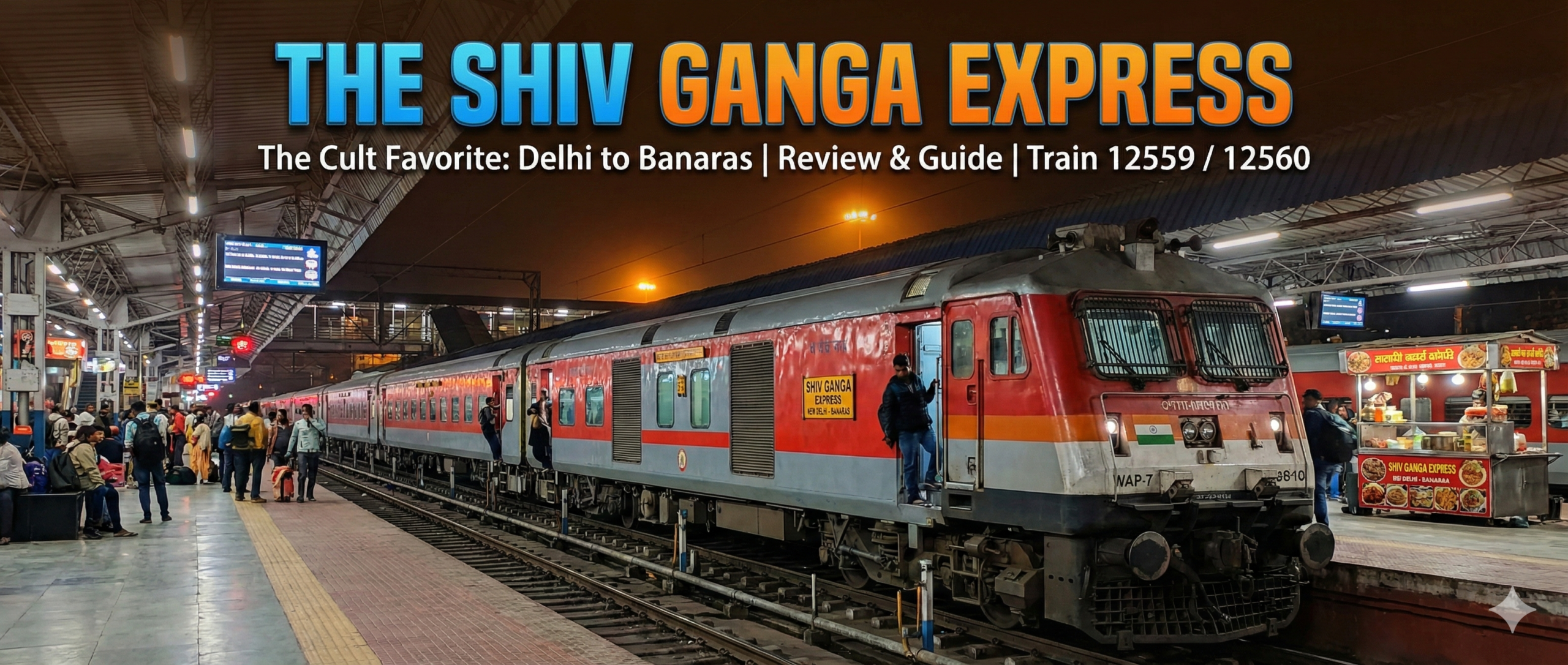
If you ask frequent travelers which is the best train to travel between Delhi and Varanasi (Banaras), many won’t say the Vande Bharat. Instead, they will swear by the Shiv Ganga Express.
For over two decades, this train has held a “cult status” among passengers. Why? because it is the “King of Overnight Travel” on this route. While other trains get delayed by fog or congestion, the Shiv Ganga Express is famous for its high priority on the tracks, often overtaking other premium trains and arriving before time.
Whether you are a pilgrim visiting Kashi Vishwanath, a student heading to BHU, or a tourist exploring the Ghats, this blog will tell you everything you need to know about this legendary train.
Read Also:- The Ultimate Delhi to Varanasi Road Trip Guide (via Agra-Lucknow Expressway)
1. Why is it a “Cult Favorite”?
In the world of Indian Railways, few trains have a fan following like the Shiv Ganga Express. It isn’t just a mode of transport; it’s an emotion for people from Eastern Uttar Pradesh.
The “Rocket” Speed
Railfans often nickname this train ” The Rocket” or “The Legend.” The reason is its aggressive schedule. Once it leaves Kanpur Central, it runs non-stop at high speeds (up to 130 km/h) to New Delhi. It is known to cover the distance between Prayagraj and Delhi faster than almost any other train in its category.
The Perfect Overnight Timing
The biggest advantage of the Shiv Ganga Express is its timetable.
- For Office Goers: You can finish a full day of work in Delhi, board the train at 8:00 PM, sleep comfortably, and wake up in Banaras at 6:00 AM, ready for the day.
- Saves Hotel Costs: By traveling overnight, you save on one night’s hotel bill compared to taking a daytime train like the Vande Bharat.
Limited Stops
Unlike other trains that stop at every small town, the Shiv Ganga has very limited halts. It stops only at major junctions (Kanpur and Prayagraj), which means less disturbance during your sleep and higher safety.
Modern LHB Coaches
The train runs with modern LHB (Linke Hofmann Busch) coaches. These are the red-and-grey coaches that are safer, do not jerk as much as the old blue coaches, and have better sound insulation.
2. Schedule & Route Information
The Shiv Ganga Express connects New Delhi (NDLS) with Banaras (BSBS). Note that “Banaras” (Station Code: BSBS) is the modern, renovated station formerly known as Manduadih. It is cleaner and less crowded than the main Varanasi Junction (BSB).
Train Schedule Table
| Train No. | Route | Departure | Arrival | Travel Time |
| 12560 | New Delhi ➔ Banaras | 20:05 (8:05 PM) | 06:10 (6:10 AM) | ~10 hrs 05 mins |
| 12559 | Banaras ➔ New Delhi | 22:15 (10:15 PM) | 08:30 (8:30 AM) | ~10 hrs 15 mins |
Key Stops
The train takes the shortest and fastest route via the “Prayagraj-Kanpur” line.
- New Delhi (NDLS) – Start
- Kanpur Central (CNB) – Major Halt (5 mins)
- Prayagraj Jn. (PRYJ) – Major Halt (5-10 mins)
- Gyanpur Road (GYN) – Small Halt (2 mins)
- Banaras (BSBS) – End
Note on Punctuality:
The Shiv Ganga Express is notorious for arriving before time. It is common for the train to reach New Delhi at 8:00 AM instead of 8:30 AM. However, during dense winter fog (December-January), delays of 1-2 hours can happen, though it still performs better than most other trains.
3. Ticket Price & Coach Classes (2026 Updated)
The train offers a wide range of classes to suit every budget, from the luxurious First AC to the budget-friendly Sleeper Class. Recently, AC 3 Economy (3E) coaches have also been added to provide AC travel at a cheaper rate.
Ticket Price Table (Estimates)
| Class | Code | Approx Fare (₹) | Comfort Level | Best For |
| AC First Class | 1A | ₹ 2,725 | Luxury (Coupes/Cabins) | Couples, Privacy lovers |
| AC 2 Tier | 2A | ₹ 1,645 | Premium (Curtains, less crowd) | Families, Seniors |
| AC 3 Tier | 3A | ₹ 1,170 | Standard AC (6 berths/bay) | Regular Travelers |
| AC 3 Economy | 3E | ₹ 1,080 | Budget AC (Narrower seats) | Students, Budget Solo |
| Sleeper | SL | ₹ 455 | Non-AC (Open windows) | Backpackers, tight budget |
> Note: Prices are approximate and can vary slightly due to dynamic pricing or Tatkal charges.
Which Class Should You Choose?
- Go for 2A (AC 2 Tier): If you want the best balance of price and comfort. You get curtains for privacy and wider berths than 3A.
- Avoid 3E (AC Economy) if you are tall: The 3E coaches have an extra middle berth on the side, making the headspace very cramped. Only book this if you are on a strict budget but need AC.
- Sleeper Warning: The Sleeper class on this route is extremely popular and often overcrowded. If you prefer a quiet journey, upgrade to at least 3A.
4. Inside the Train: Amenities & Cleanliness
Cleanliness
The Shiv Ganga Express is maintained by the North Eastern Railway (NER) zone, which generally keeps this train cleaner than the standard Delhi-Howrah trains.
- Bio-Toilets: The train uses bio-vacuum toilets (similar to airplanes) in AC classes, which minimizes smell.
- Bedding: In all AC classes, you are provided with a fresh woollen blanket, a bedsheet, a pillow, and a hand towel. The linen quality is usually crisp and clean.
Charging & Connectivity
- Charging Ports: In modern LHB coaches, every berth (including Upper Berths) usually has a mobile charging socket.
- Lights: Individual reading lights are available in AC 2 Tier and First AC.
- Network: The route has excellent 4G/5G mobile coverage. You will rarely lose signal, except for a few minutes near small bridges.
Safety
Because it is a high-profile train used by politicians and VIPs, the RPF (Railway Protection Force) is active. The gangways are sealed, and the train feels secure for solo female travelers, especially in AC coaches.
5. Food Review: What to Eat?
Does it have a Pantry Car?
Yes, the Shiv Ganga Express has a pantry car attached. However, unlike the Rajdhani Express, food is NOT included in your ticket price. You have to buy it separately.
The Food Quality
- Dinner (From Delhi): The pantry usually serves standard Thalis (Paneer/Chicken, Dal, Rice, Roti). The quality is “Average” — edible but often oily.
- Dinner (From Banaras): The food loaded from Banaras is generally tastier and fresher than the Delhi side.
- Morning Tea: You will hear the familiar call of “Chai, Chai” as early as 6:00 AM. They serve tea, coffee, and cutlets/omlette bread.
Expert Recommendation: E-Catering
Since the food is not part of the ticket, you are not forced to eat the pantry food. The best option is IRCTC E-Catering.
- Kanpur Central (CNB) is a food haven. If you are on the 12560 (Delhi to Banaras), the train reaches Kanpur around 1:00 AM, so most outlets are closed.
- However, on the 12559 (Banaras to Delhi), you reach Kanpur around 12:45 AM.
- Best Bet: Order dinner via apps (RailRestro, Zoop, or IRCTC) to be delivered at New Delhi station before departure or bring your own packed dinner from home. This is the safest and healthiest option.
6. Expert Review: Pros & Cons
To give you a balanced view, here is what frequent travelers and railway experts say about the Shiv Ganga Express.
Pros and Cons Table
| Pros (Why You Should Book) | Cons (What to Watch Out For) |
| ✅ Super Punctuality: Rarely late; often arrives early. | ❌ High Demand: Tickets get sold out weeks in advance. |
| ✅ Perfect Timing: Overnight journey saves your entire day. | ❌ Crowded General/Sleeper: These coaches can get very packed. |
| ✅ Cleanliness: Better maintained than most UP-bound trains. | ❌ No Food Included: You must pay extra for meals. |
| ✅ Safety: Good security presence and safe route. | ❌ 3E Coach Discomfort: The Economy AC coaches are cramped. |
| ✅ Banaras Station: Ends at BSBS (Banaras), which is cleaner than the main station. | ❌ Winter Fog: Like all trains in North India, it can face delays in Jan/Dec. |
Expert Verdict:
“If you can get a confirmed ticket in AC 3 Tier or AC 2 Tier, the Shiv Ganga Express is unbeatable. It is faster than the bus, cheaper than the flight, and more comfortable than the Vande Bharat Chair Car for a 10-hour journey. It is the Gold Standard for the Delhi-Varanasi route.”
7. Do’s and Don’ts Guide
To ensure your journey is smooth, follow these simple tips.
What Should You Do?
- DO Book in Advance: This train is always in high demand. Open the IRCTC app exactly 120 days before travel at 8:00 AM to book.
- DO Carry Snacks: Since the train leaves at 8:00 PM and arrives early morning, having a few biscuits or a sandwich is helpful if you don’t like the pantry food.
- DO Set an Alarm: If you are getting off at Prayagraj (approx 3:45 AM), set an alarm for 3:15 AM. The train stops for only 5-10 minutes, and you don’t want to rush.
- DO Use the “Banaras” Station: When booking, ensure your destination code is BSBS (Banaras) or MUV (Manduadih – old code). Do not confuse it with BSB (Varanasi Jn). BSBS is closer to Assi Ghat and BHU.
What Not To Do?
- DON’T Rely on Platform Food at Night: Most stalls close after 11:00 PM. Carry your water and dinner.
- DON’T Stand Near Doors: The train runs at high speeds (130 km/h). The doors in LHB coaches should be kept closed for safety.
- DON’T Leave Luggage Unattended: While safe, theft can happen in any train. Chain your bags under the seat if traveling in Sleeper Class.
Conclusion
The Shiv Ganga Express (12559/12560) is more than just a train; it is the lifeline of the Delhi-Varanasi route. It offers the rare combination of speed, comfort, and reliability that is hard to find in Indian Railways.
If you want to reach Varanasi fresh, rested, and ready to explore the spiritual capital of India, this train is your best friend. Just remember to book your tickets early!
What should you do next?
Check the availability right now. If your travel date is within the next month, chances are tickets are already waiting-list. Visit IRCTC and look for Train No. 12560.
Happy Journey and Har Har Mahadev!
Read Also:- Delhi to Varanasi: Flight vs. Train vs. Bus (Cost Comparison)
