
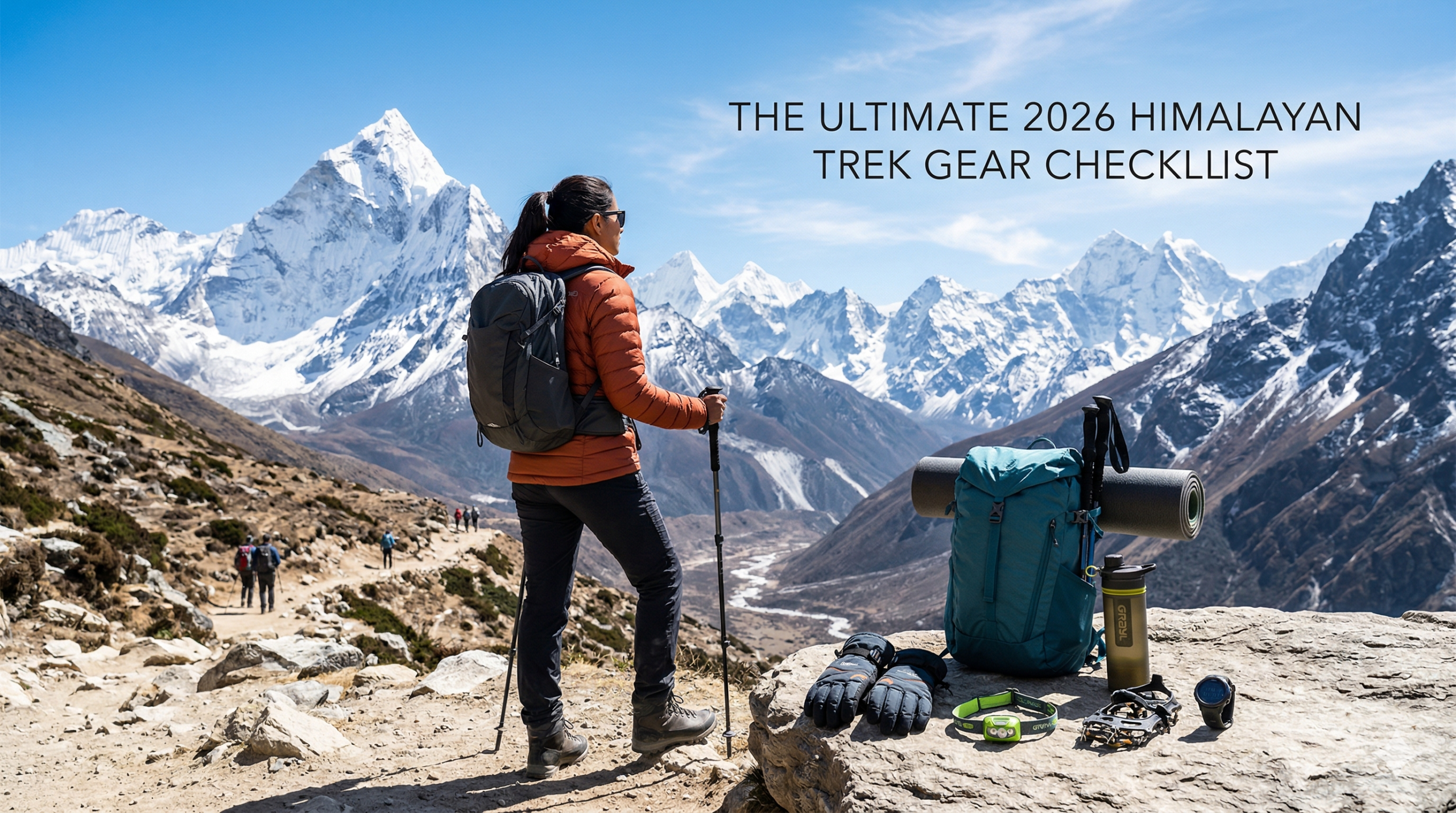
Trekking in the Himalayas is a spiritual and physical challenge that demands respect for the mountains. In 2026, the gear landscape has shifted toward ultralight materials, sustainable manufacturing, and smarter insulation. Whether you’re a beginner heading to Chopta or a veteran eyeing Everest Base Camp, the “old way” of packing heavy cotton and bulky jackets is gone. Modern trekking is about efficiency.
This guide provides a comprehensive, 3000-word deep dive into every piece of gear you need, updated for 2026 standards. We have simplified the technical jargon so you can focus on the trail, not your pack weight.
1. Footwear & Traction: Your Foundation
In 2026, the mantra for Himalayan footwear is “Light is Right.” Traditional heavy leather boots are being replaced by high-performance synthetic hybrids that offer the support of a boot with the weight of a sneaker. For high-altitude treks involving snow or ice, your choice of traction—like microspikes—is just as important as the shoes themselves.
The 2026 Footwear Standard
Your boots must be waterproof (look for GORE-TEX or similar membranes) and have a “Vibram” or high-traction rubber sole. In 2026, we see a surge in “rockered” soles that help your foot roll forward, reducing fatigue on long 15km days. Don’t forget your socks; the “Double Sock” method is outdated. Instead, use a single pair of high-quality Merino wool socks to manage moisture and prevent blisters.
| Gear Item | Top 2026 Recommendation | Purchase Link |
| Best Overall Boot | Salomon X Ultra 5 Mid GTX | Buy on REI |
| Best for Support | Lowa Renegade EVO GTX | Buy on Amazon |
| Best Budget Option | Merrell Moab 3 Waterproof | Buy on Amazon |
| Best Traction | Black Diamond Distance Spikes | Buy on Black Diamond |
Pros and Cons
- Pros: Modern boots require almost zero “break-in” time. They are significantly more breathable than older models, keeping your feet dry from both rain and sweat.
- Cons: Lightweight synthetic boots may only last 2–3 seasons of heavy use compared to 10 years for heavy leather. High-tech soles can be expensive to resoling.
Expert Review: “The Salomon X Ultra 5 is a game-changer for 2026. It provides enough stability for a 15kg pack but feels like a running shoe. For Himalayan terrain, which varies from mud to sharp rock, the grip is unrivaled.” — Tashi Sherpa, High Altitude Guide.
2. The Layering System: Your Weather Shield
The Himalayas are famous for “four seasons in one day.” You might start in a T-shirt at 2,000m and end the day in a snowstorm at 4,000m. The 2026 layering system focuses on Merino Wool for base layers and Hydrophobic Down for warmth.
Understanding the Layers
- Base Layer: This must be Merino wool or high-end recycled polyester. It pulls sweat away from your skin.
- Mid Layer (Fleece): Provides breathable warmth while you are moving.
- Insulation (Down Jacket): This is your “stationary” layer for when you stop or reach camp.
- Outer Shell: A 100% waterproof jacket to block wind and rain.
| Layer Type | Top 2026 Recommendation | Purchase Link |
| Base Layer | Smartwool Intraknit Thermal | Buy on Smartwool |
| Mid Layer | Patagonia R1 Air Hoodie | Buy on Patagonia |
| Down Jacket | Arc’teryx Cerium Hoody | Buy on Arc’teryx |
| Rain Shell | Outdoor Research Helium UL | Buy on REI |
Pros and Cons
- Pros: Highly versatile; you can adjust your temperature in seconds. Modern down jackets pack down to the size of a water bottle.
- Cons: High-quality Merino wool is expensive and requires delicate washing. Down loses warmth if it gets soaked (unless it’s treated hydrophobic down).
Expert Review: “In 2026, we recommend the ‘Active Insulation’ pieces like the Patagonia R1. It breathes so well you don’t have to take it off when going uphill, which saves time and energy.” — Outdoor Gear Lab Analysis.
3. Backpacks & Load Management
A poorly fitted backpack is the quickest way to ruin a trek. In 2026, backpacks have moved toward Ultra-High-Molecular-Weight Polyethylene (UHMWPE) fabrics—materials that are stronger than steel but light as paper.
Choosing Your Capacity
If you are carrying your own gear, a 50L–60L pack is standard. If a porter is carrying your main bag, you only need a 20L–30L daypack. The key 2026 innovation is “Anti-Gravity” suspension, which makes a 10kg load feel like 5kg by distributing weight to your hips.
| Pack Type | Top 2026 Recommendation | Purchase Link |
| Best Overall (60L) | Gossamer Gear Mariposa 60 | Buy on Gossamer Gear |
| Best Comfort (High Load) | Osprey Atmos AG 65 | Buy on REI |
| Best Ultralight (40L) | Durston Kakwa 40 | Buy on Durston Gear |
| Best Daypack | Gregory Zulu 24 LT | Buy on Backcountry |
Pros and Cons
- Pros: 2026 packs feature integrated waterproof pockets for phones and snacks. Sustainable materials mean your pack has a lower carbon footprint.
- Cons: Ultralight packs (like the Mariposa) have a weight limit; if you carry more than 15kg, they can become uncomfortable.
Expert Review: “The Osprey Atmos remains the king of comfort. If you aren’t a minimalist and want to carry a few luxuries, the suspension system is worth every extra gram.” — GearJunkie 2026 Testing.
4. Sleeping Systems: Rest in Sub-Zero Temps
Sleep is when your body recovers and acclimates to high altitude. In the Himalayas, teahouse rooms are not heated. A sleeping bag rated for -10°C (14°F) is the minimum requirement for most high-altitude treks.
Down vs. Synthetic
In 2026, Down is still king for its weight, but Synthetic is preferred for monsoon treks because it stays warm when wet. Always pair your bag with a sleeping liner (silk or fleece) to keep the bag clean and add 5°C of extra warmth.
| Item | Top 2026 Recommendation | Purchase Link |
| Premium Down Bag | Sea to Summit Spark -18°C | Buy on Sea to Summit |
| Best India-Specific | Adventure Worx -10°C High Alt | Buy on Adventure Worx |
| Budget Synthetic | Decathlon Forclaz Trek 500 0° | Buy on Decathlon |
| Sleeping Liner | Sea to Summit Reactor Liner | Buy on Amazon |
Pros and Cons
- Pros: Modern ‘Mummy’ shapes are designed to move with you, preventing that “trapped” feeling. Compression sacks in 2026 are 100% waterproof.
- Cons: High-altitude down bags are a major investment (often $400+). Zippers can still snag—always look for “anti-snag” designs.
Expert Review: “For Indian treks like Kedarkantha or Everest Base Camp, the Adventure Worx -10°C bag is incredible value. It’s built for Himalayan humidity and cold.” — Himalayan Shelter Guide.
5. Electronics & Hydration: The Tech-Forward Trekker
Gone are the days of carrying 10 liters of water. In 2026, we use filter bottles to drink from streams safely. For power, the cold kills batteries quickly, so you need high-capacity, cold-resistant power banks.
The 2026 Tech Checklist
- Water: Use a Grayl or LifeStraw bottle. It removes 99.9% of bacteria AND viruses.
- Light: A USB-C rechargeable headlamp is essential. Avoid battery-operated ones.
- Power: A 20,000mAh power bank can charge a phone 4–5 times.
| Device | Top 2026 Recommendation | Purchase Link |
| Water Purifier | Grayl GeoPress Ti | Buy on Grayl |
| Headlamp | Black Diamond Spot 400-R | Buy on REI |
| Power Bank | Nitecore NB10000 Gen 4 | Buy on Amazon |
| Trekking Poles | Black Diamond Distance Carbon | Buy on Backcountry |
Pros and Cons
- Pros: You save money and the environment by not buying plastic water bottles. Modern headlamps have “red light” modes to save your night vision.
- Cons: Titanium gear (like the Grayl Ti) is very expensive. Power banks are heavy and must be kept in your sleeping bag at night so they don’t freeze.
6. Himalayan Dos and Don’ts: The Golden Rules
Packing the right gear is only half the battle. Knowing how to use it—and how to behave in the mountains—is what keeps you safe.
The “What to Do” List (The Dos)
- Acclimatize: Spend at least 2 nights between 2,500m and 3,000m before going higher.
- Hydrate: Drink 4–5 liters of water daily. Dehydration mimics altitude sickness.
- Break-in Gear: Wear your boots and pack on local hills for at least 30km before the trek.
- Carry Cash: ATMs in the Himalayas are notoriously unreliable or non-existent.
- Pack a Medical Kit: Include Diamox (for altitude), O2 canisters (if remote), and basic first aid.
The “What NOT to Do” List (The Don’ts)
- Don’t wear Cotton: “Cotton Kills.” Once it gets wet from sweat or rain, it stays wet and drains your body heat.
- Don’t Rush: Vistari, Vistari (Slowly, slowly). Walking fast at altitude is the fastest way to get sick.
- Don’t ignore Headaches: A persistent headache at altitude is a warning. Tell your guide immediately.
- Don’t Litter: The Himalayas are a fragile ecosystem. Carry all plastic and wrappers back to the city.
- Don’t Sleep High: Follow the rule “Climb High, Sleep Low” to help your body adjust.
