
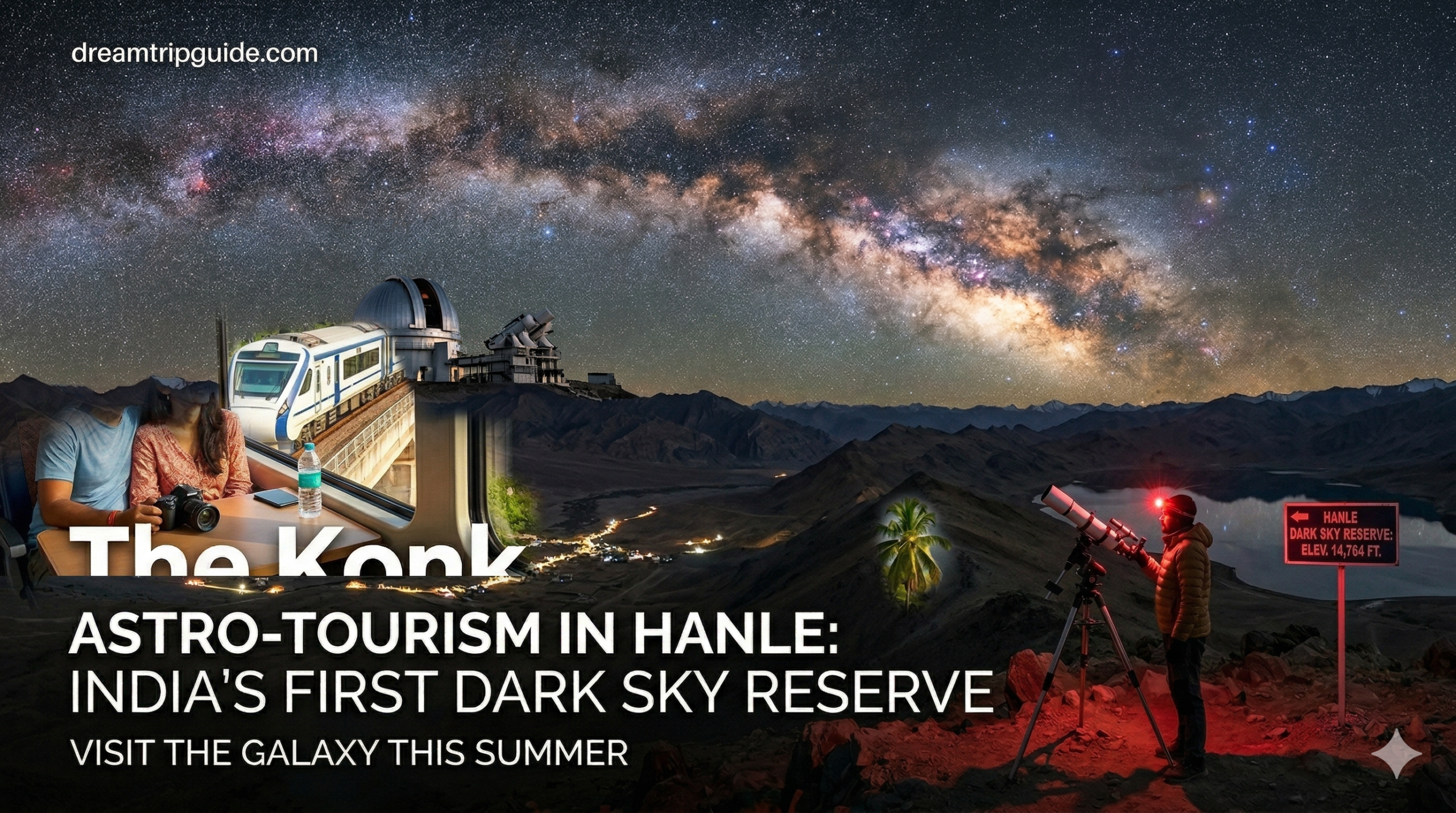
Imagine a place so dark that the Milky Way doesn’t just look like a faint cloud—it looks like a glowing river of diamonds across the sky. Welcome to Hanle, a remote village in the Changthang region of Ladakh. Sitting at a staggering altitude of 14,764 feet, Hanle was officially designated as India’s first Dark Sky Reserve in late 2022.
As we move into the summer of 2026, Hanle has transformed from a hidden military outpost into a world-class destination for “Astro-Tourism.” This isn’t just a trip; it’s a cosmic pilgrimage. While the rest of India swelters in the summer heat, Hanle offers crisp, thin air and a view of the universe that is impossible to find anywhere else in South Asia.
Also Read:- The Konkan Railway Journey: Why This is India’s Most Scenic Summer Train Ride
2. Planning Your 2026 Trip: Permits and Logistics
In 2026, the process of visiting Hanle has become much more streamlined, but it still requires careful planning due to its proximity to the Indo-China border.
- No Inner Line Permit (ILP) for Indians: As of current 2026 regulations, Indian tourists no longer need a traditional ILP for Hanle. However, you must pay the Ladakh Environment Fee (approx. ₹400) and the Wildlife Fee online. Carry at least 5-6 physical copies of the payment receipt.
- The Route: The most popular way is the Leh – Karu – Chumathang – Mahe – Loma – Hanle route (approx. 255 km). The drive takes about 8–10 hours.
- Acclimatization is Non-Negotiable: Hanle is much higher than Leh. If you rush there on Day 2 of your trip, you will get AMS (Acute Mountain Sickness). Spend at least 2 nights in Leh and 1 night in Pangong or Nubra before heading here.
2026 Travel Essentials at a Glance
| Feature | Details for 2026 |
| Altitude | 4,500 Meters (14,764 Feet) |
| Permit Requirement | Environment Fee Receipt (Online) + Aadhaar Card |
| Best Vehicle | SUV with high ground clearance (4×4 preferred) |
| Network | BSNL (Reliable), Airtel/Jio (Spotty/Coming Soon) |
| Key Attraction | Indian Astronomical Observatory (IAO) |
3. The Stargazing Experience: Meet the Astro-Ambassadors
What makes 2026 special for Hanle is the Astro-Ambassador program. The Indian Institute of Astrophysics (IIA) has trained over 20 local villagers to operate high-end 8-inch and 10-inch telescopes.
- Bortle-1 Skies: Hanle’s sky is rated Bortle-1, the darkest classification on Earth.
- The MACE Telescope: You can now see the MACE (Major Atmospheric Cherenkov Experiment) telescope—the world’s highest imaging Cherenkov telescope—which was fully operationalized recently.
- Guided Tours: You don’t need to be a scientist. Local homestays now offer “Star Parties” where guides point out constellations like Orion and the Scorpius-Sagittarius region (where the galactic center lies) using green laser pointers.
4. Accommodation: Living with the Locals
There are no 5-star hotels in Hanle, and that is its greatest charm. The village relies on Homestays, which have been upgraded in 2026 to include basic comforts like heavy blankets, warm water, and traditional Ladakhi dry toilets (though many now have western attachments).
- Top Stays: Look for names like Astro Heaven, Sky Abode, or Namdruk House.
- Cost: Expect to pay between ₹2,500 to ₹4,500 per night, including home-cooked vegetarian meals (perfect for your diet!).
- Sustainable Tourism: These homestays now use “Warm Light” bulbs and thick blackout curtains to prevent light leakage, ensuring the Dark Sky Reserve remains dark.
5. Pros and Cons of a Summer Visit to Hanle
Summer (May to September) is the peak window, but it comes with its own set of trade-offs.
The Comparison
| Pros (Why Summer 2026?) | Cons (The Challenges) |
| Pleasant Days: Daytime temps are 15°C–20°C. | Freezing Nights: Nights still drop to -5°C. |
| Clear Visibility: Best time to see the Milky Way core. | Oxygen Levels: Extremely thin air can be taxing. |
| Road Access: All passes (Chang La) are open and safe. | Limited Resources: No petrol pumps or ATMs for 200km. |
| Wildlife: Best time to see Black-necked Cranes. | Dust: Summer winds can be very dusty. |
6. Expert Review: The Professional Traveler’s Take
“Hanle in 2026 is the final frontier of Indian tourism. Unlike the crowded banks of Pangong Tso, Hanle offers a spiritual silence. The highlight isn’t just the stars; it’s the ride to Umling La (the world’s highest motorable road) which is just 3 hours away. If you are a photographer, the Bortle-1 sky here allows for single-exposure Milky Way shots that look like they were taken from a space station. It is raw, it is cold, but it is life-changing.” — Travel Expert, 2026.
7. The Ultimate Do’s and Don’ts for Hanle
What to Do ✅
- Use a Red-Light Torch: White light ruins night vision for 20 minutes. Wrap your phone flash in red cellophane if you don’t have one.
- Carry Portable Oxygen: Since you live alone and are traveling, always keep a small “OxyBlast” can in your bag for emergencies.
- Hydrate Constantly: Drink at least 4-5 liters of water daily to fight altitude sickness.
- Check the Moon Phase: Plan your trip during the New Moon (Amavasya) for the darkest skies.
What Not to Do ❌
- No High Beams: If driving at night within 22km of the village, use low beams only. Light pollution is a crime here!
- Don’t Sleep Immediately: When you arrive, stay awake for a few hours to let your lungs adjust.
- No Littering: The Changthang Wildlife Sanctuary is home to rare Snow Leopards and Tibetan Wolves. Keep it pristine.
- Don’t Forget Sunscreen: At 14,000ft, the summer sun will burn your skin in minutes, even if it feels cold.
Conclusion: Your Gateway to the Galaxy
Saurav, for a blog like dreamtripguide.com, Hanle represents the future of sustainable travel. It’s a place where we learn to look up again. As you ride your bike or drive through the vast plains of Hanle this summer, remember that you are standing on one of the few places on Earth where the window to the universe is still wide open.
Also Read:- The Great Himalayan National Park: A Guide to Eco-Trekking and Trout Fishing in Tirthan Valley
Quick Travel Summary Table
| Category | Information |
| Distance from Leh | 255 km (8-10 Hours) |
| Best Time for Milky Way | June to August (New Moon Phase) |
| Must-Visit Nearby | Umling La Pass (19,024 ft) |
| Packing Essential | Three layers of clothing + Red Light Torch |
| Estimated Budget | ₹15,000 – ₹20,000 for a 3-day trip from Leh |
