
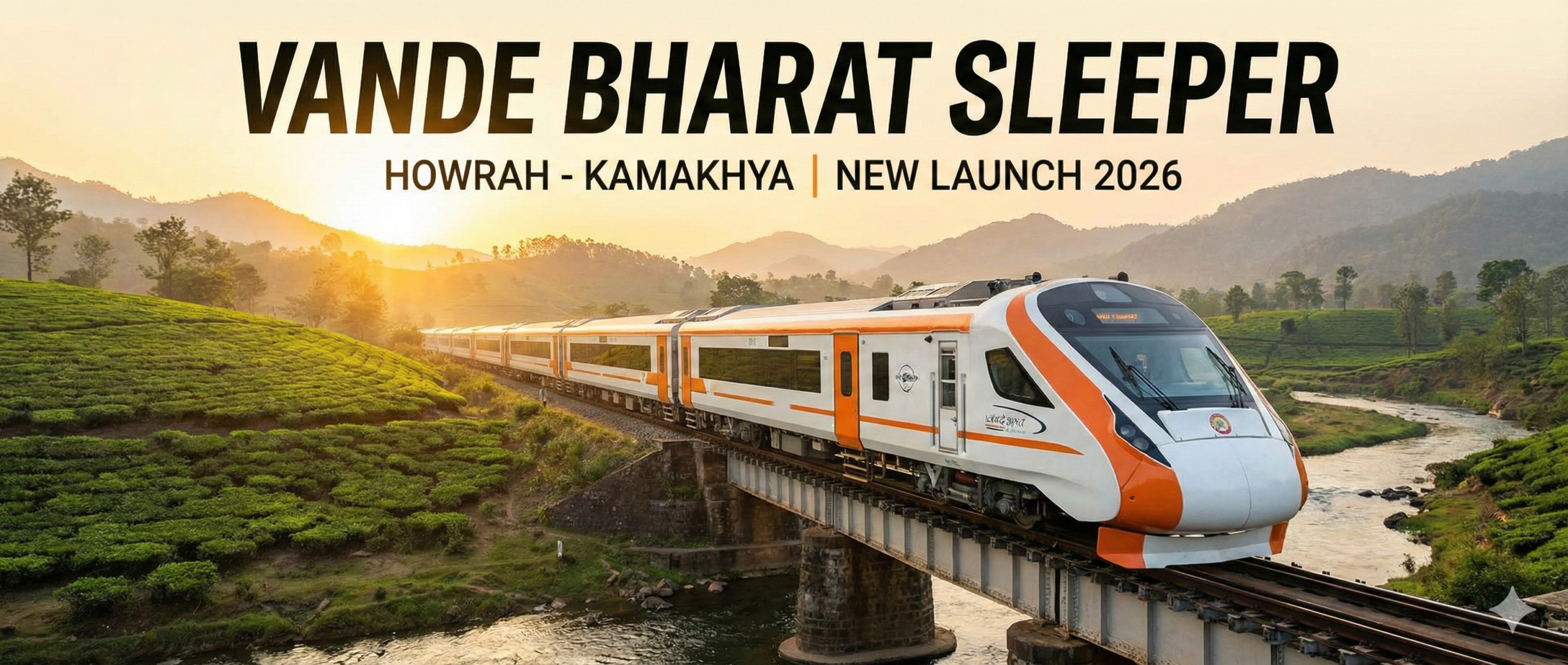
The wait is finally over! On January 17, 2026, Prime Minister Narendra Modi flagged off India’s very first Vande Bharat Sleeper train, marking a historic milestone in Indian rail history. For years, the “Vande Bharat” brand has been synonymous with speed, white-and-orange chair cars, and day travel. But today, that definition changes forever with the launch of the Howrah to Kamakhya Vande Bharat Sleeper.
This isn’t just another train; it is Indian Railways’ answer to premium overnight travel, designed to compete directly with flights and the legendary Rajdhani Express. Connecting Kolkata (Howrah) in West Bengal to the gateway of the Northeast, Guwahati (Kamakhya), this train promises to reduce travel time, enhance safety with the KAVACH system, and offer an “airline-like” experience on tracks.
In this detailed review, we will deep-dive into everything you need to know: ticket prices for 2026, the full route map, what it feels like inside the coaches, expert opinions, and a critical look at the pros and cons. Whether you are a tourist heading to Assam or a business traveler returning to Bengal, this guide will help you decide if the Vande Bharat Sleeper is the right choice for your next journey.
Read Also:- 5 Best Stopovers on a Delhi to Varanasi Road Trip
1. The Route: Howrah to Kamakhya Connectivity
The selection of the Howrah to Kamakhya route for the debut of the Vande Bharat Sleeper is strategic and significant. This corridor is known as the “Chicken’s Neck” of India—a vital link connecting the main Indian landmass with the Seven Sister States of the Northeast. Historically, trains on this route have faced congestion and delays, often taking 18 to 20 hours. The Vande Bharat Sleeper shaves significant time off this journey, covering the distance in just 14 hours.
Train Numbers and Schedule
The service operates with the following train numbers:
- Train No. 27575: Howrah (HWH) to Kamakhya (KYQ)
- Train No. 27576: Kamakhya (KYQ) to Howrah (HWH)
The schedule is tailored for business and leisure travelers who prefer overnight journeys to save daytime productivity. The train departs in the evening and arrives early the next morning, allowing passengers to get a full night’s sleep and wake up fresh at their destination.
Key Stops and Connectivity
Unlike the non-stop Duronto Express, the Vande Bharat Sleeper makes limited but important commercial halts. This ensures that people from intermediate cities like Malda and New Jalpaiguri (the gateway to Darjeeling and Sikkim) also benefit from this premium service.
Why this route matters:
For decades, the Saraighat Express and Kamrup Express were the lifelines here. However, getting a confirmed ticket was a struggle, and the travel time was long. The Vande Bharat Sleeper serves as a faster, more reliable alternative. It bypasses the need for locomotive reversals (thanks to driver cabins at both ends), which saves precious time at stations.
Below is the detailed schedule and halt list for the inaugural run.
Route & Time Table
| Station Name | Arrival Time (Approx) | Departure Time (Approx) | Significance |
| Howrah Jn (HWH) | Start | 18:20 (6:20 PM) | Major Terminal in Kolkata |
| Bandel Jn | 19:10 | 19:12 | Suburban Connectivity |
| Nabadwip Dham | 19:55 | 19:57 | Pilgrimage Hub |
| Katwa Jn | 20:30 | 20:32 | Junction Point |
| Azimganj Jn | 21:25 | 21:30 | Connecting Murshidabad |
| New Farakka Jn | 22:30 | 22:32 | Industrial Hub |
| Malda Town | 23:20 | 23:30 | Gateway to North Bengal |
| New Jalpaiguri (NJP) | 02:30 | 02:40 | Gateway to Darjeeling/Sikkim |
| New Cooch Behar | 04:15 | 04:17 | Heritage City |
| New Alipurduar | 04:40 | 04:42 | Dooars Region |
| New Bongaigaon | 06:10 | 06:12 | Industrial Town |
| Rangiya Jn | 07:15 | 07:17 | Transit Hub |
| Kamakhya (KYQ) | 08:20 | End | Gateway to Guwahati |
Note: The return train (27576) follows a similar pattern, departing Kamakhya at 18:15 and reaching Howrah at 08:15.
2. Vande Bharat Sleeper Ticket Price 2026
One of the biggest questions on everyone’s mind is: Is it affordable? The Vande Bharat Sleeper is positioned as a premium service, sitting slightly above the Rajdhani Express in terms of pricing but significantly cheaper than a last-minute flight ticket.
The fare structure adopts a dynamic approach but with a transparent base. Unlike standard trains where you have RAC (Reservation Against Cancellation), the Vande Bharat Sleeper has a strict “Confirmed Tickets Only” policy. There is no RAC and no Waitlist. If you book a ticket, you are guaranteed a berth. This mimics the airline model—you either have a seat, or you don’t.
Fare Breakdown by Class
The train features three primary classes:
- AC 3-Tier (3A): The most popular choice for families and budget-conscious premium travelers.
- AC 2-Tier (2A): Offers more privacy with curtains and fewer berths per bay.
- AC First Class (1A): The pinnacle of luxury with lockable cabins and shower facilities.
The prices vary based on distance. The end-to-end fare from Howrah to Kamakhya is higher than the fare for shorter legs like Howrah to Malda.
Ticket Price Table (Estimated 2026 Fares)
| Class | Route | Base Fare (Approx) | Catering & GST Included (Est) |
| AC 3-Tier | Howrah to Kamakhya | ₹ 2,299 | ₹ 2,450 – ₹ 2,600 |
| AC 2-Tier | Howrah to Kamakhya | ₹ 2,970 | ₹ 3,200 – ₹ 3,400 |
| AC 1st Class | Howrah to Kamakhya | ₹ 3,640 | ₹ 4,000 – ₹ 4,200 |
| AC 3-Tier | Howrah to NJP | ₹ 1,334 | ₹ 1,500 – ₹ 1,650 |
| AC 2-Tier | Howrah to NJP | ₹ 1,724 | ₹ 1,900 – ₹ 2,100 |
| AC 1st Class | Howrah to NJP | ₹ 2,113 | ₹ 2,300 – ₹ 2,500 |
> Note: Fares are subject to dynamic pricing and may increase during peak holiday seasons. The prices mentioned above are indicative of the launch rates.
Is it worth the money?
When you compare these prices to flights, the value becomes clear. A flight from Kolkata to Guwahati often costs between ₹4,000 and ₹7,000, plus the hassle of airport security and baggage limits. The Vande Bharat Sleeper 1st Class offers a similar price point to a budget flight but with the luxury of a bed, better food, and no luggage weight restrictions.
For the 3rd AC passenger, the price is about ₹500-₹800 higher than a standard express train, but for that premium, you get speed, safety, and brand-new amenities.
3. Inside the Vande Bharat Sleeper Coach
Step inside, and the first thing you notice is the color palette. Gone are the dull blues and browns of older Indian trains. The Vande Bharat Sleeper features cream, beige, and wood-finish interiors that feel airy, modern, and sophisticated. The design philosophy is “human-centric,” focusing on ergonomics and passenger comfort.
The train is a “trainset,” meaning there are no separate engines attached; the driving cabs are integrated. This allows for sealed gangways (the connection between coaches). Unlike older trains where moving between coaches was noisy and dusty, the Vande Bharat gangways are fully sealed, dust-free, and air-conditioned, making the entire train feel like one long, continuous tube.
AC 3-Tier (The Economy Premium)
The 3-Tier coaches are the biggest upgrade.
- Cushioning: The berths use a new composite foam that is firmer yet more comfortable than the old Rexine seats.
- Ladders: The climbing ladders are ergonomically designed with wider steps and handles, making it much easier for seniors and children to reach the Upper Berth.
- Amenities: Every berth has its own dedicated reading light, a USB charging port, and a mobile holder. There is also a small snack table for the Side Lower passenger, a feature often missing in older trains.
AC 2-Tier (The Privacy Choice)
The 2-Tier coaches offer a significant jump in personal space.
- Configuration: The classic 2×2 bay structure remains, but the aisle is wider.
- Privacy: High-quality curtains isolate every berth, not just the bay.
- Lighting: The ambient lighting is soft and diffused. At night, “floor glow lights” guide you to the restroom without disturbing others.
AC First Class (The “Hotel on Wheels”)
The First Class is the showstopper.
- Cabins: It features lockable 4-berth cabins and 2-berth coupes.
- Showers: Yes, there is a hot-water shower cubicle in the First Class coach! This is a game-changer for business travelers who want to head straight to a meeting upon arrival.
- Noise Insulation: The insulation is superior, reducing track noise to a mere hum, ensuring a disturb-free sleep.
Common Features Across All Classes
- Bio-Vacuum Toilets: Similar to airplanes, these toilets use a vacuum system that saves water and eliminates foul odors. They are touch-free and modular.
- Automatic Doors: The entry doors are automatic (operated by the driver), and the internal partition doors open with a touch button.
- Information Screens: Digital screens above the doors display the train speed, next station, and safety messages.
4. Expert Review: Performance & Safety
To give you an unbiased perspective, we have synthesized reviews from railway experts and early travelers who experienced the inaugural run.
The “Jerk-Free” Promise
One of the most touted features of the Vande Bharat Sleeper is its “jerk-free” ride. According to railway officials, the train uses Semi-Permanent Couplers and a superior suspension system.
- Expert Take: “In traditional trains, you feel a distinct ‘thud’ when the train starts or stops. The Vande Bharat Sleeper accelerates smoothly, almost like an electric car. You can keep a glass of water on the table, and it barely ripples at 130 km/h.”
Speed and Acceleration
While the maximum tested speed is 180 km/h, the Howrah-Kamakhya route currently allows for a maximum operational speed of 130 km/h in certain sections.
- Expert Take: “The real advantage isn’t just top speed; it’s acceleration. This train can go from 0 to 100 km/h much faster than a Rajdhani. This helps it make up for lost time if there are unexpected signals.”
Safety: The KAVACH System
Safety is a major selling point. The train is equipped with KAVACH, an indigenous anti-collision technology.
- How it works: If two trains accidentally end up on the same track, the system automatically applies brakes to prevent a collision. It also prevents the driver from overspeeding.
- Fire Safety: The train has aerosol-based fire detection and suppression systems in electrical cabinets and toilets, a significant upgrade over older smoke detectors.
Review Summary
Experts agree that the hardware is world-class. The challenge, however, will be maintenance. The beige interiors and complex automatic doors require disciplined usage by passengers and rigorous cleaning by the railways.
Pros and Cons Table
| Pros (What’s Good) | Cons (What Could Be Better) |
| Speed: Fastest option on the route (14 hours). | Price: Significantly more expensive than regular trains. |
| No Waitlist: Only confirmed seats; peace of mind. | No RAC: If seats are full, you have zero chance of getting on. |
| Hygiene: Bio-vacuum toilets are odor-free and clean. | Upper Berths: Despite improvements, climbing can still be tricky for the very elderly. |
| Safety: KAVACH system and fire suppression. | Dynamic Fare: Prices may spike during Durga Puja or Bihu. |
| Smooth Ride: reduced vibration and noise. | Limited Luggage: Not as much storage space as older, wider coaches. |
5. Food & Dining Experience
A train journey in India is incomplete without discussing the food. The Vande Bharat Sleeper aims to elevate the catering experience, moving away from the standard “Dal-Chawal” served in aluminum foil.
The Pantry Car Upgrade
Unlike the Vande Bharat Chair Car, which has mini-pantries in each coach, the Sleeper version includes a dedicated, high-tech pantry car. This allows for better heating, storage, and preparation of meals.
The Menu: Local Flavors
Indian Railways has promised a menu that reflects the region. For the Howrah-Kamakhya route, expect a culinary treat:
- From Howrah: The menu features Bengali favorites. You might find Luchi-Alur Dum for breakfast, or Fish Curry (Rui/Katla) and Kosha Mangsho (Chicken/Mutton) options for dinner.
- From Kamakhya: The return journey introduces Assamese flavors. Expect dishes that use bamboo shoot hints or local rice varieties, along with standard North Indian staples.
Service Style
The service is modeled after airlines.
- Welcome Drink: Passengers in 1st and 2nd AC are greeted with a welcome drink (fruit juice or buttermilk) upon boarding.
- Tray Service: Meals are served on ergonomic trays that fit perfectly on the snack tables. The cutlery is upgraded to sturdier, eco-friendly materials.
- Tea/Coffee: There is a focus on providing hot, high-quality tea—essential for a route connecting two tea-loving regions (Bengal and Assam).
Cost of Food
If you opt for “Food Included” in your ticket, the cost is added to your fare.
- Breakfast: ~₹150 – ₹200
- Dinner: ~₹300 – ₹350
- Tip: You can also choose “No Food” at the time of booking and bring your own, but purchasing on board later might cost slightly more and have limited choices.
6. What To Do & What Not To Do
To ensure you have the best experience on this premium train, here are some quick tips.
What Should You Do?
- Book Early: Since there is no RAC or Waitlist, tickets will sell out instantly. Plan your trip weeks in advance.
- Use the Reading Light: If you are awake late at night, use your personal reading light instead of the main cabin lights to avoid disturbing others.
- Bring a Water Bottle: While they provide water, having a reusable bottle is eco-friendly. There are RO water dispensers in some newer coach designs (check onboard).
- Try the Shower (1st AC): If you are traveling First Class, make use of the shower facility to freshen up before arrival.
What Not To Do?
- Do Not Force Doors: The inter-coach doors are automatic. Do not try to push or pull them manually; you might damage the sensors.
- Do Not Smoke: The train has sensitive smoke detectors. Smoking in the toilet will trigger emergency brakes and land you a heavy fine or jail time.
- Don’t Overpack: The luggage space under the seats is designed for standard trolley bags. oversized trunks or sacks (common on this route) might not fit well.
- Don’t litter: The train has dustbins in every bay. Use them to keep the beige interiors clean.
Read Also:- Travel India on ₹1200 a Day: The 2026 Inflation-Proof Guide
Conclusion & Next Step
The Howrah to Kamakhya Vande Bharat Sleeper is more than just a train; it is a statement of modern India. It successfully bridges the gap between the speed of a flight and the comfort of a train. While the price is higher, the time saved, the safety features, and the sheer comfort make it a compelling option, especially for business travelers and families.
If you are planning a trip to the Northeast or returning to Kolkata, this train offers a stress-free, luxurious start to your journey.
What should you do next?
If you are planning to travel in the next 3 months, check the IRCTC website right now. With the hype surrounding the launch, seats for the upcoming weeks are likely to be booked out within hours. Go to irctc.co.in and search for Train No. 27575 to experience the future of Indian rail travel yourself!
Disclaimer: This blog is based on the latest information available as of January 2026. Fares and schedules are subject to change by Indian Railways.
