
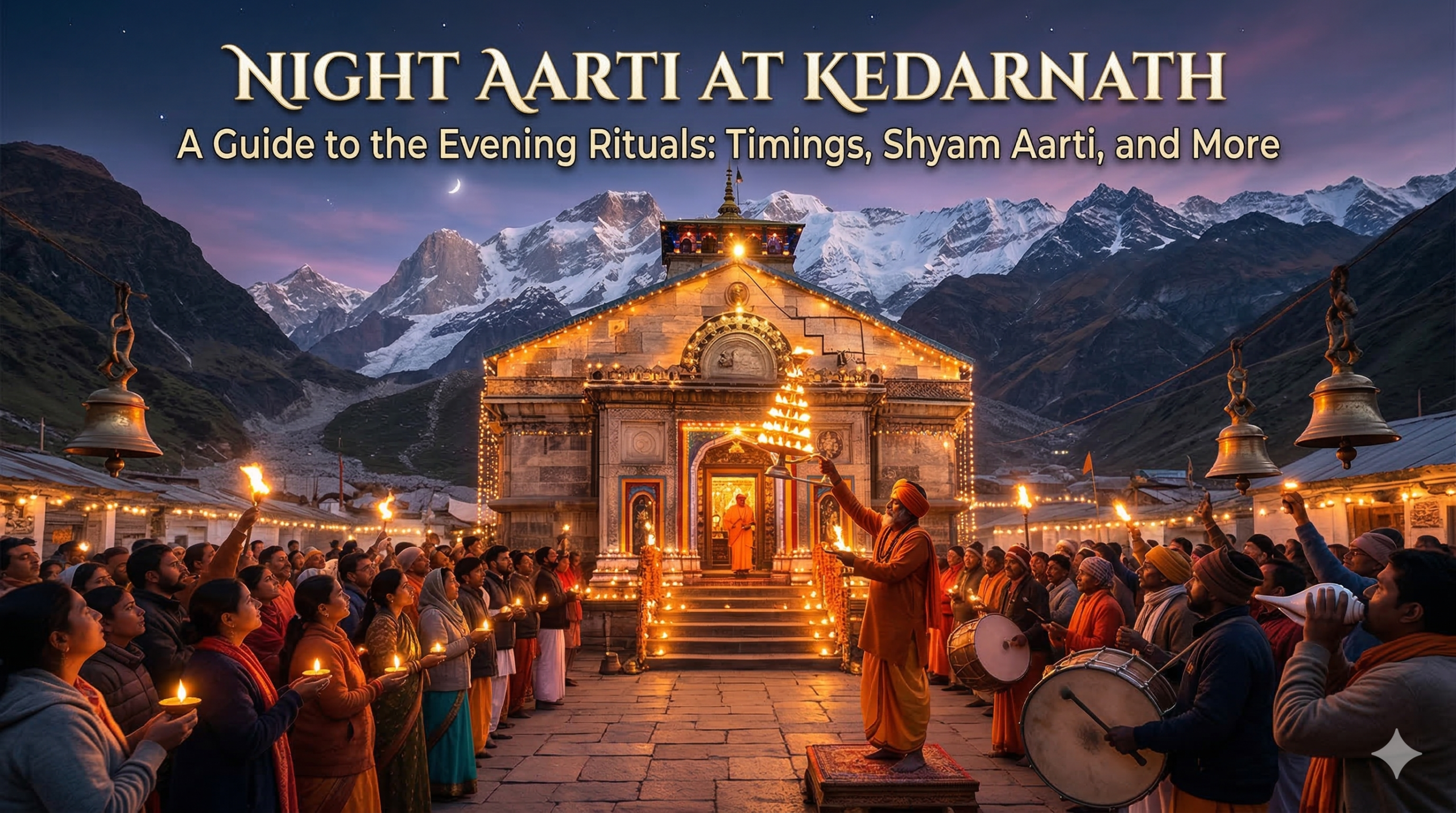
If you’ve ever wondered what it feels like to stand at the edge of the world while the air vibrates with ancient chants, the Night Aarti at Kedarnath is your answer. While thousands flock to the temple for morning Darshan, the evening rituals offer a different, more mystical experience. As the sun dips behind the Kedar Dome, the temple transforms into a beacon of light amidst the cold Himalayan shadows.
In this guide, we’ll explore the Kedarnath evening Aarti timings, the significance of the Shyam Aarti, and how you can immerse yourself in the profound spiritual atmosphere at night.
Read Also:- The Sacred Panchmukhi Doli Journey: From Ukhimath to Kedarnath
1. The Divine Transition: Temple Darshan Hours & Evening Prep
Understanding the temple darshan hours is crucial for any pilgrim. The temple typically opens at 4:00 AM and closes for a brief afternoon break between 3:00 PM and 5:00 PM. The evening session begins at 5:00 PM, leading up to the grand finale of the day.
The Afternoon Hush
During the break, the temple sanctum is cleaned, and the priests prepare for the evening ceremonies. This is a great time for pilgrims to find a spot on the stone platform outside. As the clock strikes five, the heavy silver doors swing open again. Unlike the morning, which is characterized by the “Abhishek” (ritual bathing of the Shiva Lingam), the evening is focused on “Shringaar” (decoration).
The Shringaar Ritual
The Shiva Lingam, which is a natural rock formation representing the hump of a bull, is meticulously decorated. Priests use sandalwood paste, fresh flowers brought from the valleys, and sacred ash. Watching this preparation is a meditative experience in itself. The hustle of the morning crowd settles into a rhythmic wait. The air grows colder, and the scent of incense becomes more pronounced, signaling that the lighting ceremony is about to begin.
Timing Your Visit
To truly experience the Aarti, you should be inside the temple complex by 5:30 PM. This allows you to witness the transition from natural twilight to the warm glow of the temple lamps. For 2026, the local administration has streamlined the queuing system, but for the evening Aarti, the atmosphere remains more communal and less rushed than the morning peaks.
| Event | Tentative Timing (2026) |
| Afternoon Closing | 3:00 PM – 5:00 PM |
| Evening Re-opening | 5:00 PM |
| Shringaar (Decoration) | 5:30 PM – 6:30 PM |
| Main Evening Aarti | 6:30 PM – 7:30 PM |
| Temple Closing | 8:30 PM – 9:00 PM |
🏔️ Kedarnath Yatra Checklist 2026: 12 Must-Have Items for a Successful Trek

- ✅Altitude Protection: Prevents breathlessness and headaches caused by low oxygen levels at Kedarnath top.
- ✅Instant Energy: Helps you recover faster during the steep 16km trek from Gauri Kund.
- ✅Lightweight: Fits easily in your side pocket and weighs almost nothing.

- ✅Unbeatable Grip: Anti-skid soles designed specifically for slippery mountain rocks and mud.
- ✅100% Waterproof: Keeps your feet dry during sudden rains or while crossing small streams.
- ✅Ankle Support: Prevents injuries on the uneven zig-zag paths of the Kedar valley.

- ✅Total Coverage: Covers you and your large backpack completely during heavy mountain rains.
- ✅Quick Dry: Much better than heavy raincoats; it's light and dries in minutes.
- ✅Windproof: Blocks the freezing cold winds that follow the rain at high altitudes.

- ✅Heat Retention: Advanced fabric that locks body heat even when the temperature drops to 0°C.
- ✅Odour Resistant: Can be worn for multiple days without feeling unhygienic.
- ✅Slim Fit: Fits comfortably under your regular clothes without looking bulky.

- ✅Cold Protection: Battery dies fast in cold weather; this ensures your phone stays alive for photos.
- ✅Massive Capacity: Charge your phone and camera 4-5 times fully during the trip.
- ✅Fast Charging: Don't waste time at charging points in tea stalls.

- ✅Knee Support: Reduces 25% of the pressure on your knees during the steep descent.
- ✅Better Balance: Essential for crossing slippery patches or walking in narrow trails.
- ✅Anti-Shock: Absorbs ground impact to prevent wrist and shoulder pain.

- ✅12H Hot: Keep hot water/tea ready to fight the freezing cold of the Himalayas.
- ✅BPA Free: Safe and healthy stainless steel that won't rust.
- ✅Strong Body: Survives accidental drops on rocky terrains easily.

- ✅Mountain Ready: Contains pain sprays, bandages, and altitude sickness tablets.
- ✅Lightweight: Small enough to fit in any backpack side pocket.
- ✅Must Have: Medical help is far away on the trek; be your own first responder.

- ✅Hands-Free: Essential for early morning treks (3 AM) so you can use trekking poles freely.
- ✅High Brightness: Powerful beam that covers up to 100 meters clearly.
- ✅Weatherproof: Continues to work even during rain or heavy mist.

- ✅No Wet Smell: Dries in minutes so you don't carry a heavy, smelly towel in your bag.
- ✅Super Tiny: Folds into a small pouch, leaving more room for warm clothes.
- ✅Gentle: Ultra-soft fabric that is perfect for cold weather skin care.

- ✅High Altitude Protection: Himalayan sun is harsh and causes severe tanning & burns.
- ✅Non-Greasy: Doesn't feel oily while trekking or sweating.
- ✅Sweat Resistant: Stays on your skin even during high-intensity walking.

- ✅Dual Protection: Ponchos are good, but this ensures no water enters your bag.
- ✅Reflective Logo: Helps others see you in heavy mist or night treks.
- ✅Universal Fit: Fits perfectly on all 30L to 60L trekking backpacks.
2. The Heart of Devotion: Shyam Aarti and Chants
The Shyam Aarti (Evening Prayer) is the soul of the Kedarnath experience. As the stars begin to peer through the Himalayan sky, the chief priest stands before the deity with a multi-tiered brass lamp.
The Symphony of Sound
The Aarti isn’t just a visual spectacle; it is an auditory immersion. The massive temple bells, some weighing hundreds of kilograms, begin to toll in a synchronized rhythm. They are accompanied by conch shells (Shankh) and small hand-held cymbals. The sound echoes off the surrounding mountain walls, creating a “dome of sound” that feels like it’s vibrating through your very chest.
Chants and Mantras
During the Aarti, the priests and devotees recite the Shiva Tandava Stotram and the Mahamrityunjaya Mantra. Even if you don’t know the words, the collective energy of hundreds of voices chanting in unison is overwhelming. It is said that the evening Aarti is when the “Ganas” (the celestial attendants of Shiva) are most active, and the boundary between the physical and spiritual worlds is at its thinnest.
The Lighting Ceremony
As the main lamp is waved in circular motions (Aarati), smaller lamps are lit throughout the “Mandapa” (hall). The flickering flames reflect off the ancient stone carvings of the Pandavas and other deities etched into the temple walls. This lighting ceremony symbolizes the removal of darkness (ignorance) and the welcoming of light (knowledge).
3. The Mystical Night: Spiritual Atmosphere at Night
Once the main Aarti concludes around 7:30 PM, the spiritual atmosphere at night takes on a deeply personal tone. While the crowds begin to head back to their tents or guest houses, a few seekers remain in the courtyard.
The Silence of the Peaks
At an altitude of 3,583 meters, the silence at night is profound. With the temple illuminated by floodlights and the peaks of Kedarnath and Kharchakund glowing under the moonlight, the setting is ethereal. The “Bhairav Nath” temple, situated on a nearby hill, stands guard over the valley, and its silhouette adds to the protective, sacred feeling of the place.
Meditation and Reflection
The evening is the best time for meditation. The intense energy of the Aarti leaves a lingering sense of peace. Many pilgrims sit silently on the cold stone floor, wrapped in heavy woolens, simply staring at the temple spire (Shikhara). It is a time for introspection, where the worries of the world seem to vanish against the backdrop of the eternal Himalayas.
The Cold and the Cosmos
Be prepared—the temperature at Kedarnath drops drastically after sunset, often touching sub-zero levels even in May and June. However, the clarity of the night sky is unparalleled. You can often see the Milky Way stretching across the temple, a reminder of the cosmic nature of Lord Shiva, who is also known as Vyomakesha (He whose hair is the sky).
| Feature | Night Experience Details |
| Temperature | -2°C to 5°C (Summer nights) |
| Visibility | High (Excellent for stargazing) |
| Crowd Level | Moderate to Low (Post-Aarti) |
| Key Landmark | Illuminated Temple & Kedar Dome |
4. Practicalities: Planning Your Evening Stay
To witness the Kedarnath evening Aarti timings in full, you cannot rely on a day trip. Helicopter services usually stop by 4:00 PM or 5:00 PM, meaning you must stay overnight at the top.
Accommodation Options
Staying at the Kedarnath base is a test of endurance but highly rewarding. Options range from GMVN (Government) cottages to private tents and “Dharamshalas.”
- GMVN Swargarohini: The most comfortable option near the temple.
- Nandi Complex: Budget-friendly bunk beds.
- Tented Colonies: Located about 1 km from the temple; basic but essential.
Food and Essentials
Post-Aarti, the local “Bhandaras” (community kitchens) and small eateries serve hot, simple Satvik food—usually Dal, Rice, and Sabzi. It is vital to eat early, as most places close by 9:00 PM. Always carry a thermos with hot water; staying hydrated is the best way to fight altitude sickness during the cold night hours.
Safety at Night
The path around the temple is well-lit, but if you venture even slightly toward the base camp, you’ll need a torch. The terrain is uneven, and patches of ice can be slippery. Always keep your physical movements slow to conserve oxygen in the thin night air.
5. Summary: Pros, Cons, and Expert Advice
Is the night Aarti worth the freezing temperatures? Let’s look at the breakdown to help you decide.
Pros and Cons of Evening Rituals
| Pros | Cons |
| Intense Energy: The vibration of the bells and chants is more powerful than in the morning. | Extreme Cold: The temperature drop can be harsh for children and senior citizens. |
| Better Photography: The temple looks stunning when illuminated against the dark sky. | Accommodation Stress: You must stay overnight, which requires advance booking. |
| Peaceful Darshan: The queue for the evening “Shringaar” Darshan is often shorter. | Helicopter Limitations: You cannot fly back the same day if you attend the Aarti. |
Expert Review: The Spiritual Seeker’s View
“The morning Darshan is about ‘Darshan’ (seeing the Lord), but the evening Aarti is about ‘Anubhav’ (experiencing the Lord). If your health permits, I always recommend staying overnight. The 2026 season will see improved laser lighting on the temple facade, making the evening even more visual. Just remember: the mountain belongs to the elements at night—respect the cold and your body’s limits.” — Swami Vidyanand, Himalayan Retreat Lead
What to Do and What Not to Do
What to Do:
- Layer Up: Wear at least 4 layers (Thermal + Shirt + Sweater + Heavy Jacket).
- Book GMVN Early: Night stays are limited; book 3 months in advance via the official portal.
- Participate: Don’t just watch; join the claps and chants. The energy is infectious.
- Carry a Power Bank: Phone batteries drain 3x faster in the cold.
What Not to Do:
- No Flash Photography: Inside the temple, photography is strictly prohibited. Respect the sanctity.
- Don’t Wander Alone: Stay within the temple and base camp perimeter. The surrounding wilderness is rugged.
- Avoid Heavy Meals: Digestion slows down at high altitudes at night. Eat light.
- Don’t Ignore Headaches: If you have a persistent headache at night, it’s a sign of AMS. Alert the medical post near the temple immediately.
The Night Aarti at Kedarnath is a reminder that even in the coldest, darkest places, faith provides a warmth that no fire can match.
Read Also:- Rudra Cave Meditation: How to Stay in the Famous ‘Modi Cave’ in 2026
👉 Also Read – Book Kedarnath Package
Would you like me to find the current weather forecast for Kedarnath or help you check the availability of GMVN rooms for your travel dates?
