
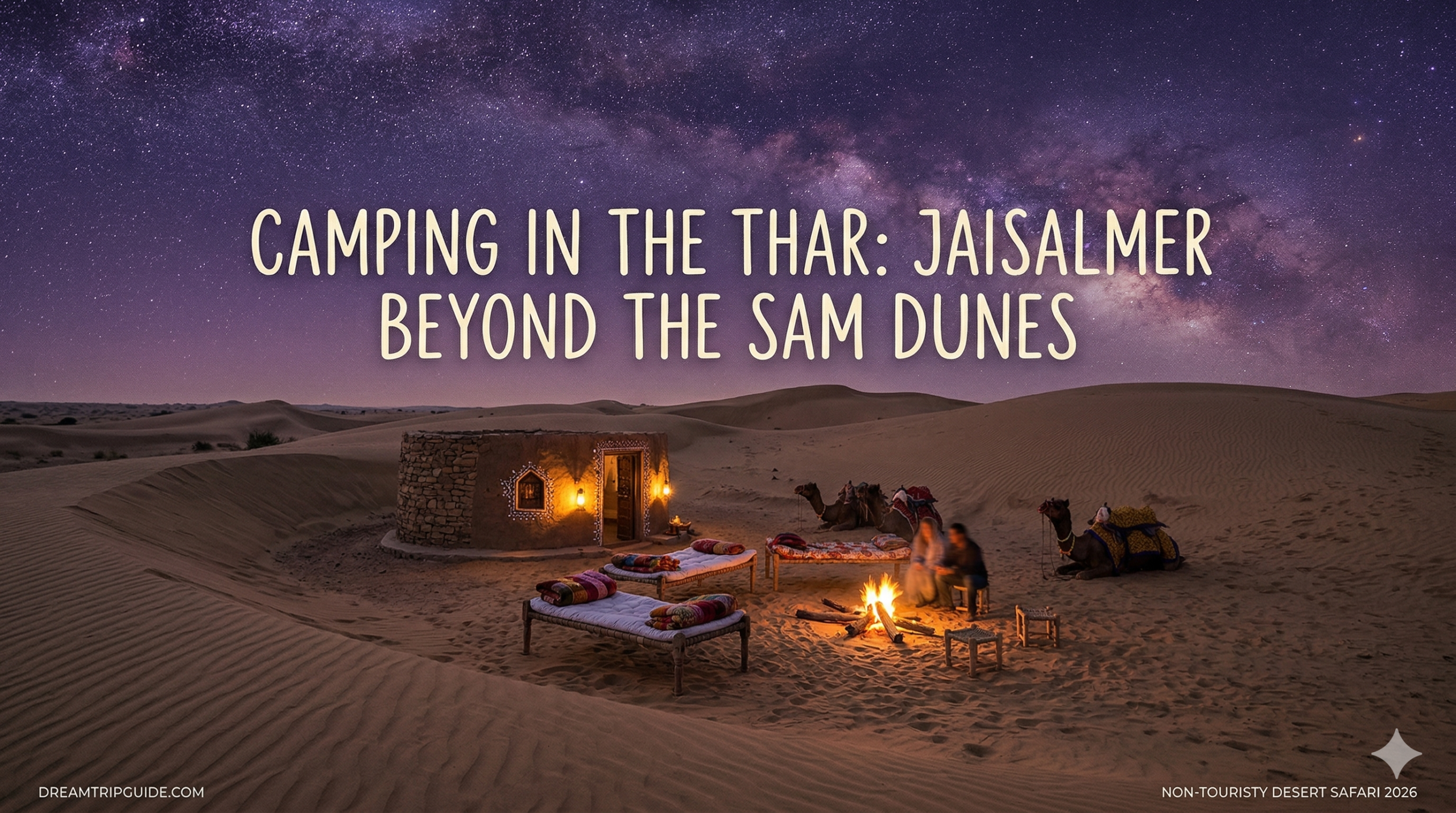
Jaisalmer, the “Golden City,” is the gateway to the Great Indian Desert. For years, the Sam Sand Dunes have been the face of Rajasthan’s desert tourism. However, in 2026, travelers are looking for something deeper. They want the silence of the dunes, the crackle of a campfire without the noise of loud speakers, and the authentic taste of Ker Sangri under a canopy of infinite stars.
This guide is for those who want to skip the commercial crowds and find a non-touristy desert safari Jaisalmer experience. We dive into the quiet charms of Khuri, the logistics of sleeping under the open sky, and what to expect from the upcoming Jaisalmer Desert Festival.
Read Also:- India’s Ghost Villages: Kuldhara & The New Ruins
Non-Touristy Desert Safari Jaisalmer: Finding the True Silence
Most tourists land in Sam, where hundreds of jeeps and loud music often drown out the desert’s soul. If you are seeking a non-touristy desert safari Jaisalmer, you need to head toward the “Off-Beat” tracks like Khaba Fort or the Sudasari Desert National Park. In these areas, the dunes are pristine, the ripples in the sand are made by the wind rather than tire tracks, and the wildlife—like the Great Indian Bustard—is actually visible.
A truly authentic safari in 2026 involves a slow-paced camel trek. Instead of a 20-minute ride for a photo-op, choose a half-day trek that takes you deep into the dunes where the only tracks are yours and the desert foxes’. The “Jeep Safari” in these quiet zones is more about exploration than high-speed stunts. You’ll visit abandoned Paliwal Brahmin villages and ancient fossil parks, giving you a sense of the Thar’s prehistoric past.
Comparison: Sam vs. Non-Touristy Spots
| Feature | Sam Sand Dunes | Non-Touristy Spots (Khuri/Khaba) |
| Crowd Level | Very High (Commercial) | Very Low (Peaceful) |
| Main Attraction | Cultural Shows & Dune Bashing | Stargazing & Nature Walks |
| Vibe | Party & Carnival | Serenity & Traditional |
| Photography | Busy backgrounds | Clean, endless horizons |
Export to Sheets
Khuri Sand Dunes Camping: The Authentic Village Experience
If Sam is a city of tents, Khuri sand dunes camping is a village of dreams. Khuri is located about 45 km from Jaisalmer and offers a much more intimate connection with the Thar. The village itself is charming, with mud houses decorated with traditional Mandana paintings. Camping here usually means staying in small, family-run desert camps that prioritize Rajasthani hospitality over mass-scale luxury.
In 2026, Khuri has become the go-to for “Slow Travel.” Most camps here provide traditional huts (dhani) or simple tents. The evening doesn’t involve a Bollywood dance performance; instead, you sit around a small fire with local Manganiyar folk singers who play the Kamaicha and sing songs of the desert’s heroes. The food is cooked over wood fires, offering a smoky flavor to Bajra Rotis and Lehsun Chutney that you simply can’t find in city hotels.
Pros and Cons of Khuri Camping
- Pros: Genuine local interaction, minimal light pollution for stars, supports local village economy.
- Cons: Fewer luxury “glamping” options, limited mobile connectivity, further drive from Jaisalmer city.
Sleeping Under Stars Thar Desert Price and Logistics
There is a massive difference between sleeping in a tent and sleeping under stars Thar desert. Known as “Open Sky Camping,” this is the ultimate desert experience. You are provided with a comfortable mattress, a thick “razai” (traditional quilt), and a charpoy (traditional bed) placed right on top of a sand dune. There is no roof, no walls—just you and the Milky Way.
The sleeping under stars Thar desert price in 2026 typically ranges from ₹2,500 to ₹5,500 per person. This usually includes a camel safari, dinner, a night under the sky, and breakfast the next morning. It is a raw experience, meaning there are no attached washrooms in the middle of the dunes (you use the “great outdoors” or return to a base camp). It is perfect for adventurous couples and solo travelers looking for a spiritual connection with nature.
Pricing Table (Indicative 2026)
| Package Type | Inclusions | Price (Approx.) |
| Basic Open Sky | Camel + Mattress + Simple Veg Dinner | ₹2,500 |
| Traditional Dhani | Mud Hut + Folk Music + Buffet | ₹3,500 |
| Luxury Glamping | AC Tent + Private Bathroom + High-end Decor | ₹8,000+ |
Export to Sheets
Jaisalmer Desert Festival 2026 Dates and Highlights
If you want to witness the desert in its full glory, you must time your visit with the Jaisalmer Desert Festival 2026. This annual cultural extravaganza turns the golden dunes into a colorful kaleidoscope of Rajasthani heritage. It usually takes place a few days before the full moon in the Hindu month of Magh.
Jaisalmer Desert Festival 2026 Dates: February 1st to February 3rd, 2026.
The festival features unique competitions like the “Moustache Competition,” “Turban Tying,” and “Mr. Desert.” The highlight is the grand finale at the Sam Dunes on the full moon night, featuring a spectacular fireworks display and camel races. While it is a busy time, visiting the non-touristy spots during the day and the festival events in the evening offers the best of both worlds.
Expert Review: The Shift Toward Soulful Travel
“The Thar Desert is changing. In 2026, we are seeing a ‘return to roots.’ Travelers no longer want the plastic luxury of air-conditioned tents in a crowded row. They want the ‘Open Sky’ experience. Khuri and the remote dunes near the Pakistan border are seeing more interest because they offer silence—a luxury that money can’t buy in Sam. If you want the real Jaisalmer, go where the roads end.” — Vikram Singh, Desert Expedition Leader
The “Do’s and Don’ts” of Desert Camping
To ensure you have a safe and respectful trip to the Thar, keep these tips in mind:
What to Do:
- Layer Up: The desert is hot by day but can drop to 5°C at night. Carry thermal wear.
- Carry a Power Bank: Remote dunes have no electricity.
- Hydrate Constantly: Even if you don’t feel thirsty, the dry air dehydrates you quickly.
- Respect Wildlife: If you see a Chinkara (gazelle) or a desert fox, keep your distance and don’t feed them.
What Not to Do:
- Don’t Waste Water: Water is the most precious resource in the Thar. Use it sparingly.
- No Loud Music: Respect the “silence of the dunes.” Use headphones if you must listen to music.
- Don’t Leave Trash: Whatever you take into the dunes (plastic bottles, wrappers), you must bring back to the city.
- Don’t Solo Trek: It is very easy to lose your way in the dunes as landmarks look the same. Always have a local guide.
Read Also:- The Scenic Route: A Review of the Bangalore-Coimbatore Vande Bharat Experience
Would you like me to generate a 3-day itinerary for an off-beat Jaisalmer trip or a banner image for this blog post?
