
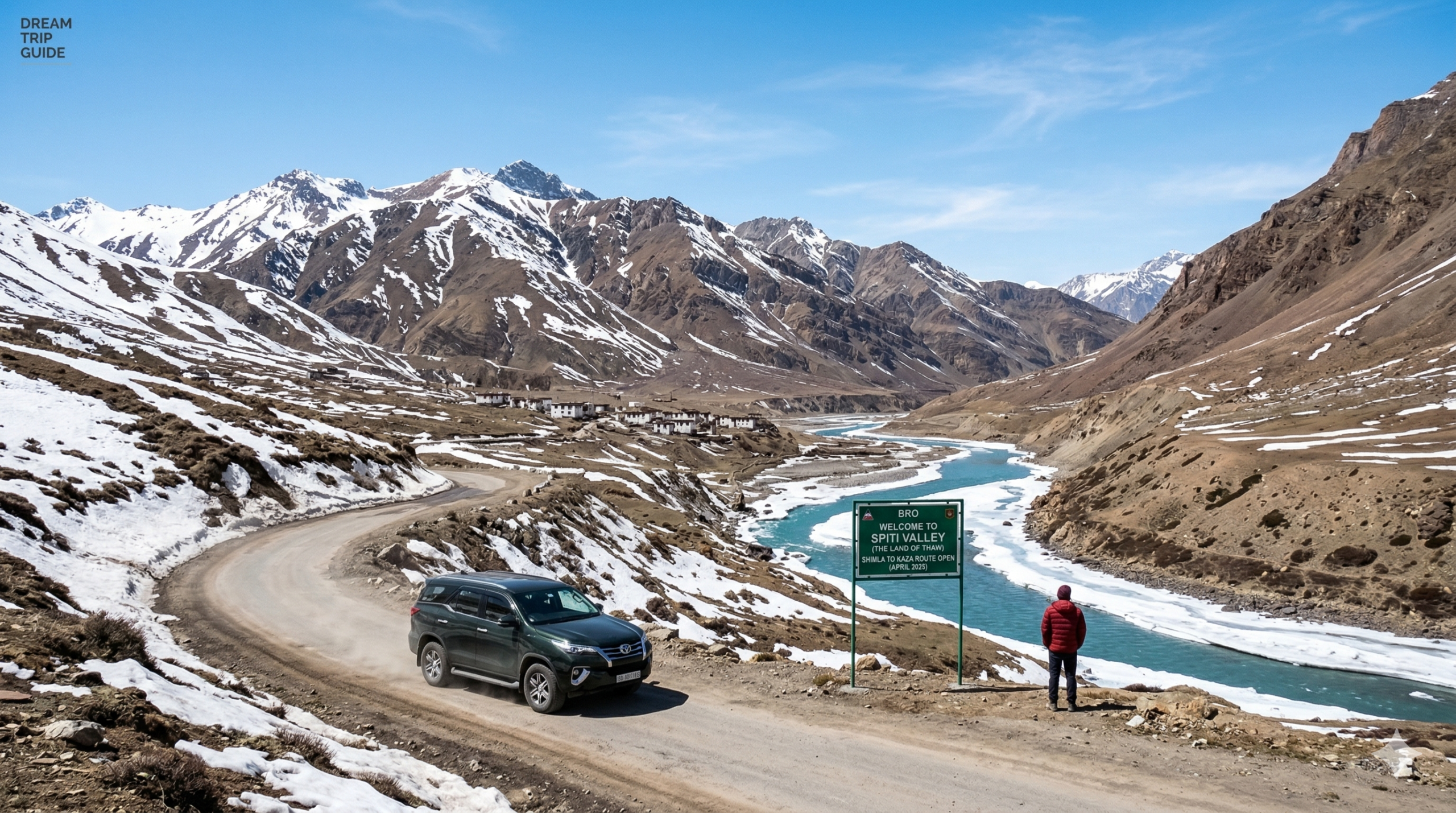
Late April is the “Golden Window” for Spiti. It is the time when the harsh, bone-chilling winter of -30°C begins to fade, replaced by a “manageable” cold and the first whispers of spring. This isn’t the lush green spring of the plains; it is a rugged, high-altitude awakening where white snowcaps meet the stark, chocolate-brown desert mountains.
The Landscape of Contrast In late April, you witness a visual phenomenon known as the “Big Thaw.” Frozen waterfalls like those near Lingti begin to crack and roar again. The Spiti River, once a silent sheet of ice, starts to flow with turquoise glacial melt. You will see “Snow Walls” on the sides of the road near Nako and Tabo that are still 5-10 feet high, yet the valley floors are beginning to show the first signs of hardy Himalayan flora.
The Solitude Factor Since the Manali route is closed, the “mass tourists” are absent. You won’t find the traffic jams of June or the selfie-sticks of July. In late April, the monasteries are quiet, the monks have more time to share butter tea with you, and the “World’s Highest Post Office” in Hikkim feels like it truly belongs to the end of the world. For a blogger like you, Khushi, this is the best time for cinematic, people-free photography.
Expert Review: > “Traveling Spiti in late April is like watching a black-and-white movie slowly turn into color. It requires patience and a high-clearance vehicle, but the reward is seeing the most authentic version of Spiti—raw, silent, and incredibly powerful.” — Dheeraj Sharma, Himalayan Travel Expert.
Read Also:- The “Early Bird” Ladakh Guide: Why April 2026 is the Best Month for a Crowd-Free Expedition
2. The Only Gateway: The Shimla-Kinnaur Route
If you are planning a Spiti trip in April 2026, there is one golden rule: The Manali-Kaza route (via Kunzum Pass) is CLOSED. The only way in and out is the Hindustan-Tibet Highway (NH-5) starting from Shimla.
The Gradual Ascent The beauty of the Shimla route is the gradual acclimatization. You start at 7,000 feet in Shimla/Narkanda and slowly climb to 12,500 feet in Kaza over 3 days. This significantly reduces the risk of Acute Mountain Sickness (AMS). You pass through the lush apple orchards of Kinnaur, which are in full bloom in late April, providing a stunning contrast to the barren Spiti landscape you will enter later.
Road Conditions & “Black Ice” While the BRO (Border Roads Organization) keeps this road open year-round, late April brings “Black Ice”—thin, invisible layers of frozen water on the road. This makes driving before 9:00 AM or after 5:00 PM dangerous. Melting snow also creates “slush traps” and seasonal waterfalls that can wash over the road. A 4×4 or a high-clearance SUV is not just a luxury; it’s a safety requirement.
Quick Info Table: Spiti Valley April 2026 Essentials
| Feature | Details for Late April 2026 |
| Route Access | Shimla to Kaza (OPEN) | Manali to Kaza (CLOSED) |
| Day Temperature | 5°C to 12°C (Sunny but crisp) |
| Night Temperature | -5°C to -15°C (Freezing) |
| Vehicle Type | 4×4 SUV or High Clearance 2WD (Innova/Scorpio) |
| Connectivity | BSNL is king; Airtel/Jio work only in Kaza/Tabo |
| ATM Access | Last reliable ATM in Kaza (Carry 10-15k Cash) |
| Key Attraction | Chuli Mendok (Apricot Blossom) in lower valleys |
Export to Sheets
3. High-Altitude Survival: Water, Toilets, and Warmth
A Spiti trip in April is not a “luxury holiday”; it is an expedition. You must prepare your readers for the reality of “Off-Season” mountain living.
The Dry Toilet Reality Because pipes remain frozen at night, running water is rare in Kaza, Langza, and Hikkim during April. Most homestays use Traditional Dry Toilets (compost toilets). It takes a day to get used to, but it’s the most eco-friendly way to live in a cold desert. For bathing, homestays will provide buckets of hot water heated on a wood-fired stove (Bukhari).
Staying Warm The Bukhari is the heart of every Spitian home in April. It’s a metal stove in the center of the living room where everyone huddles to drink Salted Butter Tea. Nights are incredibly cold, so “The 4-Layer Rule” is essential:
- Base Layer (Thermals)
- Mid Layer (Fleece or Woolen Sweater)
- Heavy Layer (Down Jacket)
- Shell Layer (Windcheater/Raincoat)
4. Must-Visit Spots: From 1000-Year-Old Mud to Snow Leopards
In late April, the “High Circuit” villages are just becoming accessible. Here is what you cannot miss:
1. Key Monastery (Kye Gompa) Perched like a castle on a hill, Key Monastery looks surreal in April when there are still patches of snow on its white walls. You can witness the morning prayers and see the monks preparing for the upcoming summer festivals.
2. The Fossil Village: Langza At 14,400 feet, Langza is famous for the giant golden Buddha statue facing the Shilla Peak. In April, you can still find marine fossils (Ammonites) from the Tethys Sea under the melting snow patches.
3. Pin Valley National Park The valley of the “Grey Ghost.” Late April is a great time to spot Snow Leopards and Ibex as they remain at lower altitudes before the summer heat drives them higher into the mountains. The village of Mudh is the perfect base for this.
4. Tabo Monastery Known as the “Ajanta of the Himalayas,” this 1000-year-old mud monastery is at a lower altitude, making it relatively warmer and a great spot for your first night in Spiti.
5. The “Pros and Cons” of Chasing the Thaw
Pros
- Incredible Photography: The mix of blue skies, white snow, and brown earth is a photographer’s dream.
- Cheaper Stays: Since it’s technically “off-season,” you can negotiate better rates at homestays.
- Authenticity: You get to see the real life of Spiti before it becomes a tourist hub.
- No Traffic: The “World’s Most Treacherous Road” is all yours.
Cons
- Physical Hardship: No running water and sub-zero nights are not for everyone.
- Limited Food: Most “fancy” cafes in Kaza stay closed until mid-May. You will eat a lot of Dal-Chawal and Thukpa.
- Road Risks: Shooting stones and black ice require a very experienced driver.
- No Circuit: You have to come back via the same Shimla route, making the return journey feel long.
6. The Ultimate Do’s and Don’ts for April
The Do’s (The Survival Guide)
- Carry a Physical Map: Google Maps will fail you when the network drops. Download offline maps or buy a paper one.
- Hydrate Constantly: In the dry Spiti air, you lose moisture through breathing. Drink 4 liters of water daily to prevent AMS.
- Pack a Power Bank: Cold drains batteries 2x faster. Keep your phone and camera batteries inside your jacket for warmth.
- Juley Everywhere: The word “Juley” means Hello, Thank You, and Goodbye. It’s the magic key to the locals’ hearts.
The Don’ts (The Fatal Mistakes)
- Don’t Rush: Spend at least 2 nights in Kinnaur (Kalpa/Sangla) before entering Kaza. Rushing to 12,000 feet will lead to severe AMS.
- Don’t Litter: Spiti has no waste management system. Whatever plastic you take in, you must bring back to Shimla/Chandigarh.
- Don’t Touch the Fossils: It is illegal to take fossils away from Langza. Take photos, but leave the history where it belongs.
- Don’t Drive at Night: The risk of black ice and landslides increases tenfold once the sun goes down.
7. Expert Review: Why April 2026?
“2026 is seeing a unique weather pattern. With a slightly heavier winter, the ‘Thaw’ in late April is expected to be more dramatic than usual. For travelers who have already seen Ladakh, Spiti in April offers a more rugged, intimate, and spiritually rewarding experience. It is the last frontier for those who truly want to ‘chase the snow.'” — Local Spiti Guide, Kaza.
Read Also:- The Scenic Route: A Review of the Bangalore-Coimbatore Vande Bharat Experience
